

Master Your 12 Inch Pizza Stone for Perfect Pizza
You've probably had this pizza night before. The dough looked good on the counter, the sauce was right, the cheese browned nicely, and then you cut into it and the bottom sagged. The center stayed pale. A slice folded under its own weight, and the crust ate more like warm bread than pizza.
That's the exact problem a 12 inch pizza stone solves when you use it correctly. It isn't a niche gadget for obsessive hobbyists. It's the most common pizza stone size for a reason, and it sits right in the sweet spot for home ovens, small family dinners, and backyard grill sessions.
Plenty of cooks are clearly chasing that same result. The global pizza stone market was valued at USD 1.16 billion in 2024 and is projected to reach USD 1.98 billion by 2033 at a 6.2% CAGR, driven in part by demand for tools that recreate the results of the $44 billion US pizza market (pizza stone market data). People want crisp bottoms and better browning at home. A stone is one of the simplest ways to get there.
Table of Contents
- The End of Soggy Homemade Pizza
- Why a 12 Inch Stone Is the Home Standard
- Cordierite The Secret to a Crispy Crust
- Mastering Heat for a Perfect Bake
- Baking Techniques From Dough to Done
- Proper Cleaning and Long-Term Care
- Choosing Your Hans Grill Pizza Stone
The End of Soggy Homemade Pizza
A baking sheet can cook pizza. It usually can't bake great pizza. The difference shows up in the bottom crust first. Instead of setting fast and crisp, the dough steams against the metal and stays soft longer than it should.
A good stone changes that cooking environment. It gives the dough a hot, dry surface that behaves more like the floor of a proper pizza oven than a thin pan does. That one change fixes a lot of common home pizza failures at once. You get better bottom browning, a firmer slice, and far less of that wet center that ruins the first cut.
What goes wrong on a pan
Most disappointing homemade pizza comes from a short list of problems:
- Weak bottom heat: The base doesn't get hit hard enough when the dough lands.
- Moisture staying trapped: Steam hangs around under the crust instead of escaping.
- Heat loss during loading: By the time the pizza goes in, the surface you're baking on isn't helping much.
- Overbaking the top to save the bottom: Cheese and rim finish before the underside does.
Practical rule: If the cheese is done but the underside is still pale, your baking surface isn't storing enough heat.
That's why the 12 inch pizza stone has become such a standard tool in home kitchens. It's large enough for the kind of pizza often made at home, but still manageable in a regular oven or on a grill. It bridges the gap between casual weeknight pizza and the kind of crust people usually assume requires specialized equipment.
The good news is that this isn't hard to learn. Most failures come from two myths and one setup mistake. Fix those, and a basic 12 inch pizza stone starts producing the kind of crisp, golden base that makes homemade pizza worth repeating.
Why a 12 Inch Stone Is the Home Standard
The 12 inch size works because it matches common home cooking practices. It handles a personal pie, a dinner for two, or a smaller pizza for a family table without taking over the whole oven. It also leaves you enough room to maneuver with a peel, which matters more than most beginners realize.
Historically, the modern pizza stone dates back to the early 1970s, when Pat Bruno introduced the idea, and Sears began selling them in 1974, followed by broader wholesale adoption in 1975 (history of the pizza stone). That's a big reason the 12 inch format feels so familiar. It's been part of home pizza culture for decades.
What the size really means
A 12 inch stone does not mean you should build a full 12 inch pizza edge to edge. In practice, you want a little margin around the pie. That space helps in three ways:
- Air can circulate better around the pizza.
- Launching is easier because you're not aiming at a tiny target.
- Overflow is less likely if sauce or cheese shifts during transfer.
Before buying or using one, measure the inside of your oven or grill grate. You want comfortable clearance around the stone so heat can move around it. If the stone barely fits, performance drops and handling gets awkward fast.
For standard ovens and many grills, a 12 inch round stone is a very forgiving size. For compact countertop appliances, it can be a trap.
When a 12 inch stone is the wrong fit
Poor online advice frequently causes a lot of wasted dough. People often say a 12 inch pizza stone is ideal for toaster ovens and air fryer ovens because it sounds compact. However, the underlying issue isn't just fit. It's heat recovery.
In toaster or air fryer ovens rated at 800 to 1500W, a 12 inch stone absorbs 40% more heat than the appliance can replenish per minute, which creates a cold center effect. The mismatch gets worse because 95% of online guides assume a standard 3000W+ oven (toaster oven size and thermal lag guide). The edge starts coloring while the center lags behind.
If your countertop oven struggles to recover heat after opening the door, the stone may be too much thermal mass for the appliance.
That doesn't mean the stone is bad. It means the appliance is underpowered for that setup. In a full-size oven or a grill with real heat behind it, the same 12 inch stone makes sense. In a low-wattage countertop unit, it often creates more frustration than crisp crust.
Cordierite The Secret to a Crispy Crust
Size matters, but material matters more. A 12 inch pizza stone only performs as well as the material it's made from. For home pizza, cordierite is the one to look for because it handles heat and moisture the way pizza dough needs.
Why material matters more than brand hype
Cordierite works because it's porous without being fragile. Standard cordierite pizza stones have a water absorption rate of 17% to 18%, which is the ideal range for pulling steam from dough and preventing sogginess. That porous structure, combined with a low coefficient of thermal expansion, helps the stone resist thermal shock while promoting a crisper crust (cordierite material specifications).
It functions as a controlled sponge for steam, not for liquid. The dough hits the hot surface, moisture gets drawn away from the base, and the crust sets before it can turn gummy. That's a completely different bake than what you get on a slick metal tray.
Cordierite also tolerates aggressive oven and grill use better than generic ceramic. If you're comparing surfaces, it helps to read a deeper breakdown of the best pizza stone material.
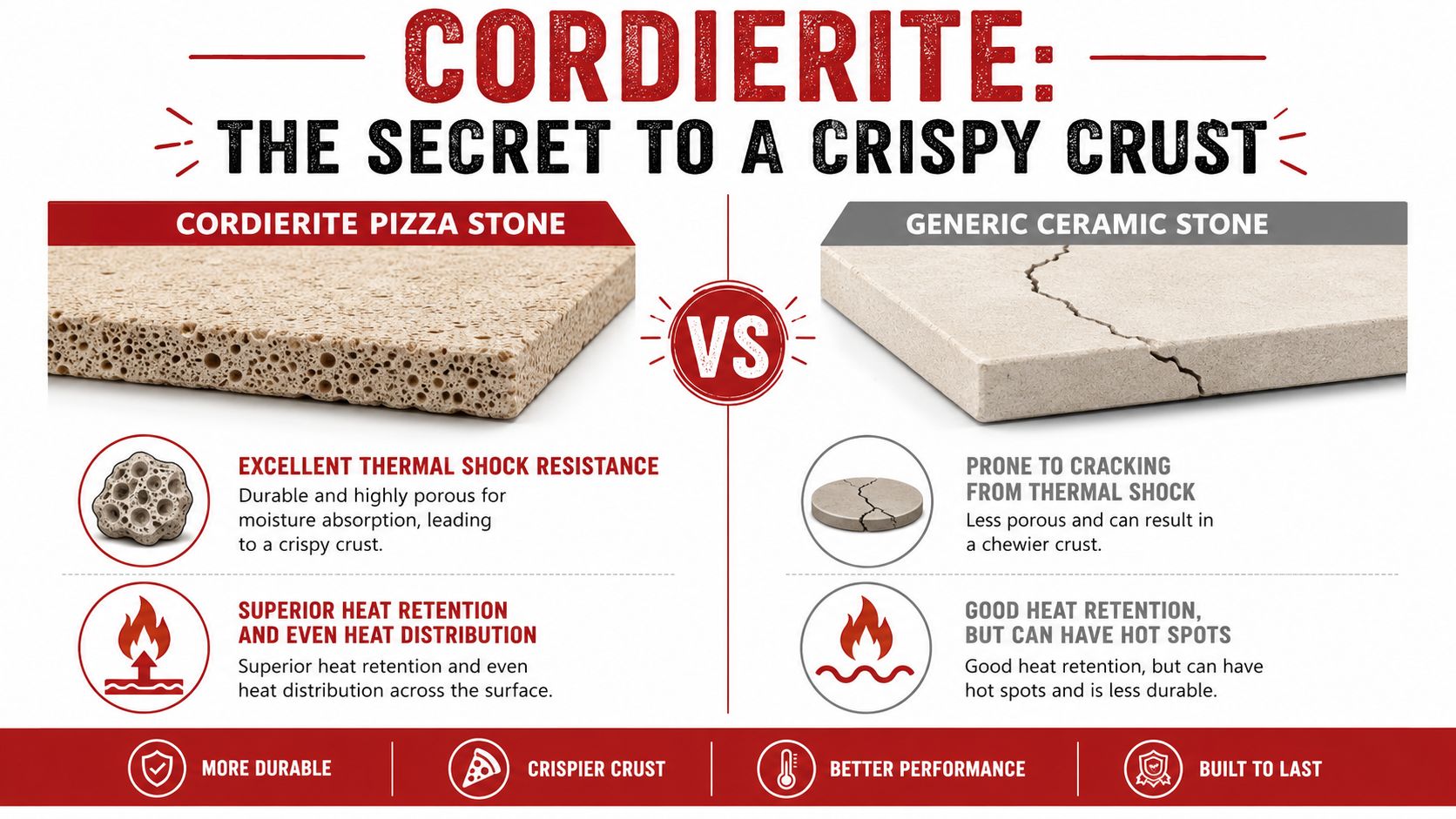
Pizza Surface Material Comparison
| Material | Heat Retention | Moisture Absorption | Durability | Best For |
|---|---|---|---|---|
| Cordierite | Strong, even, steady | Excellent | High, especially under changing heat | Home ovens, grills, repeated pizza baking |
| Generic ceramic | Good, but less forgiving | Lower than cordierite | More prone to cracking under stress | Lighter occasional use |
| Steel | Very strong and fast | None | Very durable | Bakers who want aggressive bottom heat |
Each surface has a place, but they don't behave the same way.
- Cordierite suits cooks who want crispness without being overly harsh on the bottom.
- Generic ceramic can work, but it's less forgiving when heat shifts quickly.
- Steel bakes differently. It drives hard bottom heat but doesn't absorb moisture the way a stone does.
A pizza stone should help dry the underside of the dough while delivering steady heat. Cordierite does both.
For most home cooks chasing a classic crisp base, cordierite is the safest bet. It's the material that consistently gets closest to that pizzeria-style balance of browning, structure, and slice integrity.
Mastering Heat for a Perfect Bake
A pizza stone isn't magic. It's stored energy. If you don't fully charge that energy before the dough goes on, the bake falls apart.
A 12 inch cordierite stone with a 0.6 inch thickness requires a full 30 minutes of preheating at 500°F (260°C) to store enough thermal energy for a proper bake. Skip that step, and you get a pale, undercooked crust regardless of how long the pizza stays in the oven (preheating guidance for cordierite stones).
Treat the stone like a heat battery
That's the cleanest way to think about it. The stone needs to absorb heat thoroughly, not just feel hot on the surface. A rushed preheat is one of the biggest reasons people think their stone “doesn't work.”
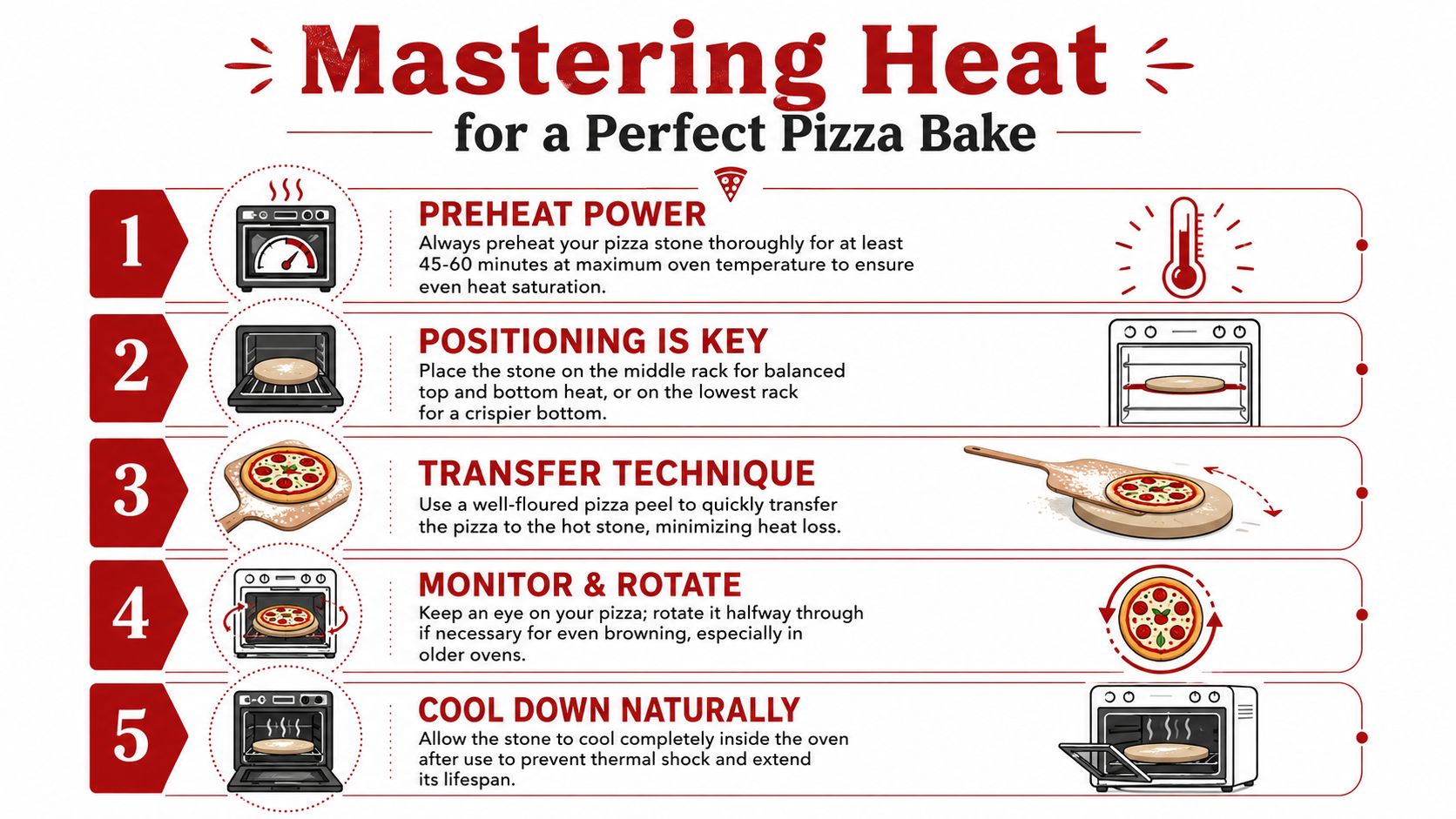
Three habits make the biggest difference:
- Preheat with the stone already inside. Don't place a cold stone into a fully hot oven.
- Give the heat time to penetrate. Surface warmth isn't enough.
- Load fast. The longer the door or lid stays open, the more performance you lose.
If you want a dedicated explanation of why this matters, this guide on whether you should preheat a pizza stone covers the logic well.
Here's a useful visual cue. If the top is cooking much faster than the bottom, the stone wasn't charged enough. If the bottom colors before the cheese has time to melt properly, your setup is probably too low in the oven or too close to direct heat on a grill.
Oven and grill setup that actually works
The bake changes depending on where the heat comes from.
For home ovens:
- Middle rack gives the most balanced top and bottom cooking.
- Lower rack helps when you want more bottom color and crunch.
- Avoid constant door checks because every peek dumps heat you need.
For grills:
- Let the grill stabilize before loading so the stone isn't fighting temperature swings.
- Use controlled heat rather than wild direct flame under the stone.
- Keep the lid closed as much as possible once the pizza goes on.
This video shows the process in motion and helps newer bakers understand timing and transfer:
Hot stone, quick launch, closed oven. Most stone-baking problems come from breaking one of those three rules.
Once the heat is right, technique takes over. That's where a lot of otherwise good pizzas get lost.
Baking Techniques From Dough to Done
A hot stone can still produce a messy pizza if the dough is too large, the peel isn't prepared, or the launch hesitates. The final minutes before baking matter more than people expect.
The easiest win is sizing the pizza sensibly. On a 12 inch pizza stone, a slightly smaller pizza is easier to launch, easier to rotate if needed, and less likely to drip cheese onto the stone. Crowding the edge rarely improves the bake.
Build a pizza that fits the stone
A practical setup looks like this:
- Keep the dough moderate in size. Leave breathing room around the perimeter of the stone.
- Go lighter on toppings than you think. Heavy topping loads slow down the center.
- Use sauce with restraint. Excess moisture is the enemy of a crisp base.
- Finish shaping on the peel only when you're ready to bake. The longer raw dough sits there, the more likely it is to stick.
One common beginner mistake is turning the peel into a waiting area. Dough starts grabbing the surface almost immediately, especially with sauce already on it. Work with some urgency. Shape, top, launch.
The launch matters as much as the bake
A confident transfer beats a careful, slow one. The pizza should move from peel to stone in one smooth action.
Use this rhythm:
- Dust the peel lightly.
- Place the stretched dough on it.
- Add toppings without lingering.
- Give the peel a small shake to confirm the dough still moves.
- Open the oven or grill, aim for the center, and launch.
The pizza should slide before you walk to the oven. If it doesn't, fix it on the peel. Don't hope it will magically release later.
Once it's on the stone, leave it alone at first. Let the crust set. After that, check for the signals that matter:
- The rim should look golden and lightly blistered
- The cheese should be fully melted and settled
- The underside should feel dry and structured, not limp
- A lifted edge should show real color, not just dryness
If one side browns faster in an older oven or a grill with uneven heat, rotate the pizza partway through. That isn't cheating. It's smart baking.
The best stone-baked pizzas feel light in the hand but firm underneath. That contrast is what you're chasing.
Proper Cleaning and Long-Term Care
Bad forum advice results in real damage. A lot of people treat a cordierite stone like cast iron and try to season it with oil. That's one of the worst things you can do.
Stop oiling cordierite stones
Contrary to advice repeated on many BBQ forums, oil should never be used to season a cordierite stone. It creates a sticky, carbonized layer that blocks the stone's porous surface, increases dough-stick rates by 30%, and can reduce heat transfer efficiency by up to 11% (cleaning and seasoning guidance for cordierite stones).
That residue doesn't improve the stone. It clogs the very surface that helps the crust bake dry and crisp. On high-heat cooks, especially on grills, the problem gets worse because oil burns into the stone instead of helping it.
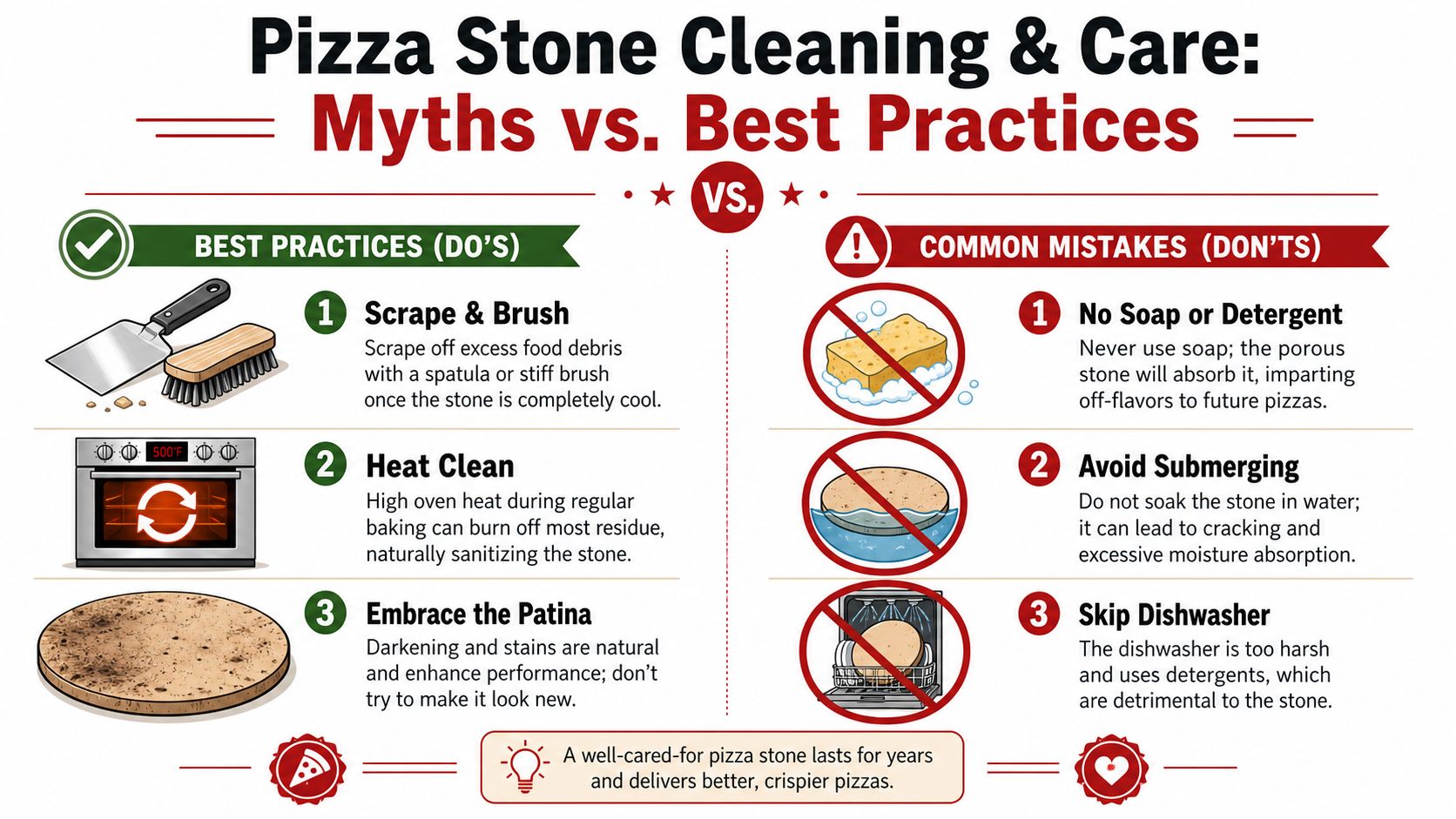
Dark marks are normal. A pizza stone is a working surface, not a serving platter.
How to clean without ruining performance
The right approach is simple and low drama. Let the stone cool fully, scrape off any baked-on debris, and brush away loose bits. That's enough most of the time.
A few care rules are worth following:
- Never use soap. The stone is porous and can absorb it.
- Don't soak it. Too much water gets into the stone and creates problems later.
- Don't chase a spotless look. Staining is part of normal use.
- Let it cool naturally. Sudden temperature changes are hard on any stone.
If you want a fuller explanation, this article on whether you wash pizza stones is a good reference.
For storage, keep the stone somewhere stable where it won't get knocked or wedged under heavy cookware. Most long-term damage happens outside the oven, not inside it. A chipped edge or accidental drop ruins more stones than normal baking ever will.
A well-used stone should look used. That's not neglect. That's proof it's doing its job.
Choosing Your Hans Grill Pizza Stone
By this point, the checklist is pretty clear. A good pizza stone should fit a real home setup, hold heat well, resist thermal shock, and help the dough bake dry on the bottom. For most home cooks, that points straight toward cordierite.
Hans Grill focuses on exactly that kind of performance-oriented pizza gear. The lineup is built around tools for ovens and BBQs, with a strong emphasis on materials that support repeatable crust results instead of gimmicks. If you're shopping after learning what matters, that's the right place to start.

The 12 inch size makes sense when you want an easy-to-handle stone for regular pizza nights. If you want more baking area for larger pies, multiple flatbreads, or bread baking, a rectangular stone can be the better fit. That's a practical upgrade path, not a different philosophy. The same core traits still matter. Cordierite, stable heat, and good real-world usability.
What matters most is choosing a stone that matches your baking methods. If you use a full-size oven or a grill and want reliable crispy crusts, a well-made cordierite stone is the smart buy. If you mainly use a weak countertop oven, changing the appliance or surface strategy may matter more than chasing a different brand.
If you're ready to upgrade pizza night with a cordierite baking surface built for real ovens and grills, take a look at Hans Grill. Their range covers compact home setups and larger-format baking, so you can choose the stone that matches the way you cook.


