

Best Pizza Peel: The Complete 2026 Material Guide
You've probably had this happen. The dough looked right, the steel was blazing hot, the toppings were balanced, and then the pizza welded itself to the peel for one fatal second. You nudged it forward, the front edge grabbed, the back end sagged, and half the mozzarella ended up on the oven floor.
That moment is why peel choice matters more than most home cooks think. A pizza peel isn't a side accessory. It's the tool that transfers a soft, fragile, topped dough onto a brutally hot surface without wrecking the shape you just built.
The tricky part is that people shop for the best pizza peel by material alone. Wood or metal. Perforated or solid. That's useful, but it's not the first question I'd ask. The first question is what job the peel needs to do in your setup. A peel that feels easy for launching can be clumsy for turning. A peel that works well in a backyard grill can feel oversized in a narrow indoor oven.
Table of Contents
- Why Your Pizza Peel Choice Actually Matters
- What a Pizza Peel Does and the Three Jobs It Performs
- Wood, Metal, or Perforated Materials Compared
- Size, Shape, and Handle Length for Ovens and Grills
- How to Launch and Turn a Pizza Without Sticking
- Troubleshooting Common Pizza Peel Problems
- Hans Grill Picks and the Pain Points They Solve
- Your Quick Pizza Peel Decision Checklist
Why Your Pizza Peel Choice Actually Matters
A pizza peel usually enters the story right before the failure.
You stretch the dough, dust the peel, build a tidy pie, and line up with your steel or stone. Then the dough sticks just enough to ruin the launch. The front lip catches. The pie folds. Toppings slide. You spend the next five minutes scraping burnt cheese off the oven floor and pretending the second pizza was always the plan.
That isn't bad luck. It's usually a mismatch between tool and workflow.
The Peel Is the Hand-Off Tool
The peel is the only thing standing between your hands and a very hot baking surface. That matters because pizza is softest and least forgiving right before launch. At that moment, the peel has to do several things at once:
- Support the dough without stretching it out of round
- Release cleanly with one quick motion
- Clear the oven mouth without catching the front edge
- Keep your hands far enough from heat that you can stay steady
If any one of those fails, the whole launch can fail.
Practical rule: Most bad launches aren't caused by dough alone. They start with the wrong peel head, the wrong handle length, or a peel surface that doesn't suit the job.
Old Tool, Modern Problem
The peel itself is ancient. Its roots are tied to old bread-baking traditions going back to Roman and even Egyptian practice, and the word comes from the Latin pala, meaning shovel or spade. Modern Neapolitan pizza culture still treats the peel as a specialized tool, with separate peels for loading, turning, and managing oven embers, as outlined in Gozney's history of the pizza peel.
That old division of labor still makes sense at home. The best pizza peel for a steel in your kitchen might be a poor choice for a portable oven or charcoal grill.
What Actually Decides a Good Peel
A peel lives or dies by a few practical details:
- Head size
- Head shape
- Leading edge thinness
- Overall weight
- Handle length
- Surface material
Those specs matter more than brand hype. They decide whether the peel launches cleanly, turns neatly, and retrieves without singeing your knuckles.
What a Pizza Peel Does and the Three Jobs It Performs
Before comparing wood, aluminum, or perforations, it helps to think about the peel as a workflow tool. A pizza peel doesn't do one job. It does three different jobs, and each one asks for something slightly different from the tool.
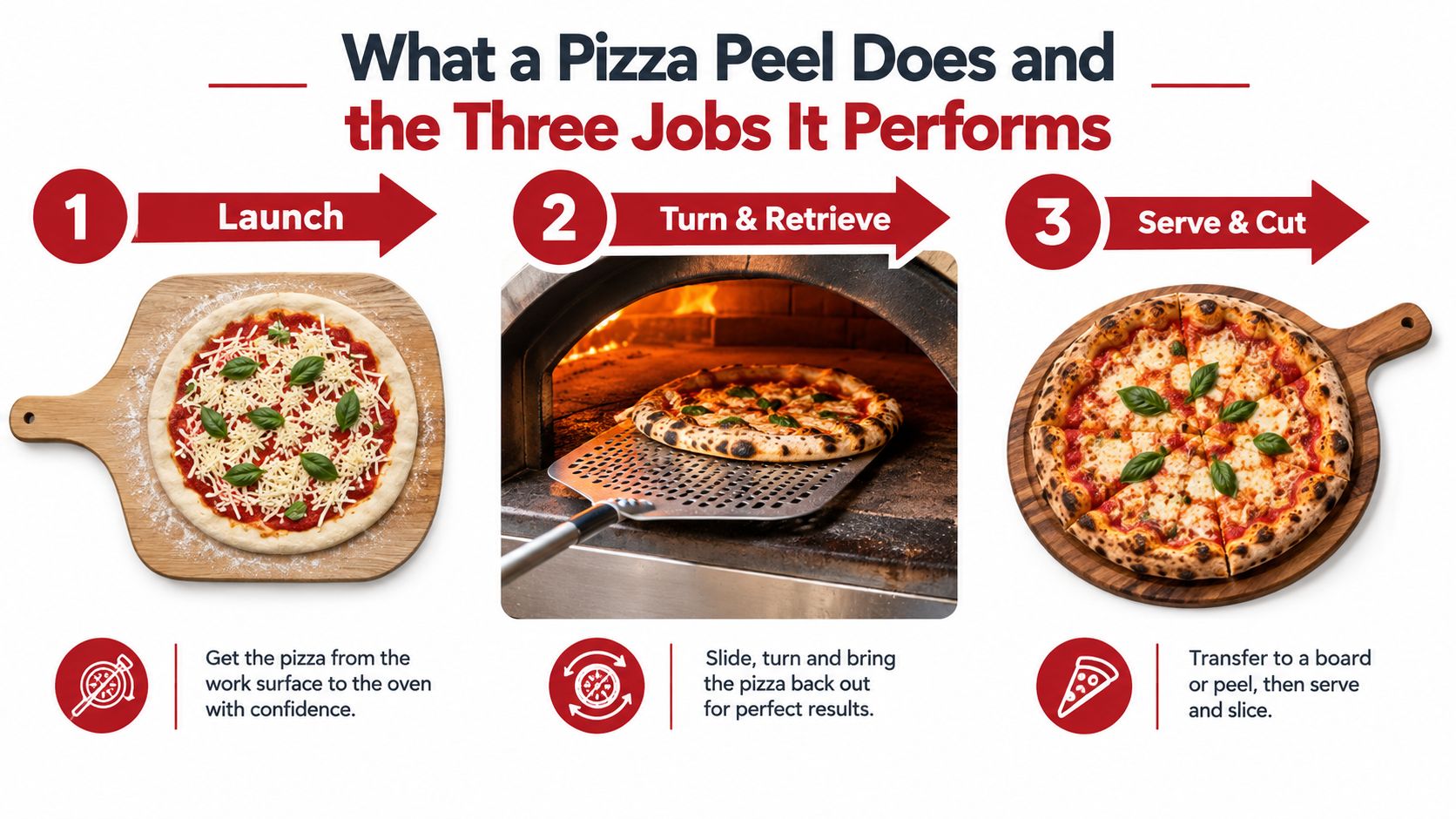
If you want a visual walkthrough of the motion itself, Hans Grill also has a useful guide on how to use a pizza peel.
Launching
Launching is the make-or-break job. You're carrying a raw, topped pizza from bench to stone or steel and asking it to slide off without sticking, tearing, or deforming.
For launch, the peel needs:
- a flat surface
- enough width for the pizza you make
- a front edge thin enough to stay level
- a surface that won't grab wet dough too fast
This is why many home cooks like a dedicated launch peel. The demands are specific. Raw dough is fragile, and you usually only get one clean shot.
Turning
Turning is a different motion entirely. Once the pizza starts baking, the crust sets, the bottom firms up, and now you need to rotate the pie so one side doesn't burn before the other catches up.
A turning tool works best when it's:
- smaller
- quicker to maneuver
- easy to angle under the rim
- light enough to rotate inside a hot oven
A broad launch peel can turn a pizza, but it's often awkward. In a compact oven, it can feel like steering a canoe in a bathtub.
Retrieving
Retrieving sounds simple until you do it with hot hands and a fully baked pie. At this point, the pizza is firmer, but the environment is hotter and less forgiving.
What matters most here is:
- Reach so your hands stay clear of oven walls or grill grates
- Rigidity so the peel doesn't flex under the finished pie
- Control so you don't gouge your stone or dump the pizza on the threshold
One tool can do all three jobs, but that doesn't mean it does all three well.
That's where most disappointment starts. People buy one peel, expect it to launch like wood, turn like a small round metal peel, and retrieve like a rigid serving board. Some peels can cover two of those jobs decently. Very few feel ideal at all three.
Wood, Metal, or Perforated Materials Compared
A peel choice usually goes wrong before the first pizza even hits the oven. Someone buys a nice wood peel because raw dough sticks less, then tries to turn a pizza in a small portable oven and bangs the crust into the side wall. Or they buy a thin aluminum peel for everything, build the pizza too slowly, and watch it glue itself to the metal.
Material matters because each one favors a different part of the workflow. Launching raw dough is one job. Turning in high heat is another. Getting a finished pizza back out without folding it in half is a third. A practical guide at Pizza Oven Zen makes the same point and also notes that flour choice and speed often matter as much as the peel itself.
Wood for launching
Wood is still the easiest launch surface for many home cooks, especially indoors on a stone or steel. Dough sits on it with less panic. You get a little more working time while you straighten the edge, fix a topping slide, or check that the pizza will still move.
That forgiveness has a cost. Wood is thicker, so the front edge is never as clean under a baked crust as metal. It also takes more care. Leave it wet, store it badly, or park it too close to flame often enough, and it will warp, split, or scorch. On a backyard grill or a live-flame portable oven, wood works best as a launch peel, not the tool you keep reaching into heat with.
Solid metal for heat and retrieval
A solid aluminum peel suits cooks who bake hot and move fast. The edge is thinner, which helps under finished crusts and makes retrieval cleaner. It also shrugs off the heat that slowly punishes wood.
The trade-off is less forgiveness with raw dough. Metal grabs damp dough fast, especially if the sauce sits too long or the bench flour is uneven. That makes solid metal a strong choice for retrieval and a workable launch peel for cooks with a rehearsed routine. It is less friendly for slow assembly.
Perforated metal for one-peel households
Perforated metal sits between the two. It keeps the thin leading edge and heat tolerance of aluminum, but the holes help shed excess flour and reduce the chalky layer that can burn under the crust. For cooks using one peel for launch and retrieval, that balance is useful.
It is not perfect. Some perforated peels flex more than a solid one, and very soft, high-hydration dough still feels calmer on wood. But if the problem is, "I want one peel that launches well enough, retrieves cleanly, and survives a hot outdoor oven," perforated metal is usually the smartest compromise.
| Material | Best For | Pros | Cons | Heat Tolerance |
|---|---|---|---|---|
| Wood | Launching raw dough indoors on stone or steel | Forgiving surface, useful for serving, easier for slower assembly | Absorbs moisture, can scorch, needs gentler care | Moderate |
| Solid metal | Retrieving and grill or high-heat oven use | Thin edge, durable around heat, slides under baked crust well | Raw dough can stick quickly, less forgiving during launch | High |
| Perforated metal | Dual-purpose use, especially hot ovens | Thin edge, less excess flour under the pie, good all-around control | Can flex a bit more, still less forgiving than wood for very soft dough | High |
Match the material to the oven, not just the dough
Indoor bakers using a stone or steel usually do well with a wood launch peel plus a small metal turning or retrieval peel if they make pizza often enough to justify both tools. Grill users and portable oven owners usually benefit more from metal, because those setups punish short handles, thick edges, and fragile wood fast.
That is why I do not treat this as a simple wood versus metal decision. Start with the job and the oven. Then pick the material that makes that job easier.
Size, Shape, and Handle Length for Ovens and Grills
A peel that looks right on a product page can still be wrong the first time you try to launch through a tight oven opening. I have bought peels that felt generous on the counter and clumsy everywhere else. Too wide, and the head clips the oven mouth. Too long, and indoor use turns awkward. Too short, and a grill or portable oven starts roasting your knuckles.
Size makes more sense when you start with the job.
If the peel is mainly for launching raw dough in a home oven onto a stone or steel, match the head to the pizzas you make, with a little room for control. If the peel is for turning in a hot outdoor oven, smaller is better because speed matters more than carrying surface. If you want one peel to handle both jobs, avoid going oversized. Big heads look reassuring, but they add weight and make the launch angle fussier.
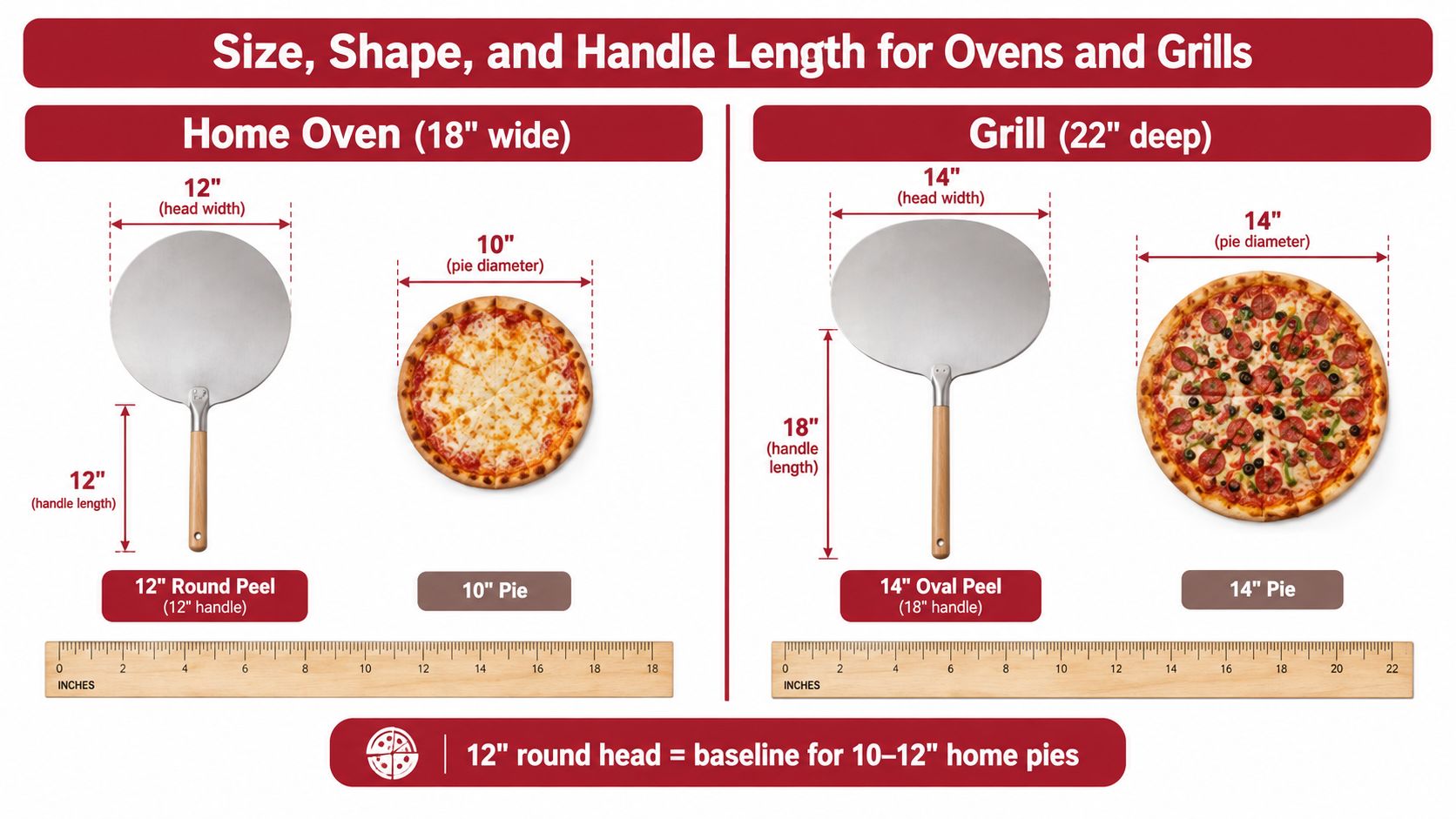
Match the Head to the Pizza and Oven
For most home cooks, these are the dimensions that work:
- A head around your usual pizza size if this is a launch peel for indoor baking
- A smaller round head if this is a turning peel for a portable oven or live-fire setup
- A gently tapered or round shape if the oven mouth is narrow
- A rectangular head only if you regularly make longer pies and have the clearance for it
Rounder heads are easier to live with in small ovens. They clear the opening cleanly and rotate with less fuss. Wide rectangular peels feel stable while topping a pizza, but they can become a nuisance at the exact moment you need precision.
Handle length should follow heat source, not preference alone.
A kitchen oven with a stone or steel near the front usually works fine with a shorter handle because you are launching once and backing out. A backyard grill or portable pizza oven asks for more reach. You need enough distance to protect your hand, but not so much handle that the peel starts feeling whippy or hard to steer. Short handles are one of the most common mistakes on outdoor setups. They look compact in storage and miserable over live heat.
If you are comparing proportions before you buy, this guide to pizza peel DIY dimensions and design ideas helps show how head size, handle length, and storage space affect each other.
A quick visual on peel fit helps here:
A Fast Pre-Buy Check
Before checkout, ask these questions:
- Am I buying this to launch, turn, retrieve, or cover two of those jobs
- What pizza size do I make most often
- How tight is the oven or grill opening
- Will a round head clear that opening more easily than a rectangle
- Do I cook indoors on a stone or steel, outside on a grill, or in a portable oven that needs more reach
- Can I store the handle without hating it
Buy for your tightest clearance and hottest setup, because that is where the wrong peel gets exposed fast.
How to Launch and Turn a Pizza Without Sticking
You feel the mistake right before the oven. The pizza will not slide, one corner glues itself to the peel, and now you are deciding between a mangled launch and rebuilding the whole pie.
That usually comes down to workflow, not a magic material. A wood peel can launch beautifully because the dough sits on a drier surface. A metal peel is faster to maneuver and better for retrieval. A perforated peel helps shed excess flour, which matters if you cook hot and want less burnt flour on the stone or steel. The trick is matching the peel to the job, then using it the same way every time.
Parchment can bail you out for lower-heat bakes, but it is a poor habit for very hot pizza cooking. On a stone, steel, grill, or portable oven running hard, good peel handling is the cleaner fix.
The Loading Rhythm That Works
Use a repeatable sequence:
- Start with a dry peel. Damp wood grabs. Damp metal grabs faster.
- Dust lightly with semolina or a semolina-flour mix. Too much flour burns. Too little leaves sticky patches.
- Stretch on the counter first. Move the dough onto the peel only when toppings are ready.
- Top fast. The longer raw dough sits, the more it bonds to the peel.
- Shake test before you walk to the oven. One short jerk should move the pie as a whole, not wrinkle one side.
If one spot sticks, fix it on the counter. Lift that edge, add a pinch of semolina, and test again. Walking a stuck pizza to the oven never improves the result.
The Launch Motion
A good launch is controlled and quick. Set the front lip of the peel where you want the pizza to land, keep the peel level, then pull back sharply so the pie slides forward onto the cooking surface.
Hesitation ruins more launches than bad dough. Slow dragging lets the front edge catch and folds the pizza over itself.
Indoor steel setups expose sloppy technique fast because the bottom starts setting almost immediately. If that is your setup, this guide on using a pizza peel with a baking steel shows the transfer in the context that gives home cooks the most trouble.
Turning and Retrieval
Turning is a different job from launching. Once the base has set, use a smaller metal or perforated peel to get under the rim and rotate the pie with short movements. A full-size launch peel can do it, but it feels clumsy in a tight oven and tends to shove the pizza instead of turning it.
Handle length matters here too. In a kitchen oven, a shorter peel is easier to steer. In a backyard grill or portable oven, extra reach keeps your hands out of the heat and gives you room to turn without rushing.
For retrieval, slide in from the side, get fully under the center, and lift in one motion. Sawing back and forth usually means the peel is too big for the space or you came in before the crust had enough structure to support itself.
Fix sticking before launch. After the bake starts, the problem is usually dough setup, oven position, or using one peel for jobs that are easier with two.
Troubleshooting Common Pizza Peel Problems
Peel problems usually look dramatic, but the cause is often boringly mechanical. Wrong size. Wrong surface. Wrong timing. The good news is that most of them are easy to diagnose once you know what to look for.
Sticking, Catching, and Burned Hands
The three failures I see most often are these:
- dough sticking at launch
- the peel nose catching the oven mouth
- handles getting too close to heat
Each one points to either a spec mismatch or a habit worth changing.
Quick Fix Table
| Problem | Likely Cause | Fix |
|---|---|---|
| Dough sticks on launch | Wet peel, dough sat too long, plain flour not giving enough slip | Keep the peel dry, top faster, use semolina or a semolina-flour mix |
| Peel catches the oven mouth | Head is too wide or too square for the opening | Use a rounder or more tapered peel matched to the opening |
| Handle gets too hot | Handle is too short for the setup or peel stays in too long | Use a longer handle and pull the peel out as soon as the pie lands |
| Wooden peel warps or cracks | Excess moisture or harsh cleaning | Wipe clean and dry promptly, don't soak |
| Wood chars or flakes | Using the wood peel like a cooking surface | Reserve wood for prep and launch, use metal for hot transfers |
| Turning feels clumsy | Trying to rotate with a full-size launch peel | Use a smaller turning peel |
The Problem Isn't Always the Material
People often blame wood or aluminum when the issue is head geometry. A peel can be made from a perfectly good material and still fail because the front edge is too bulky or the head is wider than the oven throat.
Maintenance matters too. Wooden peels don't tolerate neglect well. If they stay wet, they age badly. Metal peels are tougher around heat, but they don't forgive slow loading with soft dough.
The best pizza peel is the one that fits your oven, your pie size, and your rhythm. A technically nice peel that fights your setup is still the wrong peel.
Hans Grill Picks and the Pain Points They Solve
The cleanest way to shop for peels is to match the tool to the failure you're trying to stop. Most cooks aren't starting from zero. They already know what goes wrong. The dough sticks. The handle feels short. The peel is too bulky at the oven mouth. Wood starts looking rough after repeated use.
That's why I prefer thinking in pairs rather than one all-purpose hero peel.
Pain Point First, Product Second
Hans Grill is relevant here because it offers a straightforward example of a practical home setup, including the 12" Pro Pizza Peel | Aluminum + Wooden Handle and peel-inclusive sets. That kind of aluminum peel with a wooden handle suits cooks who want a thin metal front edge for transfer while keeping a more comfortable grip away from the heat.
For many home setups, the smarter system looks like this:
- A wood peel for launch if raw dough sticking is your main issue
- A smaller metal or perforated peel for turning if your oven runs hot and fast
- A longer-handled metal peel if you work over a grill or a deeper outdoor oven
What Each Option Solves
| Pain Point | Hans Grill Solution | Why It Works |
|---|---|---|
| Raw dough keeps sticking during launch | A dedicated launch peel in a forgiving surface, or a simple peel-and-stone set for home use | Keeps the workflow focused on clean transfer rather than hot-oven maneuvering |
| Knuckles get too close to heat | A peel with a longer handle and a thin metal head | Gives more reach while keeping the front edge easy to slide under the pie |
| One peel feels clumsy for turning | Pair a launch peel with a separate smaller turning tool | Splits the jobs so each tool does one thing better |
| Wooden peels wear out fast | A sealed wood handle or better-maintained wood launch peel, paired with metal for hot work | Reduces heat stress on wood and keeps it in the role where it performs best |
The Pairing I'd Recommend First
If you're buying your first serious setup, I'd start with one dedicated launch peel and one smaller turning peel. That solves the most common home problem immediately. You stop asking one oversized tool to carry raw dough, rotate a baking pizza, and retrieve the finished pie.
If budget or storage says one peel only, a metal peel with a manageable head is the compromise. It won't be as forgiving on raw dough, but it'll handle heat and retrieval better than wood.
Your Quick Pizza Peel Decision Checklist
Most peel decisions get easier once you stop trying to crown one universal winner. The best pizza peel for your kitchen might be the wrong one for your grill, and the peel that launches raw dough beautifully might be awkward once the pizza is baking.
Use this as the fast filter before you buy.
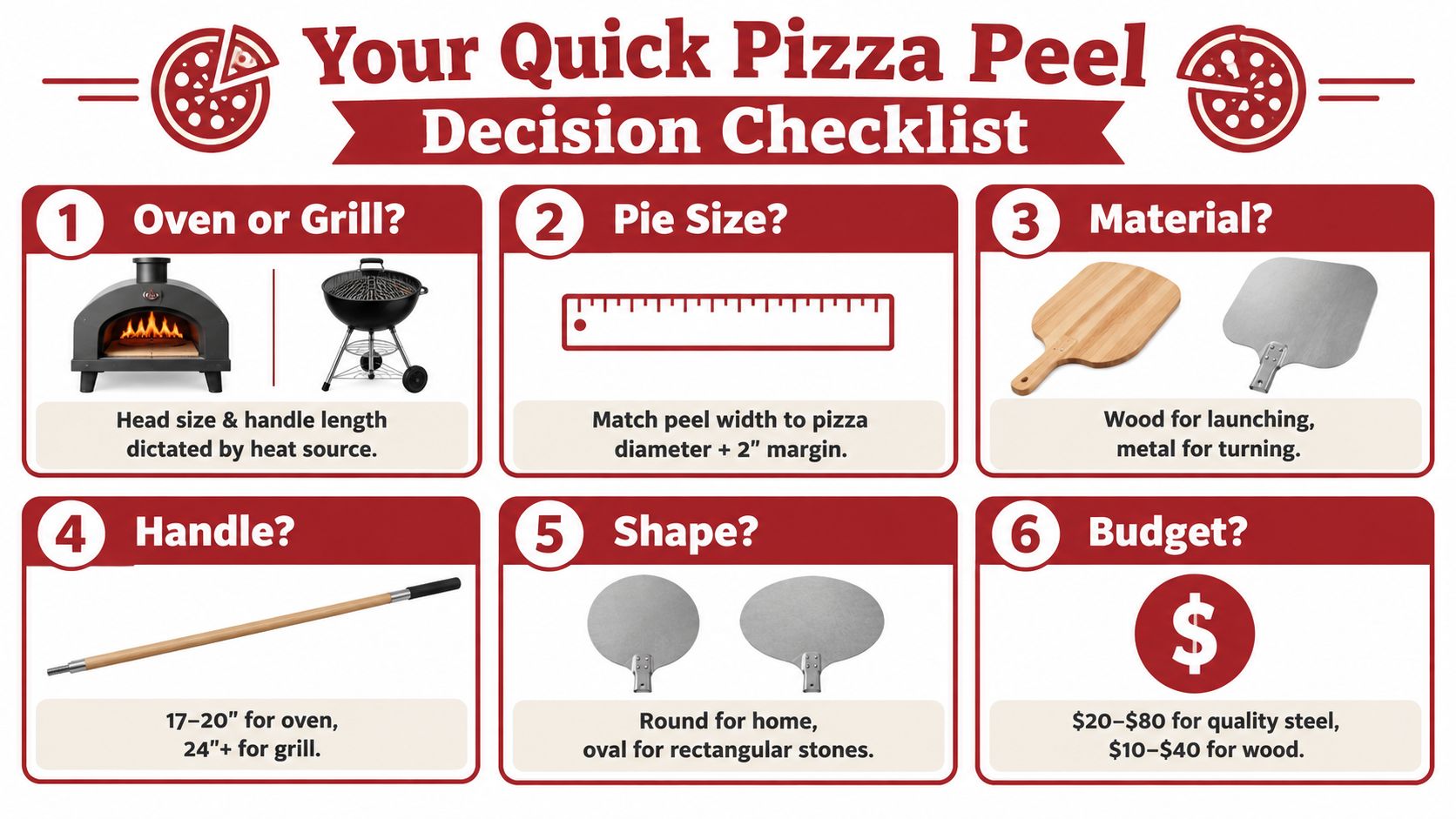
The Six Questions That Matter
- Heat source first. Indoor oven, portable pizza oven, and backyard grill all ask for different reach and maneuverability.
- Match the head to the pizza. A peel head should match the pizza diameter or run slightly smaller, not dramatically larger.
- Decide if you need one peel or two. Two peels usually make the process easier. One for launch, one for turning and retrieval.
- Think about the opening, not just the peel. A narrow oven mouth punishes wide rectangular heads.
- Choose material by task. Wood is often easier for launch. Metal is usually better around sustained heat and retrieval.
- Don't ignore maintenance. Wood needs dry storage and gentle cleaning. Metal asks less from you.
The Simple Rule
If you want one rule to remember, use this:
Match the peel to your heat source first, your workflow second, and your budget third.
That order prevents most buying mistakes. It also stops you from overvaluing material names and undervaluing fit, handle reach, and head size.
Hans Grill offers pizza peels, baking surfaces, and pizza tool sets built for the exact situations that trip home cooks up most often, especially steel-and-stone oven setups and backyard grilling. If you want to compare peels alongside stones, steels, and complete pizza kits in one place, visit Hans Grill.


