

Best Pizza Steel: How to Choose, Use, and Bake Like a Pro
You're standing in front of an oven that's already roaring, holding a room-temperature slab of steel and wondering whether pizza night really needs another heavy piece of cookware. The promise is tempting: a darker, crisper base, faster baking, and a crust that gets closer to pizzeria texture without buying a specialty oven. The catch is just as real. A steel commits you to preheating, careful handling, and a chunk of thermal mass that may spend more time in your oven than your pizza does.
The best pizza steel isn't the thickest, largest, or most expensive plate. It's the one that matches your oven clearance, fuel source, baking frequency, and preferred crust. A great steel in the wrong workflow still loses to a decent stone that you'll reliably preheat and use correctly.
Table of Contents
- Why Pizza Night Changed When Steel Hit the Market
- What a Pizza Steel Is and How It Works
- Pizza Steel vs Pizza Stone
- Thickness Size and Material Explained
- Choosing a Pizza Steel for Oven vs Grill
- Seasoning Cleaning and Long-Term Care
- Recommended Pizza Steel Setups Worth Considering
Why Pizza Night Changed When Steel Hit the Market
Pizza steel started with a practical question: how could home cooks get more heat into dough, faster? In 2012, Baking Steel inventor Andris Lagsdin read about steel's heat-transfer advantages in Nathan Myhrvold's Modernist Cuisine and began adapting a professional kitchen material for home use, as detailed in this history of baking steel. That move challenged the assumption that cordierite stone was the only serious choice for crisp pizza.
The benefit becomes obvious during a busy pizza session. After the first pie launches, the hot plate begins browning the base immediately instead of allowing heat to work slowly through ceramic. A well-preheated steel also recovers quickly between bakes, so the next pizza starts on a forceful cooking surface rather than a heavily drained one. Thin dough develops a darker underside, firmer crunch, and more pronounced edge.
Steel still has limits. It does not turn a domestic oven into a wood-fired chamber, and it cannot fix weak dough or poor heat management. The oven's upper heat remains the same, so heavily topped pizzas can still brown on top before the center finishes. Steel gives the underside a faster, stronger heat source, which makes it particularly effective for crisp, thin-crust pizza in an ordinary oven.
America's Test Kitchen has said steel can cook pizza up to 30% faster than stone. Serious Eats reported a New York-style pizza finishing in about 6 minutes on steel versus 8 minutes on stone during controlled testing. Those results explain the appeal, but they do not make steel the automatic winner for every setup. A decent stone that you preheat correctly can outperform an excellent steel used in the wrong oven position, at the wrong temperature, or without enough recovery time.
My verdict: Steel changed home pizza by fixing the weak undercarriage problem. It did not fix poor dough, a crowded oven, or an unsuitable baking routine.
Buy around your oven, grill, and crust goals. Thickness and finish matter, but workflow decides whether the plate earns its space.
What a Pizza Steel Is and How It Works
Your oven can be fully preheated and still produce a pale, soft underside. A pizza steel addresses that specific weakness. It is a flat low-carbon steel plate used in a domestic oven or on a grill. The plate stores heat during preheating, then transfers it directly into the dough when the pizza lands.
Steel conducts heat much more readily than cordierite. Carbon steel is reported at roughly 45 to 55 W/mK, while cordierite pizza stones measure around 2.5 to 13.5 W/mK, depending on formulation and source. Under home-oven conditions, that difference means steel can transfer heat into dough roughly 3.2 to 18 times faster than stone, according to this guide to pizza baking surfaces.
The heat transfer that matters
During preheating, the oven gradually loads the steel with usable heat. Once the dough reaches the plate, energy moves quickly into its underside. The result is faster expansion, firmer browning, and a drier, crisper base beneath the toppings.
That conductivity defines the steel's role. Steel surfaces can stabilize around 450°F to 500°F and bake noticeably faster than stone. America's Test Kitchen has reported that steel can cook pizza up to 30% faster than a stone, while Serious Eats recorded a New York-style pizza at about 6 minutes on steel versus 8 minutes on stone in controlled testing. Treat those results as evidence of stronger heat transfer, not a promise that steel wins in every kitchen.
Steel vs Stone Thermal Properties at a Glance
| Property | Cordierite Stone | Low-Carbon Steel |
|---|---|---|
| Reported thermal conductivity | About 2.5 to 13.5 W/mK | About 45 to 55 W/mK |
| Heat transfer into dough | Slower | Much faster |
| Bottom-crust behavior | Gentle, even browning | Fast browning and strong crispness |
| Thermal shock behavior | Can crack | Won't crack from ordinary thermal cycling |
| Care requirement | Keep dry and avoid shocks | Season, dry, and protect from rust |
Steel will not supply wood-fired flavor, radiant flame above the pizza, or the moisture behavior of a ceramic surface. It also will not save wet dough or an overloaded pie. For thin pizza with restrained toppings, its direct heat transfer supplies the force a standard oven lacks.
A steel is still only as good as the workflow around it. If the oven position, preheat, or recovery routine is wrong, a decent stone can beat an excellent plate. For practical guidance on fitting and using one, this baking steel for an oven covers the basic setup.
Pizza Steel vs Pizza Stone
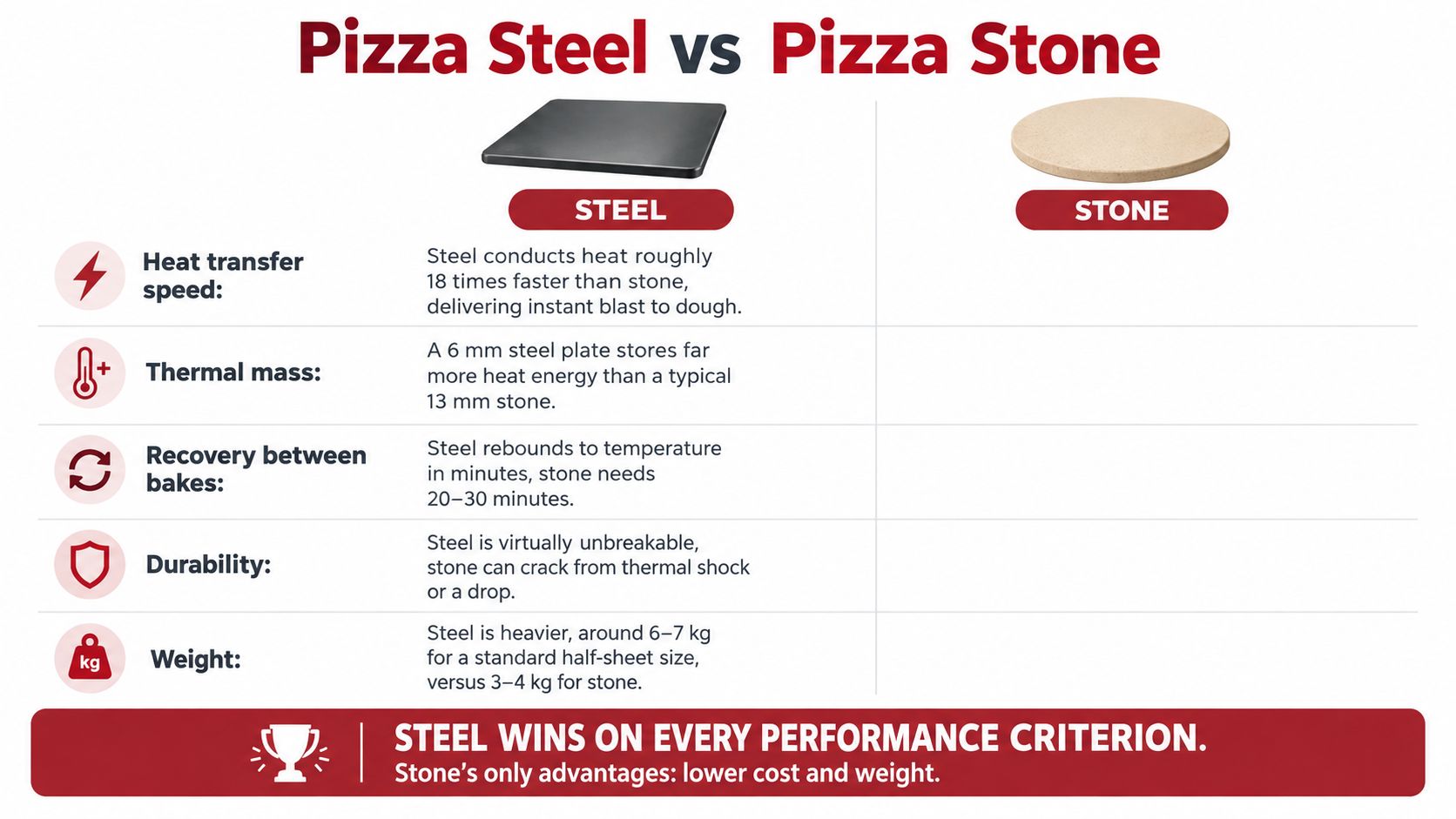
Steel wins the performance contest, but stone remains a sensible tool for some bakers. The choice changes depending on whether you care most about speed, recovery, weight, durability, or workflow simplicity.
Steel transfers heat faster, so it usually produces a darker bottom and a sharper crispness sooner. Stone heats more gently and can feel less intimidating when you're learning to launch dough. Neither surface can compensate for an oven that hasn't been preheated properly.
Where steel has the advantage
Steel is the better pick for thin New York-style, tavern-style, and Neapolitan-inspired pies in a home oven. It also makes sense on a kettle grill, where direct heat transfer helps the dough recover from the temperature disturbance created when you open the lid.
Its durability is another practical win. A stone can crack from thermal shock or a drop. Carbon steel can rust if you leave it wet, but ordinary temperature changes won't shatter it. You're trading breakage anxiety for maintenance.
Where stone still earns its shelf space
Stone is lighter to move and often easier to justify for occasional bakers. It's also a calmer choice for pan pizza and other styles where the dough has more structure and the bake depends less on a rapid blast into a thin bottom. If your household makes pizza only occasionally and you don't want a heavy plate occupying the oven, a stone may be the smarter purchase.
Weight matters. A thicker steel is a serious object, especially when you're lifting it from a low oven rack or a grill. The right size for your appliance matters more than chasing maximum surface area.
The useful verdict is style-specific:
- Thin crust: Steel gives the bottom the strongest push and is my first choice.
- Neapolitan-inspired home baking: Steel helps compensate for the lower heat of a domestic oven.
- Grilled pizza: Steel is more dependable when the lid opens and the cooking environment fluctuates.
- Detroit and pan pizza: Stone can be perfectly adequate because the pan and thicker dough reduce the need for instant conductive heat.
- Occasional baking: Stone may win because it asks less of your storage and handling routine.
For a visual demonstration of how these surfaces behave in practice, this pizza steel comparison video is useful viewing before you buy.
Thickness Size and Material Explained
Shopping for a pizza steel gets easier when you read the specifications in this order: thickness, usable dimensions, material, and finish. Thickness controls heat recovery, size determines whether the plate fits your oven, and material affects how quickly it transfers heat.
Thickness determines recovery
For most home bakers, 1/4 inch, or about 6 mm, is the practical sweet spot. Expect roughly 45 to 60 minutes to reach cooking temperature and around 13 to 18 pounds in weight, while steel stores about 1.5 to 2 times more heat than pizza stone, according to this pizza steel thickness comparison. For sizing and preheat trade-offs, compare that benchmark with this pizza steel thickness guide.
A thinner plate is easier to lift and suits a single pizza. A thicker slab keeps more heat between launches, which helps with repeated pies, but it also takes longer to preheat and demands more care when you move it.
| Thickness | Weight for 38 × 38 cm | Preheat at 500°F | Best For |
|---|---|---|---|
| 3 to 4 mm | Lightest option | Shorter | Occasional single-pizza baking |
| 6 mm | About 13 to 18 lb | Roughly 45 to 60 minutes | Most home ovens and repeated pies |
| 10 to 12 mm | Heavy | Longer | Serious hobbyists and demanding grill use |
| 15 mm and above | Very heavy | Longest | Rarely justified in a standard home oven |
A 10 to 12 mm plate makes sense when repeated baking or demanding grill use justifies the weight. 15 mm and above is overkill for a standard home oven. A great steel in the wrong workflow still loses to a decent stone, so do not buy thickness as a substitute for choosing the right baking setup.
Size should follow the oven
Measure the usable width between the rack supports and oven walls. A rectangular plate usually provides more working room than a round one, but only if its corners fit and the rack still slides smoothly.
A compact round plate suits one smaller pie. A rectangular plate handles bread, flatbreads, and varied dough shapes more flexibly. Leave clearance for your hands, the peel, and the rack movement. Maximum surface area is useless if loading the steel becomes awkward.
Material and finish
Choose low-carbon steel, often listed as carbon steel or A36 steel. It transfers heat more effectively than stainless steel. Stainless steel conducts heat at about 15 W/m·K, compared with about 45 W/m·K for carbon steel, making carbon steel the better material for this job, as explained in Serious Eats' pizza steel testing.
Bare steel needs seasoning. Pre-seasoned steel only needs an initial wash before use. Enamel cuts maintenance, but its coating creates a barrier, so it is not my first choice when conductive performance matters most.
Buying rule: Check thickness and clearance before finish, handles, or branding.
Choosing a Pizza Steel for Oven vs Grill
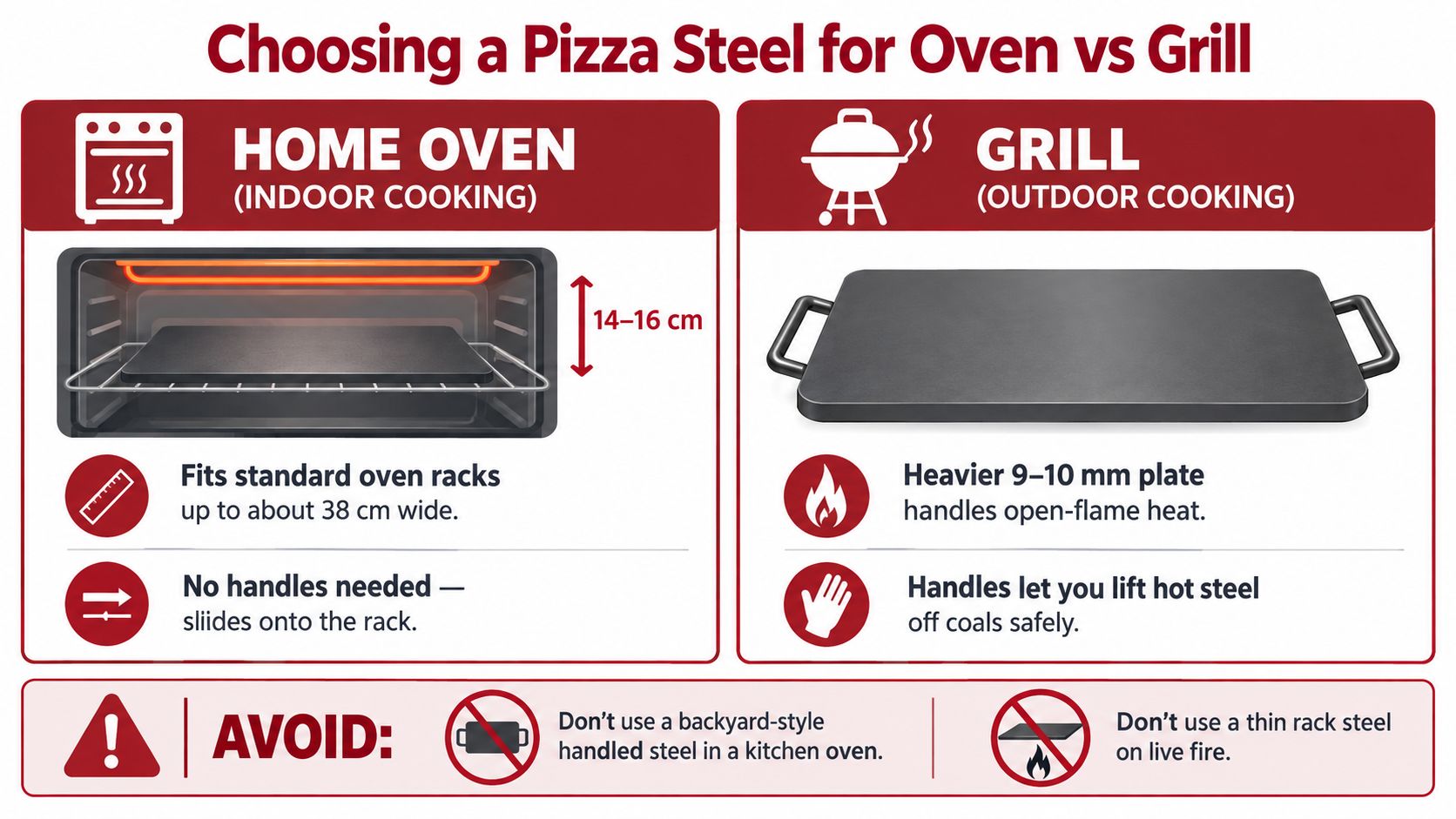
An oven steel and a grill steel live in different worlds. Treating them as interchangeable is how people end up with a plate that barely fits, handles that catch on the rack, or insufficient mass for a grill that loses heat every time the lid opens.
The home-oven setup
For a domestic oven, start with clearance. Measure the distance between the cooking rack and the broiler element, especially if you plan to finish pies under the broiler. A steel positioned close to the top element can help the top color before the bottom overbakes, but it must leave enough room for the peel and the rising crust.
A 6 to 10 mm plate is a sensible range for many home ovens. Rectangular steel usually makes better use of the rack than a round plate, provided the corners don't interfere with the oven walls. Convection ovens can work well with a thinner plate because circulating heat reaches the surface more efficiently, while a thicker steel favors repeated bakes when recovery is your priority.
Keep the steel on the rack during the full preheat. Launch the pizza with a peel, then let the oven's top heat finish the exposed crust. If you use parchment for the launch, remove it once the dough has firmed enough to move safely.
The grill setup
A grill needs a sturdier plate. The lid opening, airflow, and fuel adjustments create larger temperature swings than a closed kitchen oven, so a thicker steel makes more sense. A broad surface also gives you room to manage more than one smaller pie or move a partially baked crust away from the hottest zone.
A grill-specific plate may include handles or a shape designed around a kettle. Those features are useful outdoors but can make a kitchen-oven plate awkward. Check the steel's edges and lifting points before heating it over live fire.
Safety is part of the purchase. Use oven mitts rated above 250°C, keep a clear landing area for the hot slab, and favor rolled or smoothly finished edges. Store a larger grill plate vertically or on a secure hook so you aren't lifting it awkwardly from a crowded cabinet.
The best configuration is simple. Use a manageable rectangular steel for the oven. Use a heavier, purpose-sized plate for the grill. Don't buy a backyard slab for a narrow kitchen rack, and don't expect a thin oven plate to behave like a heat battery over live fire.
Seasoning Cleaning and Long-Term Care
Carbon steel is easy to maintain if you treat water as the enemy. The surface doesn't need a thick cast-iron patina, but it does need to stay dry and lightly protected.
First-use seasoning
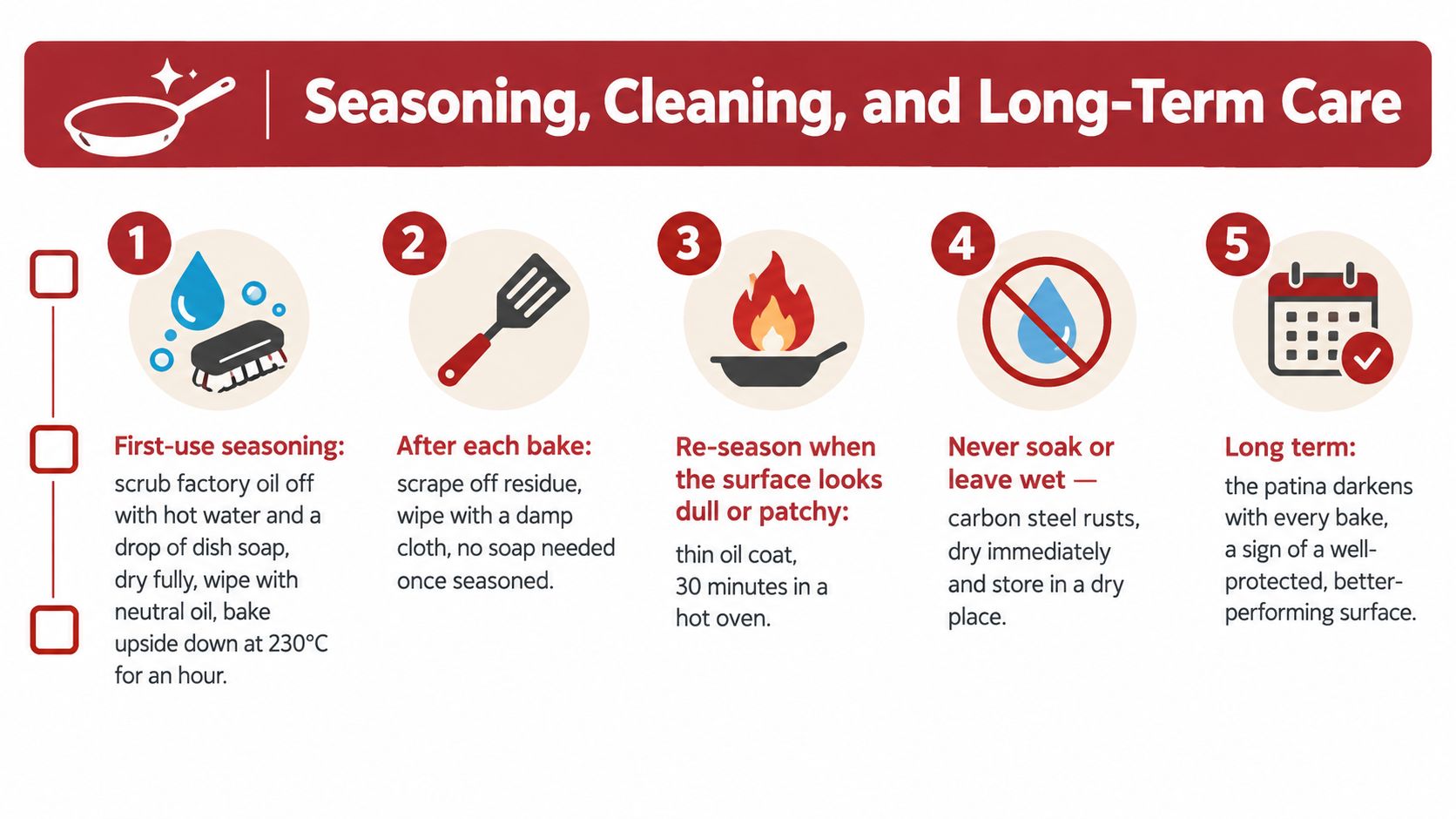
Wash the new steel with hot water and a small amount of dish soap to remove factory residue. Dry it completely on a burner or in a warm oven, then wipe on a very thin layer of neutral oil. Bake it upside down at 230°C for 45 minutes, then repeat the process if the surface still looks pale, following this pizza steel seasoning guide.
The goal is a thin polymerized layer, not a glossy pool of oil. Too much oil leaves a sticky surface and creates smoke. A light, even film protects the plate while allowing dough to release cleanly.
Cleaning after pizza
Let the steel cool enough to handle safely but remain warm. Scrape baked cheese and carbonized flour with a bench scraper or stiff spatula. Wipe away the residue with a damp cloth, then dry the plate immediately.
You don't need aggressive washing after every bake. Avoid soaking, dishwashers, and storage while damp. Trapped water can produce flash rust, especially around edges and scratches.
Fixes for common problems
- Rust spots: Scrub them away with an abrasive pad, dry the steel fully, and apply a fresh thin oil layer.
- Patchy seasoning: Re-season with a light coat of oil and another controlled bake.
- Warping: Let the plate cool naturally and check whether the shape settles. Don't pour cold water over hot steel.
- Storage: Stand it upright or hang it in a dry location, with a light oil rub whenever the surface looks unprotected.
Pizza steel care is functional rather than ceremonial. Scrape residue, remove moisture, and keep the protective layer thin. Do that and the plate will remain ready for the next dough instead of becoming a rust project.
Recommended Pizza Steel Setups Worth Considering
Buy for the way you bake, not for a ranking. A heavy steel can be the wrong choice if it crowds the rack, exceeds its weight limit, or takes longer to heat than your pizza routine allows. A decent stone in the right workflow will beat a great steel used badly.
The weeknight home baker
Choose a 6 mm steel that fits the oven rack with room to load and remove pizza safely. A rectangular plate earns its space better than a round one because it supports different pizza sizes and other baking jobs. Skip handles unless you regularly need them. They reduce usable surface area and can make oven loading awkward.
The dedicated hobbyist
For several pies in one session, prioritize heat recovery and a rack that can carry the load. A thicker plate keeps its performance steadier between launches, but check the oven's weight capacity and whether you can lift the steel without straining. The pizza steel thickness guide is useful for comparing how thickness affects heat behavior and handling.
The outdoor grill cook
Match the plate to the grill, your fuel layout, and the size of pizza you bake. A half-moon plate suits a kettle grill because it leaves room for indirect heat and fuel management. Choose edges that are easy to grip safely. Reversible or grooved surfaces can help with flatbreads, but they add little to a straightforward pizza bake.
| User Type | Recommended Thickness | Best Size and Shape | Suitable Hans Grill Option |
|---|---|---|---|
| Weeknight home baker | About 6 mm | Compact rectangle sized to the rack | Low-profile rectangular plate |
| Dedicated hobbyist | 6 to 12 mm | Larger rectangle if clearance and rack strength allow | Thicker 12 mm plate |
| Outdoor grill cook | 10 to 12 mm or more | Grill-specific half-moon or broad plate | Half-moon grill plate |
Hans Grill makes a low-profile rectangular pizza steel, a thicker Pizza Steel PRO option, and a half-moon grill plate. Those formats correspond to the three workflows above. Generic A36 carbon-steel plates and seasoned cast-steel hybrids also work when their dimensions, thickness, and finish match the appliance.
Use this rule: thickness and clearance beat brand prestige. A well-machined A36 plate that fits your oven will outperform a premium steel that blocks the rack, heats too slowly, or is too heavy for regular use.
Hans Grill's configurations cover compact home ovens, higher-mass baking, and kettle-grill cooking. Visit Hans Grill to compare the available shapes and select a plate that fits your oven or grill before your next pizza night.


