

Ceramic Pizza Stone for Oven: How It Works and What to Know
The oven's hot, the dough is stretched, and the first slice comes out with a pale, soft bottom. You've given the toppings time to bubble, but the crust still doesn't have the crisp base you wanted. A ceramic pizza stone for the oven can help by holding heat beneath the dough and transferring it as the pizza bakes, but the material and the way you handle it matter.
Whether you're trying your first homemade pie, baking on a backyard grill, watching your budget, or happily going down the pizza-making rabbit hole, it helps to know what the stone can and can't do. You'll learn how ceramic and cordierite work, how to choose a suitable surface, and how to bake and clean it without creating avoidable cracking or food-contact concerns. The two big decisions are what the stone is made of and whether you can care for it in a way that keeps it dry and protected from sudden temperature changes.
Table of Contents
- Why Home Pizza Lovers Reach for a Stone
- How a Ceramic Pizza Stone Actually Works
- Ceramic Stone vs Cordierite vs Pizza Steel
- How to Choose the Right Stone for Your Oven
- First Use and a Reliable Home-Oven Routine
- Cleaning Without Cracking or Contamination
- Long-Term Care, Storage, and When to Replace
- Pulling It All Together for Better Friday-Night Pizza
Why Home Pizza Lovers Reach for a Stone
The soft-bottom problem often starts before the pizza goes into the oven. A standard oven heats the air and the oven walls, but a thin tray may not hold enough heat to brown the base quickly when cool, moist dough lands on it. The dough then has more time to release moisture before its underside firms up, which can leave the center floppy.
A preheated stone offers a hot, solid surface under the pizza. It stores energy while the oven heats and transfers some of that energy into the dough on contact. That quick start can help the base set and dry, while the oven's surrounding heat cooks the toppings. A stone won't fix every cause of soggy crust, such as overloaded toppings or wet dough, but it gives the bottom a more consistent baking surface than a cold tray.
The trade-off is that a stone needs time to preheat and a little patience when you handle it. It can crack if you expose it to abrupt temperature changes, and a porous surface can hold moisture or cleaning chemicals. Those aren't reasons to avoid one. They're reasons to choose a material suited to your cooking and follow the manufacturer's care instructions.
This guide is for beginners who want a repeatable first bake, grill cooks dealing with hot spots, and home cooks comparing a stone with other options. It's also for anyone who enjoys experimenting with dough and wants to understand why a change in surface can affect the crust.
A stone gives the dough a hot, steady landing place. It doesn't replace good dough, sensible topping amounts, or a fully heated oven.
How a Ceramic Pizza Stone Actually Works
Think of a stone as a rechargeable heat reservoir. While it sits in the oven, it absorbs energy. When you slide a pizza onto it, the dough is cooler than the baking surface, so heat moves from the stone into the base. That contact helps the dough warm, set, and lose moisture at its underside.
The amount of stored energy depends partly on the stone's mass and specific heat capacity, which describes how much energy a material can hold as its temperature rises. In everyday terms, a substantial stone behaves a little like a warm paving slab in the sun: it takes time to heat, but it can give heat back after something cooler touches it. That's why preheating matters. A stone placed in the oven shortly before the pizza goes in may not yet have absorbed enough heat throughout its body to provide a steady bake.
The transfer is steady, not magical or instantaneous. Cordierite has moderate-to-low thermal conductivity, so heat doesn't race through it as it might through a highly conductive metal surface. That can help the base bake without an immediate, harsh burst of heat, though results still depend on the oven, stone thickness, dough, and toppings. A stone also doesn't guarantee perfectly even baking; oven hot spots and the stone's position can still affect the pie.
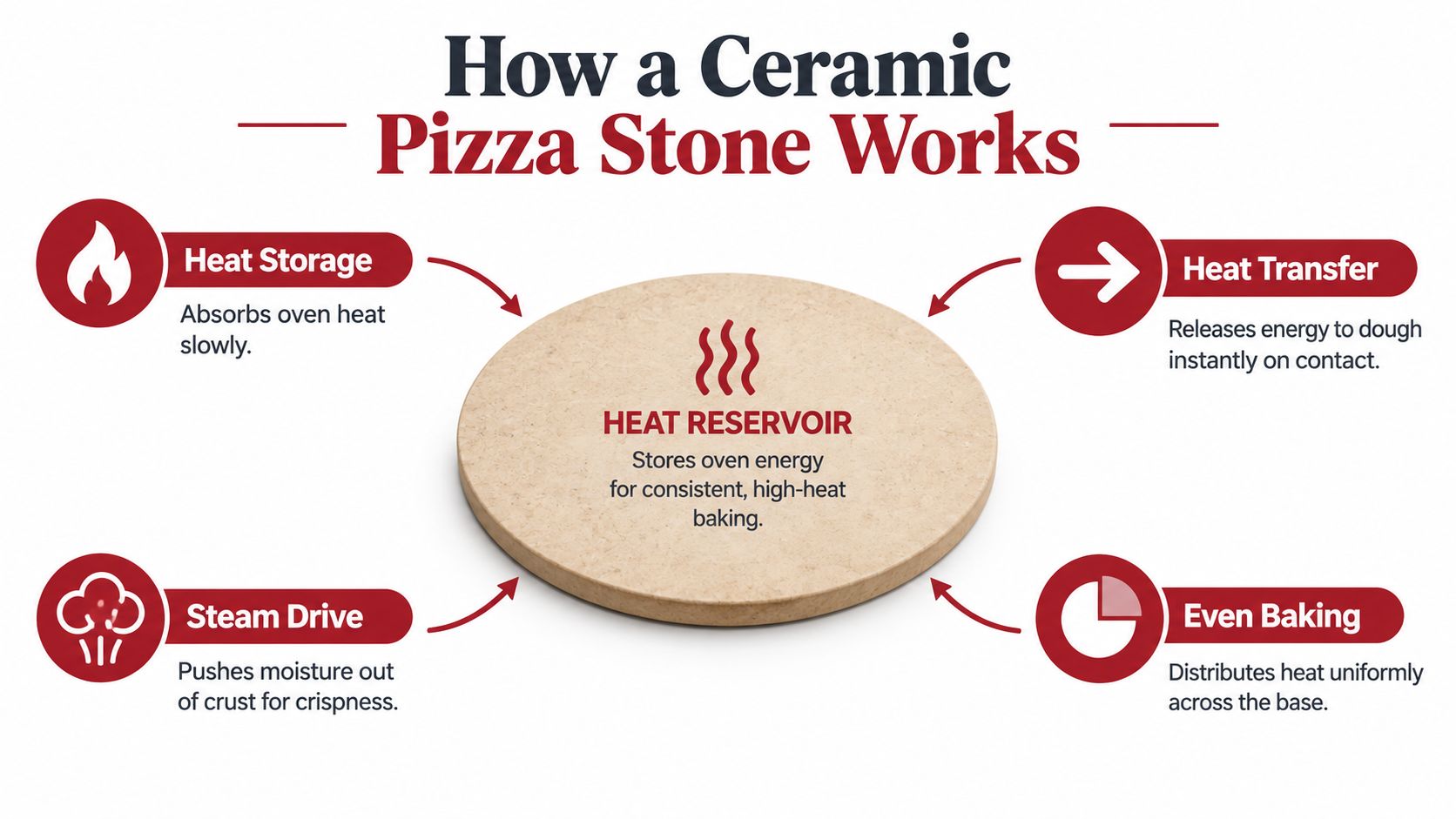
Many baking stones described as ceramic are made from cordierite, an engineered magnesium-aluminum-silicate ceramic. One reason it suits repeated oven use is its low thermal expansion: it changes dimensions relatively little as it heats, reducing the stress that can contribute to cracking. Published cordierite data give a coefficient of thermal expansion of roughly 1.0–5.0×10⁻⁶ per °C, thermal conductivity of about 1.3–1.7 W/m·K, and thermal-shock resistance in the 290–390°C range, though performance varies with composition and processing (published cordierite research).
That resistance is not immunity. A cold stone in a hot oven, a hot stone on a wet surface, or a stone exposed to a strong local temperature difference can still crack. In plain language: the stone stores heat for the pizza, but it needs to heat and cool in a controlled way.
Ceramic Stone vs Cordierite vs Pizza Steel
“Ceramic” describes a broad family of materials, not one exact recipe or performance level. Some ceramic stones are made for gentler baking and may be more vulnerable to sudden temperature changes. Cordierite is also ceramic, but its formulation is chosen to tolerate repeated heating and cooling. Steel is a different kind of baking surface altogether, with a much more conductive feel in use.
For a home cook, the useful questions are practical: How long will the surface need to heat? How aggressively will it brown the base? Is it a good match for the oven or grill you use? The table compares general tendencies, not guaranteed product specifications. Thickness, construction, oven settings, and handling all affect what you'll experience.
Compare the trade-offs
| Material | Heat-up Time | Peak Surface Temp | Durability in Home Oven | Best For |
|---|---|---|---|---|
| Generic ceramic | Depends on thickness and formulation; allow a thorough preheat | Depends on the oven and material | Can be more vulnerable to abrupt temperature changes | Budget-conscious cooks who can follow careful handling guidance |
| Cordierite | Needs time to heat through | Depends on oven settings and stone placement | Low expansion helps it tolerate repeated oven cycles, but it can still crack | Everyday oven baking and many grill setups |
| Pizza steel | Depends on thickness and steel construction | Depends on oven and placement | Doesn't have ceramic breakage concerns, but it's a heavy metal surface | Cooks seeking a strong sear and fast heat transfer |
Cordierite is a practical middle ground for many home ovens. It stores heat for the base and is designed to cope with repeated heating, while still requiring sensible care. Generic ceramic may cost less, but “ceramic” alone doesn't tell you how a particular stone was made or how it should be used.
Steel is worth considering if you want a more assertive transfer of heat into the dough and don't mind a heavier metal surface. A stone's slower, steadier heat transfer may suit cooks who prefer a more forgiving baking surface. Neither material makes a pizza Neapolitan-style on its own. Dough, oven temperature, baking conditions, and technique matter too.
Choose for your routine: If you mainly bake in a home oven and want a surface that can also work on a grill, a cordierite stone is a sensible starting point. If your priority is the feel of a searing metal surface, compare steel instead.
How to Choose the Right Stone for Your Oven
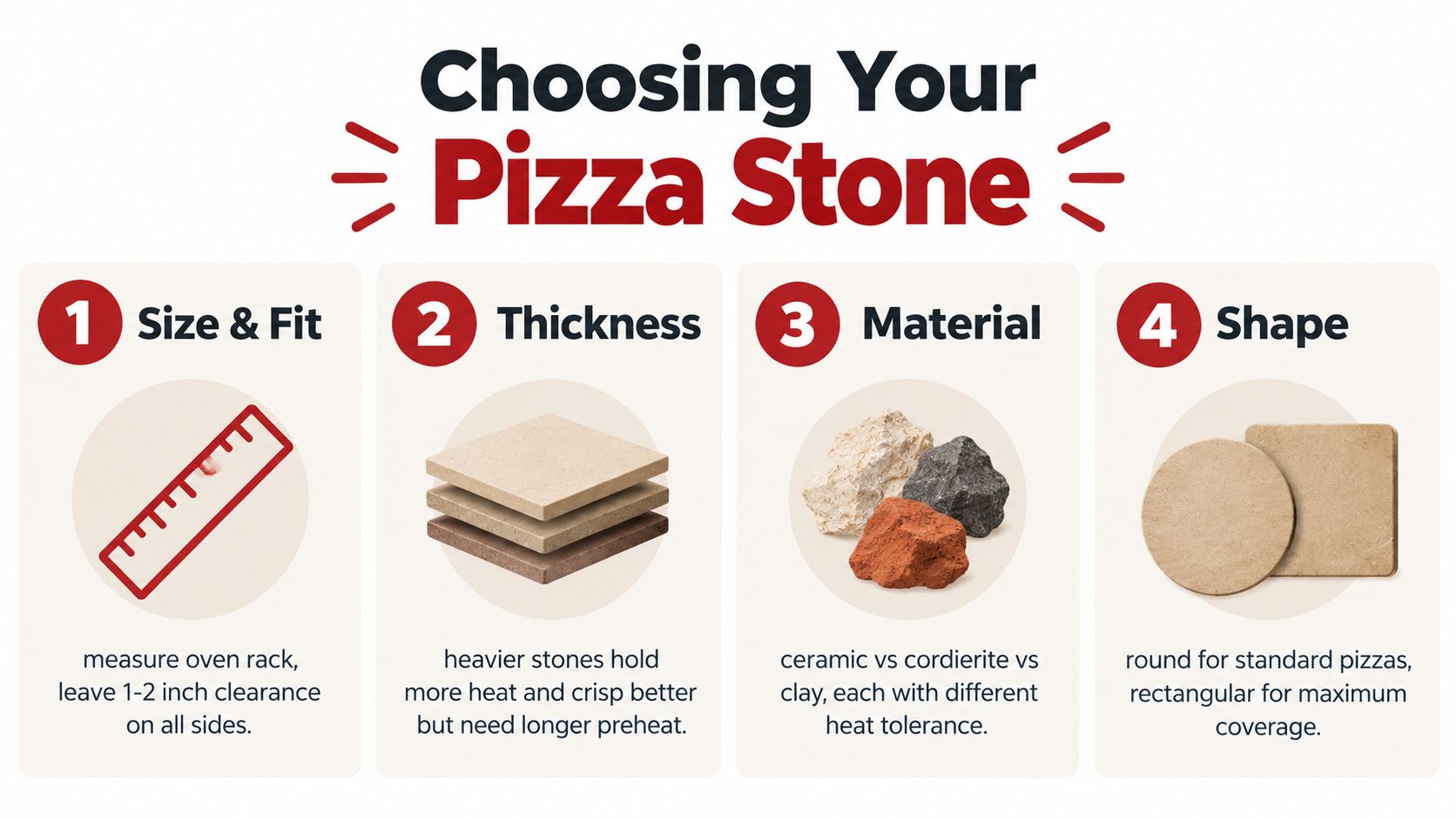
Start by checking whether the stone physically fits your oven. Measure the rack and check the appliance guidance, then leave room around the stone so air can circulate. A stone that fills the rack edge to edge can restrict airflow, and a tight fit makes it harder to slide the stone in or remove it safely.
Thickness is a balance. A heavier stone can hold more heat, which may help when cool dough lands on it, but it also takes longer to heat fully. A thinner stone may be easier to handle and faster to bring up to temperature, but it may not have the same heat reserve. Look for a flat surface without visible chips or defects, and read the maker's heating instructions rather than assuming every stone should be treated alike.
Shape depends on how you cook. A rectangular stone gives you more usable space on a standard oven rack and can suit grill cooking, while a round one matches the shape of a typical pizza. A smooth surface is straightforward for thin crusts; a textured surface may feel different under the dough, but it won't eliminate sticking if the pizza sits too long on the peel. Check whether the stone is flat or has feet, and make sure its design is compatible with your oven rack and the manufacturer's instructions.
Check the paperwork, not just the label
“Natural,” “stone,” and “food safe” are not substitutes for clear product information. Ask who made the stone, what material and glaze it uses, what maximum temperature it's intended for, and whether the seller can provide documentation for the market where you live. For ceramic foodware, EU guidance describes a written declaration confirming that migration of substances such as lead and cadmium stays below legal limits (EU guidance on ceramic food-contact products). This is a useful example of the kind of documentation buyers can look for; requirements vary by country and product type.
Use this quick listing check before buying:
- Fit: Confirm that the dimensions leave clearance on your oven rack.
- Material: Look for a specific material description, not just “stone.”
- Use: Check whether the maker approves oven, grill, or both.
- Surface and shape: Choose what suits your pies and cooking space.
- Documentation: Look for the manufacturer's identity, food-contact information, glaze details, and temperature guidance.
For weeknight oven pizzas, choose a size that fits your rack comfortably. For family-size pies or grill use, prioritize usable surface area without blocking airflow. For high-heat baking, confirm that both the material and the manufacturer's instructions match your intended setup.
First Use and a Reliable Home-Oven Routine
Read the manufacturer's instructions before the first bake, especially if the stone arrives dusty or has a coating. Don't soak it. If the instructions call for rinsing, use only minimal water and let the stone dry completely before heating it. Otherwise, a dry wipe may be all it needs.
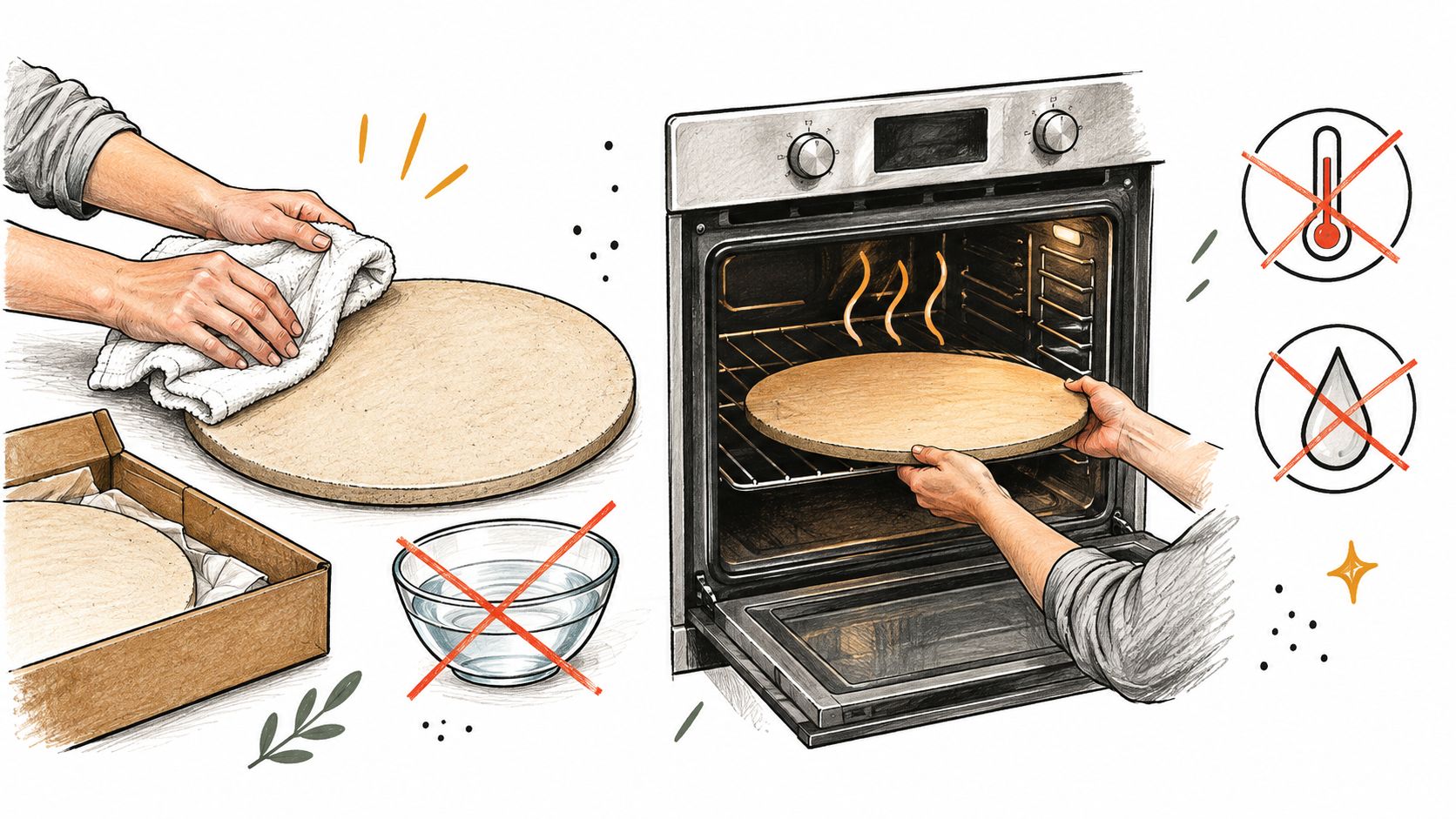
Set the dry stone on the oven rack while the oven is still cool, then heat the oven with the stone in place. This gradual warm-up helps avoid the sharp temperature change that can stress ceramic. Give it enough time to heat through, following the stone's instructions and your recipe. Turning on the oven only when the pizza is ready to launch leaves the stone with less time to build a stable heat reserve.
A peel makes launching easier, but dough can stick if it rests on the surface while you add toppings. Stretch and top the pizza on a separate work surface if you can. Dust the peel lightly with flour, semolina, or cornmeal, then give it a small shake before launching. If the dough moves freely, slide it onto the stone with a confident forward-and-back motion. If it sticks, lift an edge and add a little more dust rather than forcing it.
For help choosing a peel, see this guide to wood or metal pizza peels. A wooden peel can make it easier to prepare and launch a pie, while a metal peel can be useful for retrieving it. Whichever you use, keep toppings from spilling onto the stone and avoid leaving assembled dough sitting on the peel.
A cold stone placed on a hot oven floor can experience a sudden temperature difference; a wet stone on a hot rack faces an even more obvious moisture and heat problem. Keep the stone dry and let it warm with the oven. When the pizza is done, use a long-handled peel to remove it. Let the stone cool in the oven, then move it only when it's safe to handle and place it on a stable, heat-safe surface.
If you prefer to watch a launch and handling demonstration, this video can help you see the motion before your first bake.
Cleaning Without Cracking or Contamination
“Never use soap” is useful shorthand, but it doesn't answer every cleaning question. A stone may come through a bake with a little dry flour, a patch of baked cheese, or grease that needs attention. The right response depends on what's on the surface and whether adding moisture is necessary.
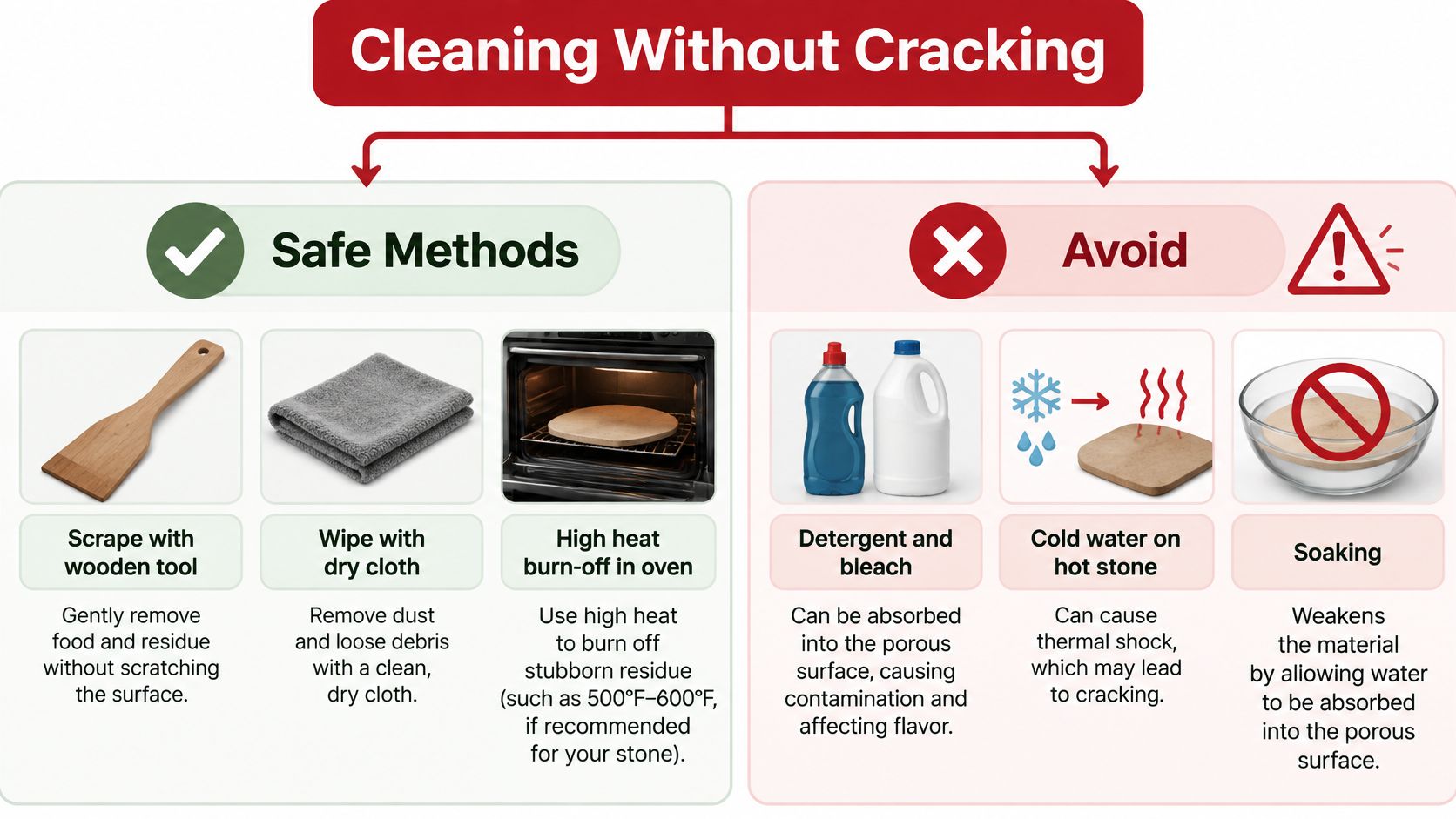
Start by letting the stone cool completely. For routine crumbs and burnt flour, scrape gently with a wooden tool or another scraper approved by the manufacturer, then wipe away dry debris. For grease or residue that won't budge, use a barely damp cloth, not a rinse under running water. Then let the stone dry completely before putting it away or heating it again.
Porous stones can absorb moisture and cleaning chemicals. Guidance for pizza-stone care warns against soap, bleach, and hydrogen peroxide because residue may remain in the pores; it also warns that a damp stone can crack when heated (pizza-stone cleaning guidance). High heat can burn off some food residue, but it doesn't remove absorbed chemicals or fix a structural crack. Follow the maker's instructions if you use an oven burn-off method, and don't assume heat makes every cleaning product safe.
Match the response to the problem
- Dry crumbs or baked flour: Scrape and wipe with a dry cloth.
- Grease or stuck food: Use the least moisture needed, then allow full drying.
- Persistent residue: Check the manufacturer's cleaning guidance before trying a burn-off.
- Suspected mold, deep oil saturation, or a crack: Don't keep baking on the stone without manufacturer guidance; replacement may be the safer choice.
The main trade-off is straightforward: adding water can help loosen residue, but moisture trapped in a porous stone can increase the risk of cracking during the next heating. For a fuller routine, see this guide to cleaning a baking stone. Don't try to make a stone look new at the expense of leaving it damp or contaminating its baking surface.
Long-Term Care, Storage, and When to Replace
The most helpful long-term habit is also the simplest: avoid sudden changes in temperature. When baking is finished, let the stone cool gradually in the oven rather than carrying it straight to a cold countertop. Cordierite is chosen in part for low thermal expansion, but no ceramic stone is immune to the stress caused by uneven or abrupt heating and cooling.
One tested cordierite formulation had about 20% porosity, a bulk density of 1.90 g/cm³, and a 2.66% loss in flexural strength after 30 air-cooling thermal-shock cycles from 25 to 1,000°C (cordierite formulation research). Those are results for a particular tested material under controlled conditions, not a promise that a home pizza stone can safely handle a wet countertop or sudden cooling. The practical lesson is to let the stone cool in a controlled way.
Stains are common with use and are usually cosmetic, not a reason to scrub aggressively. Let the stone dry before storage, and keep it somewhere dry and stable where it won't get knocked or have heavy objects put on top. Avoid wrapping a damp stone in plastic or putting it away in a humid spot.
A crack deserves more attention than a stain. Even a small crack can grow with repeated heating, and moisture can settle into a damaged area. Ask the manufacturer for guidance if you're unsure whether a crack affects safe use. This overview of why pizza stones crack can help you think through common causes.
Upgrade if your current stone no longer suits your cooking: a thicker stone may offer more heat storage, steel may suit a cook seeking stronger heat transfer, and a larger format may make room for bigger pies. Replace a cracked or persistently contaminated stone when the manufacturer can't confirm it's safe to keep using.
Pulling It All Together for Better Friday-Night Pizza
A crisp base starts with a stone that has had time to heat, a material suited to repeated oven use, and a surface that's dry and in sound condition. Cordierite is a sensible choice for many home cooks, but it still needs gradual heating and cooling. Once the stone is ready, keep the dough moving on the peel, avoid piling on wet toppings, and give the base time to bake.
The sentence to carry into the kitchen is simple: heat the stone with the oven, launch a lightly topped pizza onto a dry surface, and let the stone cool slowly afterward. If you want to experiment, a thicker stone is one route to more heat storage, while steel offers a different, more conductive surface. A rectangular cordierite stone can suit both oven and grill use, and dough-proofing boxes may appeal if your pizza hobby is starting to grow.
You don't need a specialty oven to make a satisfying pie at home. Start with a careful preheat, a manageable amount of toppings, and a stone that fits your cooking setup. Then adjust one thing at a time until Friday-night pizza tastes the way you want it to.
Hans Grill offers cordierite pizza stones for home ovens and BBQs, along with pizza steels, peels, and dough-proofing boxes for cooks building a more complete setup. If you're choosing a surface for your next bake, explore the options at Hans Grill.


