

Cordierite Pizza Stone Baking Guide
You pull a pizza from the oven and the top looks promising. The cheese is bubbling, the edges have some color, and then you lift the slice to find a pale, soft underside that bends instead of cracking cleanly. On another bake, the crust improves, but the stone develops a fracture after a rushed preheat or a splash of water during cleanup.
That frustration usually isn't caused by the dough alone. Your oven or grill can create plenty of heat, but the baking surface determines how much of that heat reaches the dough quickly and evenly. A cordierite pizza stone gives home bakers a practical middle ground between a thin ceramic plate and a commercial hearth, provided you manage temperature changes with care.
Table of Contents
- Why Your Pizza Crust Needs a Better Baking Surface
- The Science of Cordierite and Thermal Shock Resistance
- Preventing Thermal Shock in Ovens and Grills
- Comparing Cordierite Stone to Pizza Steel and Ceramic
- Cleaning and Maintaining Your Porous Baking Stone
- Maximizing Results with a Rectangular Pizza Stone
- Your Checklist for Pizzeria Quality Bakes at Home
Why Your Pizza Crust Needs a Better Baking Surface
A standard metal pan heats quickly, but it doesn't behave like a thick masonry floor. It can brown the underside where it touches the metal, yet the dough may still soften from its own moisture before the base develops the dry, firm texture one might want. A thin ceramic plate has a similar weakness, with less useful thermal mass and more vulnerability to sudden temperature changes.
A baking stone changes the contact point. Once fully heated, it stores energy and transfers that energy into the dough from below. The result is a firmer base, faster setting at the bottom, and better support for the expansion that happens when wet dough meets a hot surface.
The difference under the dough
Consider two pizzas made from the same dough. One goes onto a cool pan. The crust spreads, the underside steams, and the toppings may finish before the base has properly dried. The other lands on a thoroughly heated stone. The dough gets immediate floor heat, the bottom firms sooner, and the baker has a better chance of producing a crisp edge without drying the entire pizza.
That doesn't mean a stone creates restaurant pizza automatically. A home oven still has limitations, especially when the upper heating element can't brown the top as quickly as the stone cooks the base. A grill adds another variable, because the underside may receive intense direct heat while the lid and surrounding air remain less even. The stone improves the floor, but the baker still has to balance top heat, bottom heat, dough thickness, and launch timing.
Practical observation: A better surface often makes a bigger difference than a more elaborate topping. If the base starts cold or loses heat on contact, premium ingredients won't rescue the texture.
Cordierite works particularly well because it combines useful heat retention with resistance to rapid temperature changes. Its porous surface can also help manage moisture at the dough's underside, although it won't compensate for excessive flour, wet toppings, or a dough ball that has been left on the peel too long.
The most reliable workflow is simple. Put the stone into a cold oven or cool grill, bring the cooking chamber and stone up together, and give the surface time to heat through. Launch a pizza that slides cleanly, keep the lid or door closed as much as possible, and let the stone recover between bakes when the first pizza has pulled a lot of heat from it.
That routine turns a cordierite pizza stone from a passive slab into a controlled heat source. The material matters, but so does the way you load, heat, use, and cool it.
The Science of Cordierite and Thermal Shock Resistance
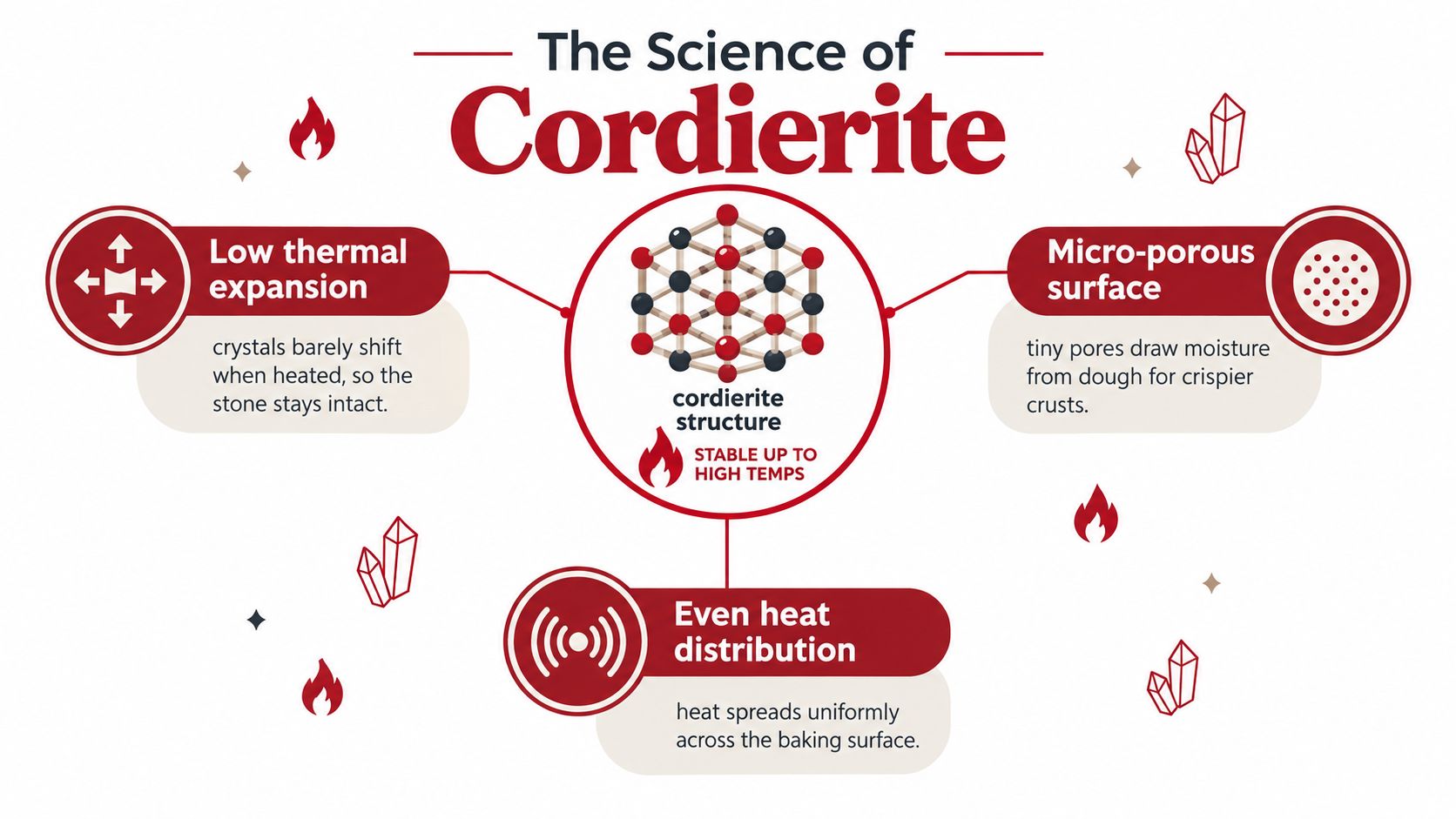
Cordierite is a magnesium-aluminum silicate ceramic with the chemical composition 2MgO·2Al₂O₃·5SiO₂. Its value in high-temperature cookware and refractory components comes largely from its unusually low thermal expansion. Published engineering data commonly place its coefficient of thermal expansion between 1.5 × 10⁻⁶ and 3.1 × 10⁻⁶ °C⁻¹, although composition, crystal orientation, porosity, and manufacturing conditions affect the final result. One cordierite ceramic body fired at 1,350°C measured 3.18 × 10⁻⁶ K⁻¹ in testing (engineering research on cordierite ceramic behavior).
Thermal expansion describes how much a material changes size as it heats. Think of the stone as a group of connected regions rather than one perfectly uniform block. If the exposed top heats much faster than the center or underside, those regions want to expand by different amounts. The resulting internal stress can produce a crack.
Cordierite's low expansion reduces that mismatch. The ceramic still heats, but its dimensions change less than those of many other materials under the same temperature increase. That gives the stone a larger margin when a cold oven begins warming or when the baking surface experiences repeated heating and cooling.
Why low expansion isn't the same as unbreakable
A cordierite pizza stone is resistant to thermal shock, not immune to it. Thermal gradients can become severe when one area receives direct flame, when a hot stone touches a cold counter, or when water reaches a surface that is still hot. Impact, trapped moisture, manufacturing defects, thickness, and uneven construction can also contribute to failure.
Laboratory research on cordierite-mullite ceramics intended for solar-thermal storage exposed samples to 30 thermal-shock cycles from room temperature to approximately 1,100°C, followed by air cooling. The researchers reported strong thermal-shock resistance after those cycles, but that result describes a particular formulation and test method, not every consumer baking stone (research on cordierite-mullite thermal cycling).
Composition can change performance significantly. Research reported that adding 10 to 20 wt% titanium dioxide raised thermal-expansion coefficients by as much as 80% because additional phases formed in the ceramic. That finding matters at the shelf because two stones can carry the same cordierite label and still respond differently to heat.
Cordierite's wider technical role comes from the same combination of low expansion, refractoriness, chemical stability, and thermal-shock resistance. It has been used in refractory components, catalyst supports, electrical substrates, and other parts exposed to rapid heating and cooling. For pizza, the useful conclusion is narrower: buy the finished product for its construction and food-contact suitability, not for the material name alone.
For a plain-language explanation of how different pizza-stone materials behave, see what a pizza stone is made of. This video also provides a visual introduction to baking-surface behavior:
Preventing Thermal Shock in Ovens and Grills
Most cracked stones don't fail during the dramatic moment people remember. The damage often begins with a small temperature mismatch, then becomes visible when the stone is heated again. Cordierite lowers the risk, but your routine determines whether that margin is preserved.
A safe oven protocol
Use this sequence for an indoor oven:
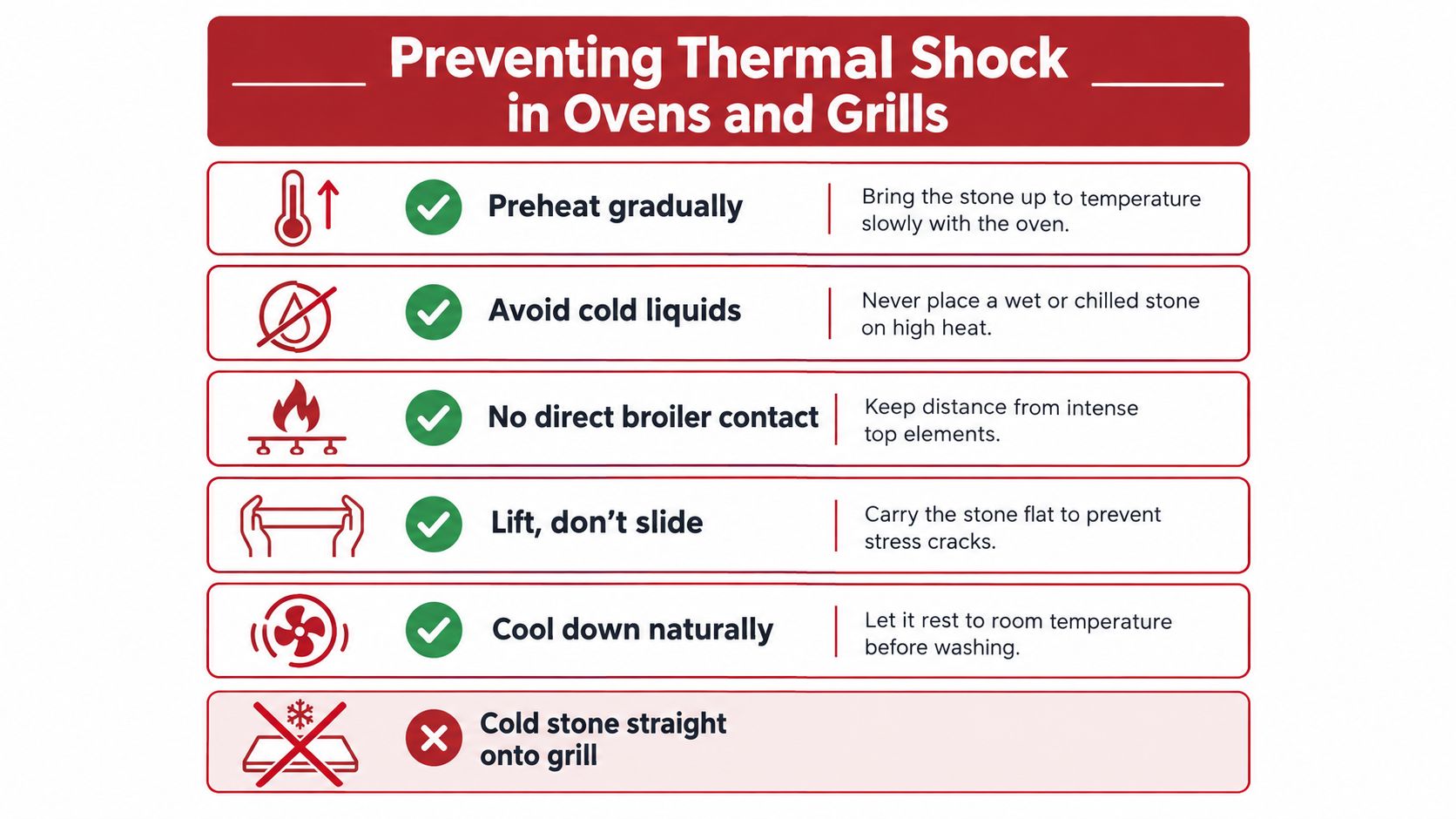
- Start cold. Place the completely dry stone on a rack before turning the oven on. A cold start lets the stone and surrounding air warm together.
- Heat gradually. Avoid sudden jumps in temperature, especially with a new stone or one that may have absorbed moisture.
- Keep the stone stable. Don't slide it across a hot rack or lift it while it is still at baking temperature. Uneven support can add mechanical stress.
- Bake without liquid contact. Cold dough is generally less dangerous than cold water because the dough touches the surface briefly and doesn't flood the stone. Never pour water over a hot stone to loosen residue.
- Cool in place. Turn off the oven and let the stone return toward room temperature inside the chamber.
A hot stone placed on a cold granite countertop can lose heat unevenly through its underside. The same principle applies to a wet pizza peel, a damp cloth, or a sink. The danger isn't only that the object is cool. It is that one part of the stone changes temperature much faster than another.
Why grills demand stricter heat control
A backyard grill is harsher than a typical oven because heat may arrive from a concentrated burner zone or a dense bed of coals. The lid can show a high overall temperature while the underside of the stone receives a much more localized burst of radiant and conductive heat. That unevenness creates the thermal gradient that careful oven users rarely see.
Grill rule: Let the stone heat with the grill. Don't place a cold stone onto a fire that has already reached full intensity.
For gas grills, begin with the stone in place and bring the burners up in stages. Avoid direct flame contact unless the manufacturer explicitly rates the stone for that setup. With charcoal, favor an arrangement that spreads heat rather than concentrating the stone over the fiercest coal bed. Give the stone time to absorb heat across its full thickness before launching.
The same guidance applies during removal. Lift the stone flat with appropriate heat-resistant handling tools, don't twist it, and don't set it on a wet or cold surface. If you need a refresher on the cold-start method, follow this practical guide to preheating a pizza stone.
The protocol is deliberately conservative because a stone is difficult to repair once a crack forms. Gradual heat, dry handling, indirect grill positioning, and natural cooling work better than trying to rescue a damaged slab after the fact.
Comparing Cordierite Stone to Pizza Steel and Ceramic
A cordierite pizza stone, a baking steel, and a standard ceramic stone can all produce a better base than a thin pan, but they don't deliver heat in the same way. The right choice depends on whether you want fast bottom browning, forgiving baking, easy handling, or broad coverage in a home oven.
Steel transfers heat rapidly and delivers aggressive contact heat. That can suit thin pizzas where the baker wants a strongly browned underside, but it also narrows the timing window. If the base receives more heat than the top, the bottom can darken before the cheese and upper crust are ready. Steel is also dense and heavy, and it needs dry storage and rust care.
Cordierite behaves more gradually. It stores heat and releases it through the baking surface without the same abrupt contact response as steel. That makes it a useful choice for bakers who want crispness with a little more forgiveness, as well as people who bake bread and thicker crusts on the same surface.
Standard ceramic can work for lighter home use, but it usually offers less tolerance for rough handling and sudden temperature changes. Its performance depends heavily on the formulation and construction, so a generic ceramic label tells you less than the manufacturer's care instructions and testing information.
Baking surface material comparison
| Material | Heat transfer speed | Weight and handling | Best crust style |
|---|---|---|---|
| Cordierite | Steady, moderate transfer with useful heat retention | Easier to handle than a dense steel plate, though still fragile under impact | Crisp thin crusts, thicker New York-style bases, and bread |
| Baking steel | Fast, forceful contact heat | Heavy and demanding to move or store | Thin crusts and strongly browned bottoms |
| Standard ceramic | Generally gentler and dependent on construction | Often manageable, but more vulnerable to sudden changes | Occasional home baking and lighter-duty use |
Match the surface to your habits
Choose steel if you already manage strong bottom heat well and want rapid browning. Choose ceramic if low-intensity use and light handling matter more than a wide safety margin. Choose cordierite if you want one surface that can serve an oven or grill while giving you a more forgiving path to a dry, crisp base.
No material fixes poor launching. A pizza that sits on the peel while you search for a lost topping can stick to steel, stone, or ceramic alike. Flour the peel lightly, keep the topped dough moving, and launch as soon as it is ready.
Cleaning and Maintaining Your Porous Baking Stone
A used stone rarely looks pristine. Dark patches, flour marks, and baked-on traces are normal consequences of repeated baking, and discoloration alone doesn't establish a food-safety problem. The surface is porous, so trying to restore its original color can cause more damage than leaving the marks in place.
What to do after baking
Let the stone cool completely before touching it. Use a blunt scraper, bench scraper, or stiff dry brush to remove loose cheese, flour, and topping residue. If the manufacturer permits minimal water, use only a small amount on a cool stone, then allow it to dry thoroughly before the next bake.
Avoid soap, soaking, and aggressive chemical cleaners. Porous ceramic can retain moisture or cleaning residues, and trapped moisture becomes a thermal-shock risk when the stone goes back into a hot oven or grill.
A simple maintenance routine looks like this:
- Scrape first: Remove hardened residue mechanically rather than dissolving it into the stone.
- Keep it dry: Store the stone where it won't sit against a damp surface.
- Accept the patina: Darkening is a normal visual change from use, not a demand for sanding or bleaching.
- Inspect the structure: A deep crack, unstable fragment, or persistent residue smell deserves more attention than color alone.
Food-contact safety starts with the finished product
Raw cordierite chemistry doesn't automatically make every refractory slab suitable for cooking. Industrial kiln shelves may contain firing residues, kiln wash, or contaminants and shouldn't be substituted for a manufactured food-contact baking stone.
The FDA evaluates lead and cadmium in food-contact ceramics through elemental analysis, and food-contact surfaces containing lead aren't authorized for ordinary food use. For general background on the distinction between industrial refractory materials and cooking surfaces, see this guide to refractory ceramics and heat-resistant materials.
When choosing a stone, ask the manufacturer for evidence that the finished product is intended for food contact. Look for material traceability, relevant compliance or testing documentation, and care instructions that acknowledge porosity. A claim about the raw material alone isn't enough.
Don't oil-season a porous stone like cast iron. Oil can soak into the surface, smoke during baking, and leave sticky or rancid-smelling patches. Regular dry baking creates the practical patina. For a detailed cleanup routine, follow this guide to cleaning a baking stone.
Maximizing Results with a Rectangular Pizza Stone
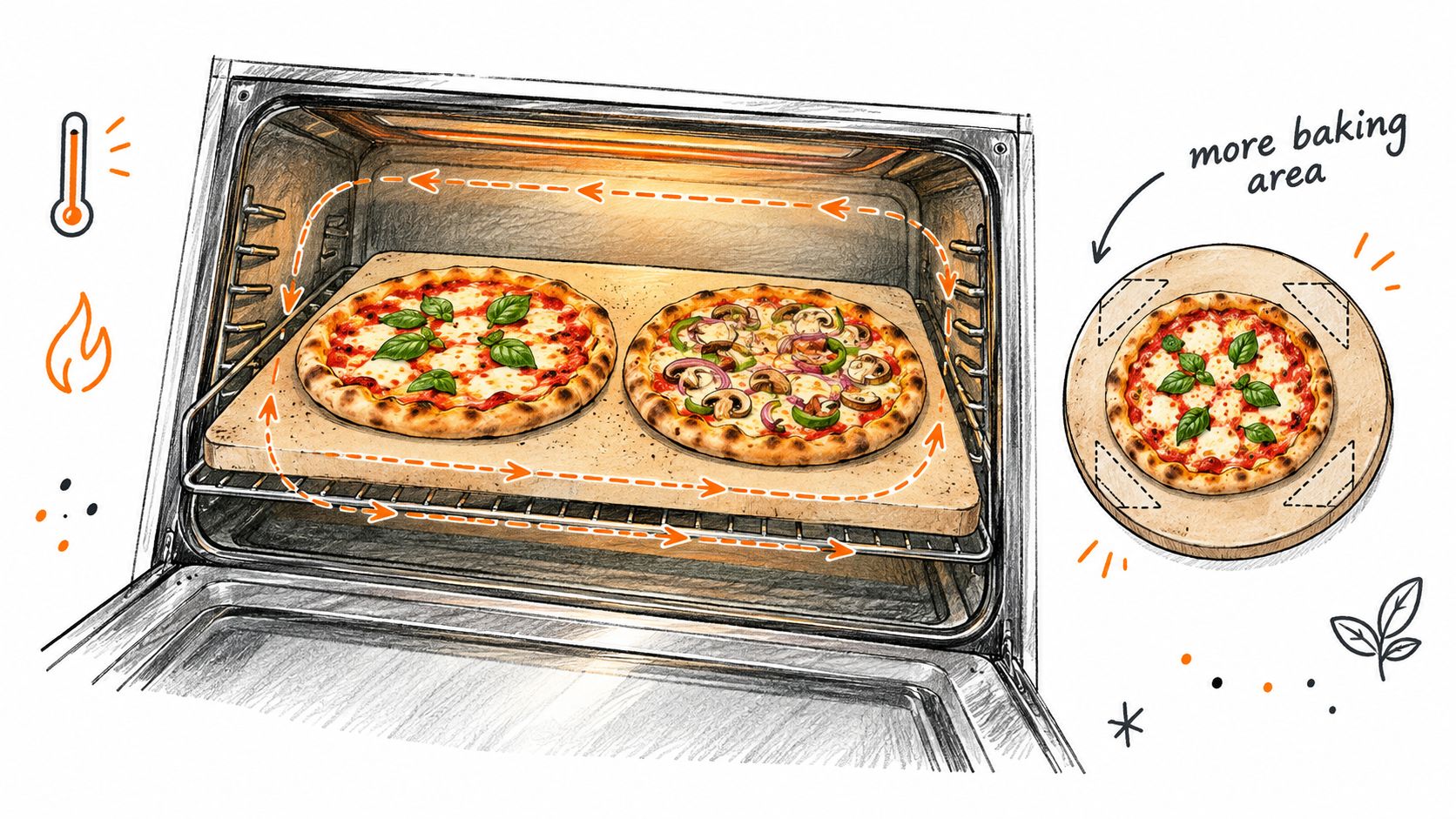
Round stones look natural beside a round pizza, but the oven rack and grill grate are usually rectangular. A rectangular cordierite stone uses that space more efficiently, especially when you bake oval loaves, elongated flatbreads, or pizzas that don't fit neatly inside a small circular boundary.
The extra corner coverage also gives you more room to recover from a crooked launch. A round stone leaves unused areas around its perimeter, while a rectangular footprint provides a wider landing zone and more consistent support near the edges. That matters when a dough round stretches during transfer or when you want to bake a larger format without balancing the crust close to the stone's rim.
Where the shape helps most
In a home oven, the rectangular format aligns with the rack and leaves fewer unused zones. On a grill, it can cover more of the grate while still allowing the baker to position the stone away from the most intense direct heat. That flexibility is useful because grill baking depends on managing hot and cool zones rather than turning every burner to maximum.
Shape doesn't replace construction quality. Check that the stone is made for food contact, that the maker provides clear temperature and handling guidance, and that the product has a support policy you can use if it arrives damaged or develops a manufacturing issue. The finished stone's thickness, porosity, formulation, and support underneath all affect its real-world performance.
A rectangular stone also makes cleanup and storage more predictable. You can place it flat on a rack, keep it stable during cooling, and use a peel that matches its usable surface instead of aiming at a small central circle.
For bakers who alternate between pizza and bread, this format is especially practical. It gives a loaf more room to expand, supports a longer dough shape, and lets the baker work with the oven's available floor area rather than fighting the geometry of a round slab.
Your Checklist for Pizzeria Quality Bakes at Home
A cordierite pizza stone gives you a stable baking floor, but repeatable results come from controlling the whole chain. Dough temperature, launch speed, heat balance, and cooling discipline matter as much as the ceramic itself.
Use this checklist before the next bake:
- Prepare the dough deliberately: Give it enough time to relax so you can stretch it without tearing or forcing a thick rim.
- Keep the peel lightly dusted: Too much flour burns on the stone and leaves bitter residue. Use only enough to release the dough.
- Start with a dry stone: Moisture and high heat are a poor combination for porous ceramics.
- Load before heating: Place the stone in a cold oven or cool grill, then raise the temperature gradually.
- Manage the grill zone: Favor indirect or distributed heat during warm-up, and avoid direct flame underneath unless the product allows it.
- Launch without hesitation: Top the dough quickly and slide it onto the fully heated surface before it bonds to the peel.
- Watch both surfaces: If the bottom is darkening too quickly, reduce direct floor heat or move the stone away from the strongest grill zone. If the top lags, improve upper heat rather than just making the stone hotter.
- Cool naturally: Leave the stone in place until it has cooled, then scrape it clean and store it dry.
The target isn't maximum heat at every moment. It's the right heat in the right place, delivered without creating a destructive temperature gradient.
A crisp base comes from cooperation between material and technique. The stone supplies stored heat, the dough supplies structure and moisture, and the baker decides how quickly those two meet.
Hans Grill offers rectangular cordierite pizza stones and other pizza-baking tools designed for use in home ovens and backyard BBQs. Visit Hans Grill to compare baking surfaces and choose a setup that matches your oven, grill, and preferred crust style.


