

Pizza Stone and Pizza Steel: How to Choose
Steel isn't the automatic upgrade that popular pizza advice makes it out to be. It can turn a pale, floppy thin crust into a crisp base, but it can also burn the underside while the dough beneath the sauce is still gummy.
A pizza stone and pizza steel are tools for balancing bottom heat against top heat. Choose by your dough, oven and baking habits, and try changing rack position or preheating before replacing a surface you already own.
Table of Contents
- Pizza Stone and Pizza Steel Compared First
- Why Steel Browns Faster Than Stone
- Match the Surface to Your Dough, Oven and Bake
- How to Preheat Ovens and Grills
- Cleaning Cracks and Rust Without Ruining the Slab
- Pick a Hans Grill Stone or Steel
Pizza Stone and Pizza Steel Compared First
The best surface isn't necessarily the one that transfers heat fastest. It's the one that finishes the base at roughly the same time as the rim, center and toppings.
Steel delivers heat aggressively, which is useful when a home oven struggles to brown thin dough. Stone gives you more time to finish the middle without blackening the underside. That extra margin matters when you're learning to launch pizza or working with toppings that release moisture.
Pizza stone versus pizza steel at a glance
| Criterion | Pizza stone | Pizza steel |
|---|---|---|
| Typical material | Cordierite, ceramic, or terracotta | Carbon baking steel |
| Thermal conductivity | Lower conductivity; gentle transfer | Higher conductivity; forceful transfer |
| Heat delivery versus stone | Baseline, slower and gentler | Much faster conduction into dough |
| Usual full preheat | Longer warm-up to heat the slab throughout | Usually a shorter warm-up, but still needs thorough heating |
| Common working thickness | A substantial slab selected for the oven and maker's instructions | A substantial plate rather than thin sheet metal |
| Best crust job | Even, gradual browning; more forgiving | Fast bottom color, crisp thin crust, stronger oven spring |
| Home-oven sweet spot | Gentler bakes and heat-sensitive toppings | Thin and New York-style pizza when bottom browning is weak |
| Main downside | Thermal shock can crack it | Heavy, very hot, and capable of scorching the base |
| Grill or BBQ | Yes, if grill-rated and heated gradually with the grill; protect from flame | Yes, if BBQ-rated; still needs controlled heat and stable support |
Read the specifications as cooking behavior
The material names tell you what you're handling. Cordierite is a ceramic material, despite the familiar word stone. Carbon baking steel is a metal plate, not a nonstick baking tray.
Heat transfer describes how the cooking surface behaves after the dough lands. Preheating describes whether that surface is ready to work. Thickness affects stored energy, weight and handling, so don't compare products by material alone.
The crust and oven rows describe useful tendencies, not guarantees. A stone can produce a crisp base, and steel won't rescue dough buried beneath wet vegetables. Neither surface supplies the top heat needed to finish the cheese.
Buying principle: Choose the surface that corrects your oven's weakness, not the surface with the most impressive specification.
For grill use, the product's rating matters more than its appearance. A slab that fits on the grate isn't automatically suitable for direct flame, and a steel plate doesn't make an unstable fire easy to control. Leave room around either surface for heat circulation and check that the rack or grate supports its weight.
Why Steel Browns Faster Than Stone
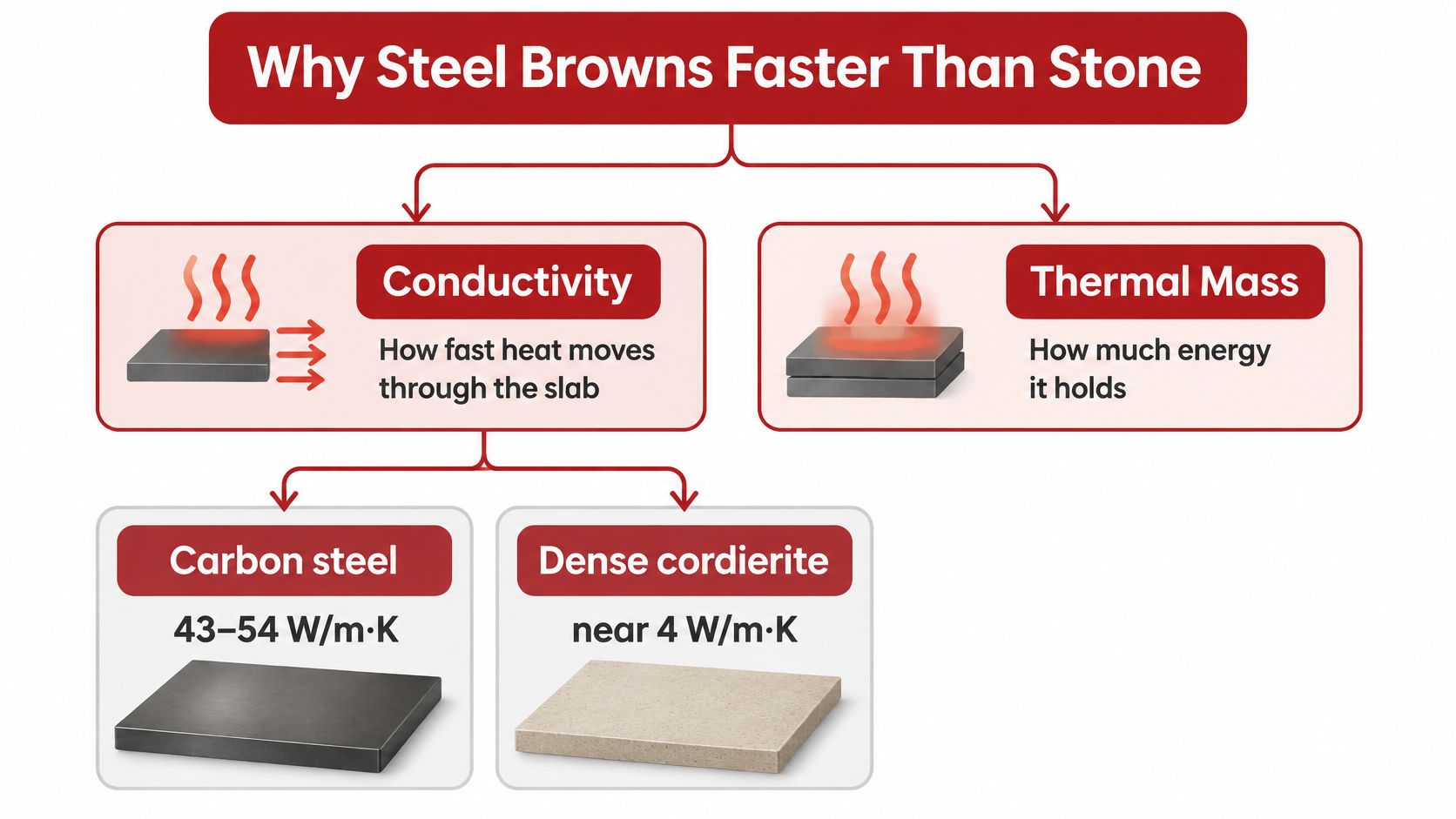
Thermal conductivity means how quickly heat moves through a material. Thermal mass describes how much energy an object can store as its temperature changes. A surface can move heat quickly without holding enough energy to sustain repeated bakes.
That distinction explains why a lightweight metal tray doesn't behave like a substantial baking steel. Both are metal, but the tray cools quickly when loaded with dough.
The diagram separates heat movement from heat storage.
What happens beneath the dough
The conductivity figures in the Queen Mary University of London source put carbon steel at approximately 43–54 W/m·K, compared with around 4 W/m·K for dense cordierite, and identify 1/4 inch as a commonly recommended baking-steel thickness for home use.
Those conductivity figures describe the material, not the speed of an entire pizza bake. Dough thickness, contact with the surface, sauce, toppings and oven heat still determine when dinner is ready.
At launch, the dough's underside is wet and relatively cool. Steel transfers energy into that contact area rapidly, helping moisture evaporate and the base set. As the underside dries, it can develop stronger color while the expanding dough forms its structure.
Stone delivers energy more gradually. That can keep the base from getting too dark while the center cooks, particularly when the pizza needs a longer stay in the oven.
Stored heat changes the next bake
A thin steel can brown an initial pizza enthusiastically, then produce a weaker result after repeated loading. It has fast conduction, but limited reserves. A thick stone may offer useful thermal buffering once fully heated, although it still replenishes energy more slowly through its body.
Neither material guarantees uninterrupted baking. Oven output, slab size, thickness and the amount of dough you load all affect recovery.
- Watch the pattern: If successive pizzas become paler, allow more recovery before launching again.
- Check contact: A badly stretched base or trapped flour can prevent even heat transfer.
- Read both sides: A dark bottom isn't proof that the center is cooked.
Faster bottom heat is helpful only while the top of the pizza can keep pace.
Rack placement sets that balance. Steel close to a strong bottom element can over-brown the base, while a rim close to a broiler can blacken before the center sets. Don't compensate for every pale pizza by moving the surface closer to the most powerful heat source.
Match the Surface to Your Dough, Oven and Bake
Which surface to use for each home pizza job
| Situation | Choose | Why | Setup note |
|---|---|---|---|
| New York or thin crust in a hot domestic oven | Pizza steel | Faster underside color and strong initial lift | Start on a middle or lower-middle rack; move higher for the next bake if the base finishes first |
| Beginner or delicate, wet toppings | Pizza stone | Gentler bottom heat gives you a wider margin | Preheat thoroughly; start on a middle rack and drain toppings |
| Thick, pan, or long bakes | Pizza stone as a forgiving starting point | The center needs time before the base gets too dark | The pan also affects browning; don't chase the darkest possible underside |
| Frozen pizza, occasional | Pizza stone only when both manufacturers permit it | Gentler conduction may help avoid aggressive bottom browning | Follow package directions; use a tray when direct loading onto stone isn't approved |
| Backyard grill, uneven fire | Pizza steel if heat fluctuations are unavoidable; stone for steady, protected heat | Steel avoids ceramic fracture, but either surface can overheat | Preheat with the lid closed; control flare-ups and shield stone from direct flame |
| Several pies in one session | A substantial steel or a thick, fully heated stone | Stored energy matters alongside conduction | Allow recovery according to the crust results, not a fixed promise |
The Pizza Blab baking-surfaces guide identifies steel as a strong choice for New York-style and thin-crust pizza in ovens operating around 250–290°C. That's a useful match between style and equipment, not a reason to use steel for every dough.
Different households need different heat
The thin-crust enthusiast. Say you stretch dough thin, use restrained toppings and want a base that stays crisp beneath a foldable slice. Steel is a sensible choice if your oven finishes the top but leaves the underside blond. Start with balanced rack placement rather than immediately putting the plate at the bottom.
Dough preparation still matters. Our guide to cold-ferment pizza dough can help you plan dough development, but fermentation doesn't remove the need to control topping moisture or stretch evenly.
The beginner making family pizza. If you're still learning the peel motion, stone gives you a less aggressive cooking surface while you improve timing. Keep the center evenly stretched, drain fresh mozzarella and cook watery mushrooms before adding them. A gentle slab can't evaporate an overloaded topping layer without consequences.
The thick-pizza household. A tall dough layer needs time for heat to reach the center. Stone is a forgiving starting point, especially when the underside already browns readily. With pan pizza, the pan's material, finish and oil layer also influence the result, so a scorched base isn't automatically the slab's fault.
The backyard pizza host. Steel is less vulnerable to ceramic cracking when outdoor heat changes abruptly, but it can still develop scorching hot spots. Control the fire before launching and rotate the pizza if one side browns faster. With stone, use steady, indirect heat and avoid repeatedly opening the lid to inspect every change.
Hydration changes the job
Hydration is the amount of water relative to flour in the dough. Wetter dough needs enough energy and time to lose moisture, but that doesn't make steel an automatic answer. A thick, wet center can remain gummy even while a highly conductive surface burns the underside.
Thin dough with modest toppings often benefits from a quick, forceful bake. Thick dough, heavily loaded pizza and dough containing browning-promoting ingredients may need gentler bottom heat and more patience.
Use the symptom to choose a change:
- Pale underside with finished toppings: Extend preheating before buying a different surface.
- Scorched base with undercooked toppings: Move the surface higher for the next bake to improve the balance of top and bottom heat.
- Soggy center with a well-baked rim: Reduce topping moisture first; if the dough itself remains gummy, reassess thickness and hydration.
- Progressively weaker bases: Give the surface more recovery between launches.
Change rack position or preheating before changing material. Keep the dough and toppings consistent while testing, or you won't know which adjustment helped.
How to Preheat Ovens and Grills
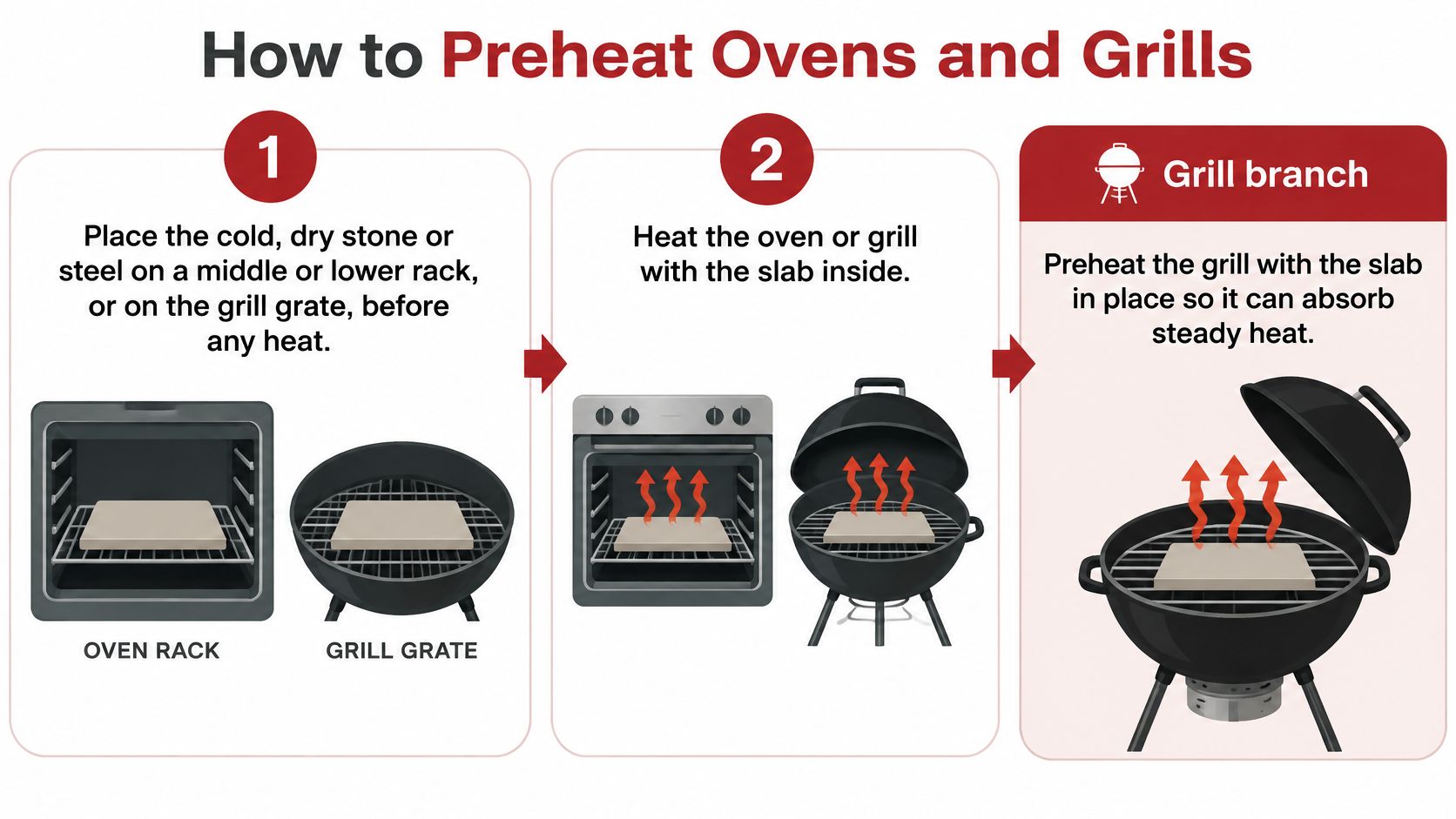
Preheat the slab, not just the air around it. The oven's ready signal tells you about the cooking chamber; it doesn't prove that a thick baking surface has heated throughout.
Use this sequence to build a stable cooking surface before you prepare the pizza.
Heat and launch in a controlled sequence
- Position the cold, dry slab. Put it on a stable middle or lower-middle oven rack before switching on the heat. Leave clearance around it and make sure it doesn't obstruct an element or vent.
- Heat the oven with the surface inside. For stone, the PizzaHQ heat-transfer guide recommends about 60 minutes so the slab heats throughout rather than only at its face.
- Prepare the peel while the slab heats. Dust a dry wooden peel lightly with semolina or flour. Stretch and top promptly, then give the peel a small shake to confirm the dough moves.
- Launch with a short forward-and-back motion. Don't pour loose flour onto the slab, and don't let sauce drip over the edge.
- Check underneath during baking. Lift an edge with the peel once the base has set. If it's coloring too quickly, finish the pizza away from direct slab contact on a suitable tray.
- Allow the surface to regain heat before loading again. Prepare the next pizza only when you're ready to launch it.
- Cool in place. Switch off the heat and leave the slab inside until it's safe to handle.
For a closer look at oven readiness, our guide to whether you should preheat a pizza stone explains why a hot chamber and a ready baking surface aren't the same thing.
Make outdoor heat steadier
On a grill, put the approved surface in place before lighting the burners or heating the chamber. Close the lid and use indirect heat or a suitable buffer to protect stone from concentrated flame. Wind, flare-ups and frequent lid opening make outdoor heating less predictable.
This demonstration provides a visual reference for preparation and handling.
Never slide a cold stone into an already-hot oven or place a hot stone on a cold counter. Cordierite's low thermal expansion improves its tolerance, but doesn't prevent damage from severe temperature gradients.
Handling reminder: Leave a heavy, hot slab where it is. Adjust rack position before the next preheat, not while carrying a fully heated surface.
Steel won't shatter like ceramic, but it can burn you, damage a countertop or warp under severe temperature changes. Keep frozen pizzas off hot stone unless the stone maker and food instructions explicitly permit direct loading.
Cleaning Cracks and Rust Without Ruining the Slab
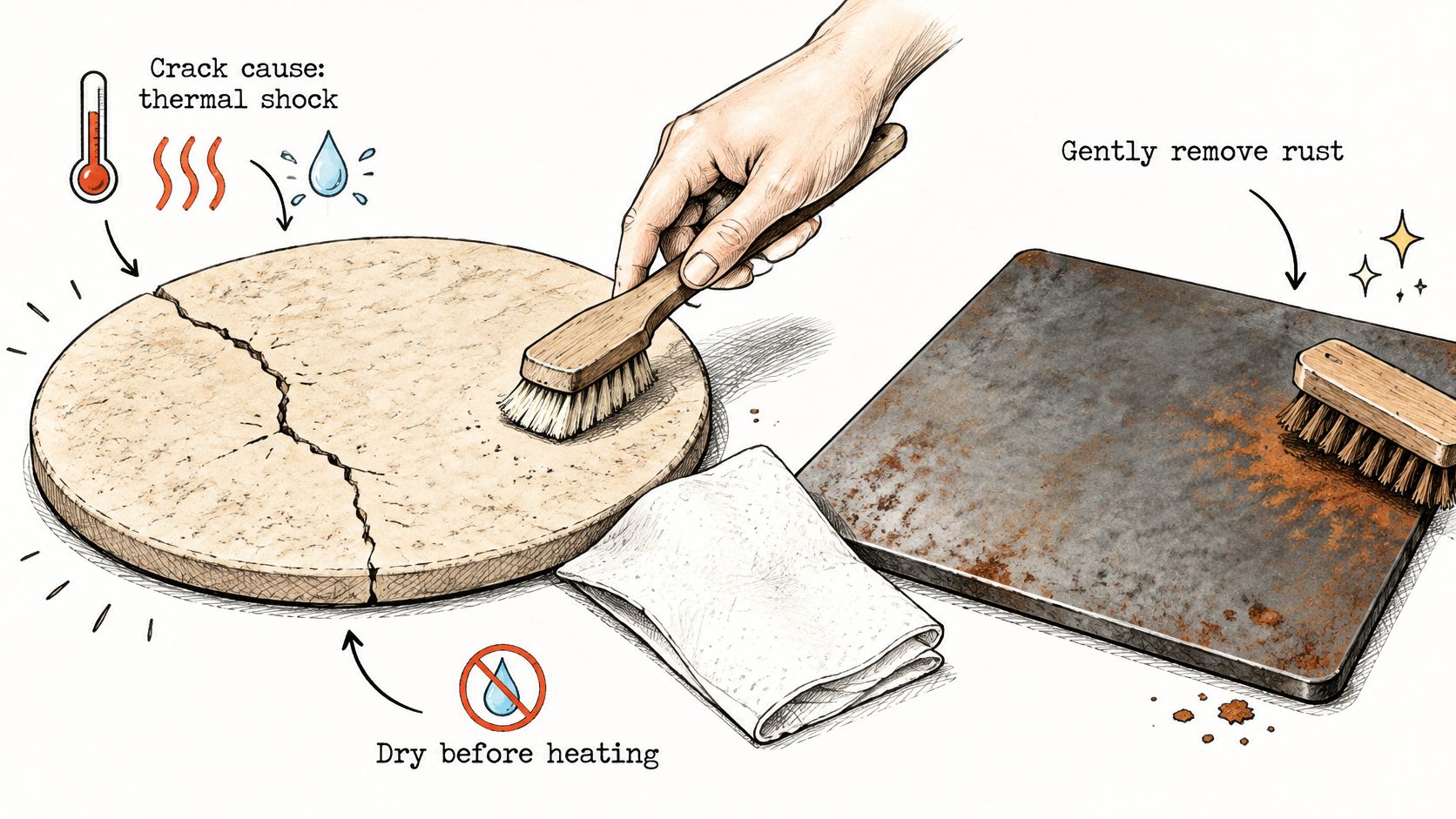
Stone and steel need different care. Sudden temperature changes can crack a ceramic stone, while moisture left on steel can cause rust. Both surfaces also stay hot long after cooking, so let them cool fully before cleaning or handling them.
If the stone has cracked
Inspect it only when it is completely cool. A hairline mark differs from loose pieces, but a crack can make the cooking surface unstable. Ask the manufacturer whether a cracked stone is safe to use, and stop using it if the crack widens, sections loosen or the surface no longer sits securely.
Never glue broken pieces together for baking. Household adhesives are not a repair method for a food-contact surface exposed to oven heat.
For routine cleaning:
- Scrape dry residue: Use a stone brush or bench scraper gently, keeping the edge shallow to avoid gouging the surface.
- Leave harmless staining alone: Dark marks are common. Focus on raised food deposits rather than trying to remove every stain.
- Use little water: For stubborn residue, dampen the surface sparingly, then let the stone dry completely before heating.
- Skip detergent unless approved: Porous ceramic may retain moisture or cleaning-product residue.
Avoid scrubbing a hot stone with a wet brush, storing it outdoors while damp or heating it again before it has dried.
If the steel has rusted
Let the steel cool, then remove surface rust with an abrasive pad or suitable brush. Wipe away the residue and dry the plate completely. Gentle heat can help remove lingering moisture.
A thin film of food-safe oil helps protect the surface. Follow the maker's instructions to restore its seasoning. The pizza steel seasoning guide explains how to build and maintain that protective layer. Too much oil can turn sticky rather than forming a useful finish.
Store either surface securely, away from moisture and where children cannot touch it while it cools. Stone is vulnerable to sudden temperature changes and absorbed moisture; steel needs to stay dry to limit rust.
Pick a Hans Grill Stone or Steel
Buy for the pizza you make. If you prefer gradual browning, longer bakes or a wider margin while learning, stone is a sensible choice. If your thin crust consistently needs stronger bottom color despite thorough preheating and sensible rack placement, steel is the more useful tool.
Our Rectangular Pizza Stone uses cordierite stone technology for crispy, pizzeria-style bases in a kitchen oven or on a BBQ; the Pizza Stone PRO XL Set costs $69.99 and includes a stone, peel and cutter. Our Pizza Steel PRO (XL) costs $119.99, suits oven or BBQ use, and can also bake bread, calzone and cookies.
Check fit and handling before ordering
Measure the usable rack or grill space, not just the outside dimensions of the appliance. You need clearance for circulation and enough room to launch and retrieve the pizza without hitting the oven walls.
Think about storage as well. A baking surface should have a secure, dry home where you don't need to lift it awkwardly or balance it against something fragile.
- Choose the cooking behavior: Gentle and gradual for stone, forceful bottom browning for steel.
- Confirm the exact item: Check dimensions, set contents and care instructions on its product page.
- Read the applicable terms: Warranty and return conditions should match the item and order type you're buying.
Don't treat a new slab as permission to change the whole recipe at once. Keep your dough, topping load and oven setting familiar while you learn how the surface behaves, then adjust from the crust you get.
The worthwhile upgrade is repeatability: a base that finishes with the toppings, a launch you can manage and a cleaning routine you'll follow. Preheat with the oven or closed grill, use appropriate protection, and keep hands and children away until the slab has cooled in place.
Hans Grill offers cordierite pizza stones and baking steel for home ovens and BBQs, so you can choose gentler baking or stronger bottom browning to suit your dough. Visit Hans Grill to compare the surfaces and choose the tool that fits your pizza night.


