

Square Pizza Screens: A Practical Guide for Home Cooks
You know the moment. The dough is stretched, the sauce is on, the toppings look right, and the rectangular pie still comes out with a center that feels softer than the edge. Or worse, it sticks just enough that the lift turns into a fold, and the whole thing sags before it reaches the cutting board. That is exactly where square pizza screens stop feeling like a niche gadget and start looking like a very practical tool for home cooks who make rectangular pies, tavern-style pizzas, or party-cut sheets.
Table of Contents
- Why Square Pizza Screens Matter
- How a Square Pizza Screen Works
- Materials, Sizes, and Shapes Worth Knowing
- Square Screens vs Stones, Steels, and Pans
- Using a Square Screen in the Oven and on the Grill
- Cleaning, Care, and How Long They Last
- When a Square Screen Is Not the Right Tool
- Buying the Right Square Screen for Your Setup
Why Square Pizza Screens Matter
A rectangular pie asks more from your equipment than a round one does. The dough has corners to support, longer edges to brown, and more surface area to manage as you launch, rotate, and retrieve it. If the base is a little weak, the whole thing shows it fast.
Why square formats stuck around
Square-cut pizza has been part of American pizza culture since the 1940s and 1950s, when pizza was still new to many diners. Historical accounts connect the shape to bar service and snack eating, not a formal sit-down meal, and one Chicago-oriented account says the pieces were meant for people stopping at a tavern on the way home, while a Detroit history ties the square format to the identity of Detroit-style pizza itself (Snack Stack). That history matters because the shape was a response to how people ate, not a random styling choice.
In home kitchens, the same logic shows up in a different way. A square or rectangular pie is often easier to serve in neat portions, but it is also more awkward to move than a round one. A square pizza screen gives the dough a lighter landing surface than a solid pan, so the pizza can breathe while it bakes instead of steaming against metal.
Practical rule: if the crust keeps going soft under the center, the problem is often support and airflow, not just the dough formula.
Why the hardware follows the food
The shape also fits the logistics of pizza making. Packaging and manufacturing sources note that square containers and surfaces use material efficiently and stack well, which is one reason rectangular formats dominate pizza handling and transport (pizza-box engineering overview). That same logic carries over to screens in a home oven or on a grill. Rectangular dough is easier to contain on a rectangular surface than on a round one, especially when the dough is soft or the toppings are heavy.
A screen is not magic. It does not create a different style of pizza by itself. It gives you a lighter, more manageable platform for a shape that already wants a longer bake path and a cleaner transfer.
How a Square Pizza Screen Works
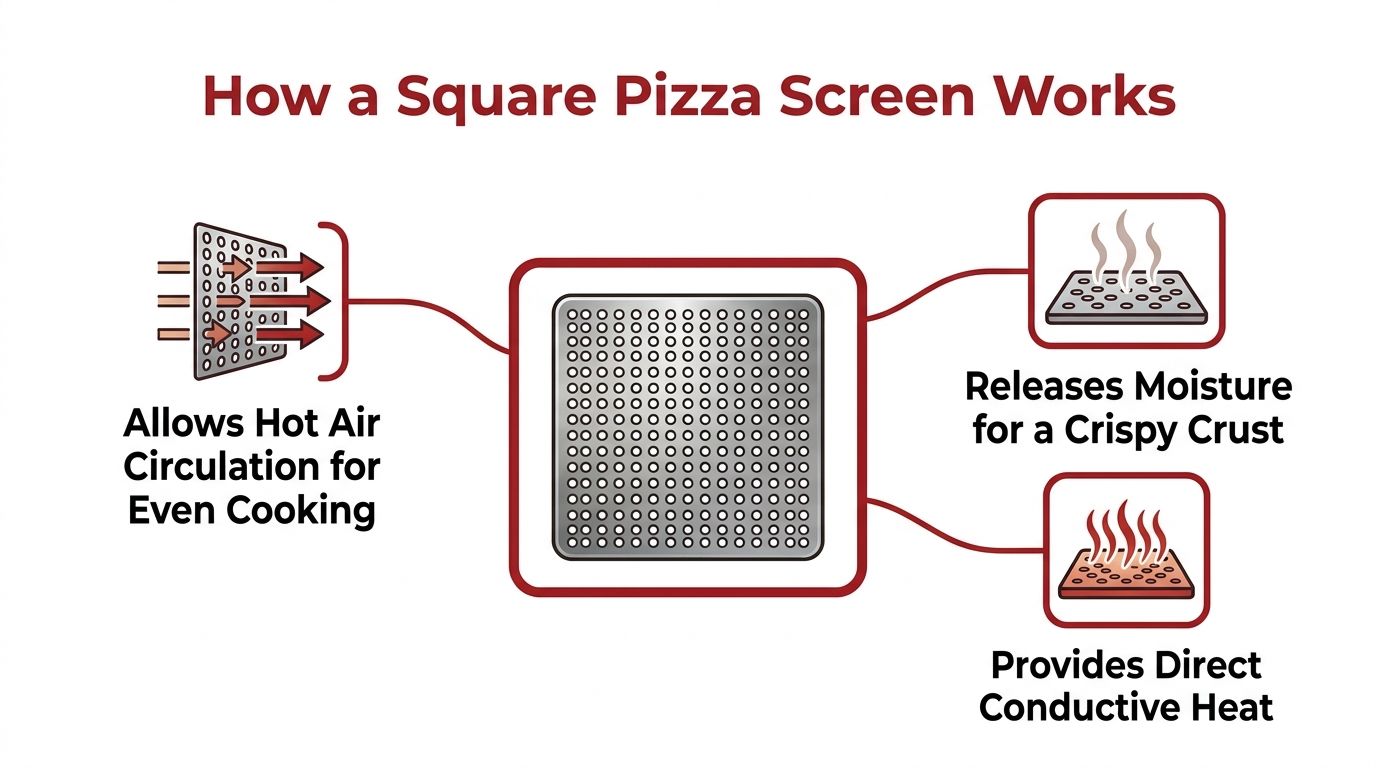
A square screen works because it gets air under the dough instead of trapping it underneath a flat surface. The perforated mesh lets hot air move across the bottom of the pizza, and that moving air helps drive off moisture that would otherwise soften the crust. It is similar to baking on a wire rack instead of on a sheet pan, the difference is how much air gets to the underside.
What the holes actually do
The holes are doing three jobs at once. They allow hot air circulation, they let steam escape, and they reduce the amount of metal the dough sits on. That combination helps the pizza bake more evenly from the edge to the center, which is why screen-based baking is often described as consistent and efficient (pizza screen guide).
A solid pan works differently. It supports the dough more completely, which can be useful for deep styles, but it also traps more moisture unless the crust and oven heat are working hard enough to dry it out. A screen is the opposite choice. It favors airflow over insulation.
Why that matters for thin square pies
For a thin, square pie, the base usually fails before the topping does. The center can stay pale while the edges look done, especially if the dough was stretched a little thicker in the middle. A screen lowers that risk because it promotes faster drying of the bottom surface.
A screen is a transfer tool first, a browning tool second. If you want a heavy, deeply browned base, the final surface still matters.
That distinction is the reason screens often show up in workflows that finish on stone or steel. The screen gets the pizza safely into the oven or onto the grill, then the hotter surface does the last bit of bottom work.
Materials, Sizes, and Shapes Worth Knowing
A good screen doesn't need a fancy sales pitch. It needs to fit your oven, fit your pizza, and hold up without warping. Once you strip away the marketing language, three things matter most, material, mesh, and size.
What to look for in the metal
Most home options are built from coated aluminum, stainless steel, or hard anodized metal. Coated aluminum is common because it's light and easy to handle. Stainless holds up well over time and resists corrosion better than basic coated options. Hard anodized surfaces sit somewhere in the middle from a feel standpoint, but the practical question is still the same, does the screen stay flat and does the coating survive regular use?
The mesh matters just as much. A coarse mesh usually makes more sense than an overly fine one in a hot home oven or grill because it gives the air more direct access to the dough. Very fine openings can support fragile dough well, but they can also act a bit more like a partial sheet, which reduces the airflow advantage you wanted in the first place.
Sizing the screen to the job
A 12-inch square screen is the most common home format because it fits many ovens without crowding the walls and gives enough room for a practical pizza size. A 14-by-16-inch rectangle makes more sense for larger Detroit-style or sheet-pan-style pies, where the shape of the dough matters as much as the crust.
Here's the simple checklist I'd use before buying:
- Measure the usable oven space. Don't trust the outer width alone. Rack clearance matters.
- Match the screen to the pizza style. Thin tavern pies need different support than a thick rectangular pan pizza.
- Choose a mesh that favors airflow. Most home cooks are better served by coarser openings.
- Skip oversized hardware if storage is tight. A screen that lives awkwardly in your kitchen gets used less.
Square hardware is useful because it aligns with the shape of the dough, but the fit to your oven matters more than the geometry on the box. A screen that's too large is a hassle. A screen that fits cleanly becomes part of the routine.
Square Screens vs Stones, Steels, and Pans
The right tool depends on what you want the bottom to do. If you want easy handling and airflow, a screen has a real advantage. If you want maximum thermal punch, a stone or steel still wins. If you want deep walls and a richer pan-style bake, the pan stays in the conversation.
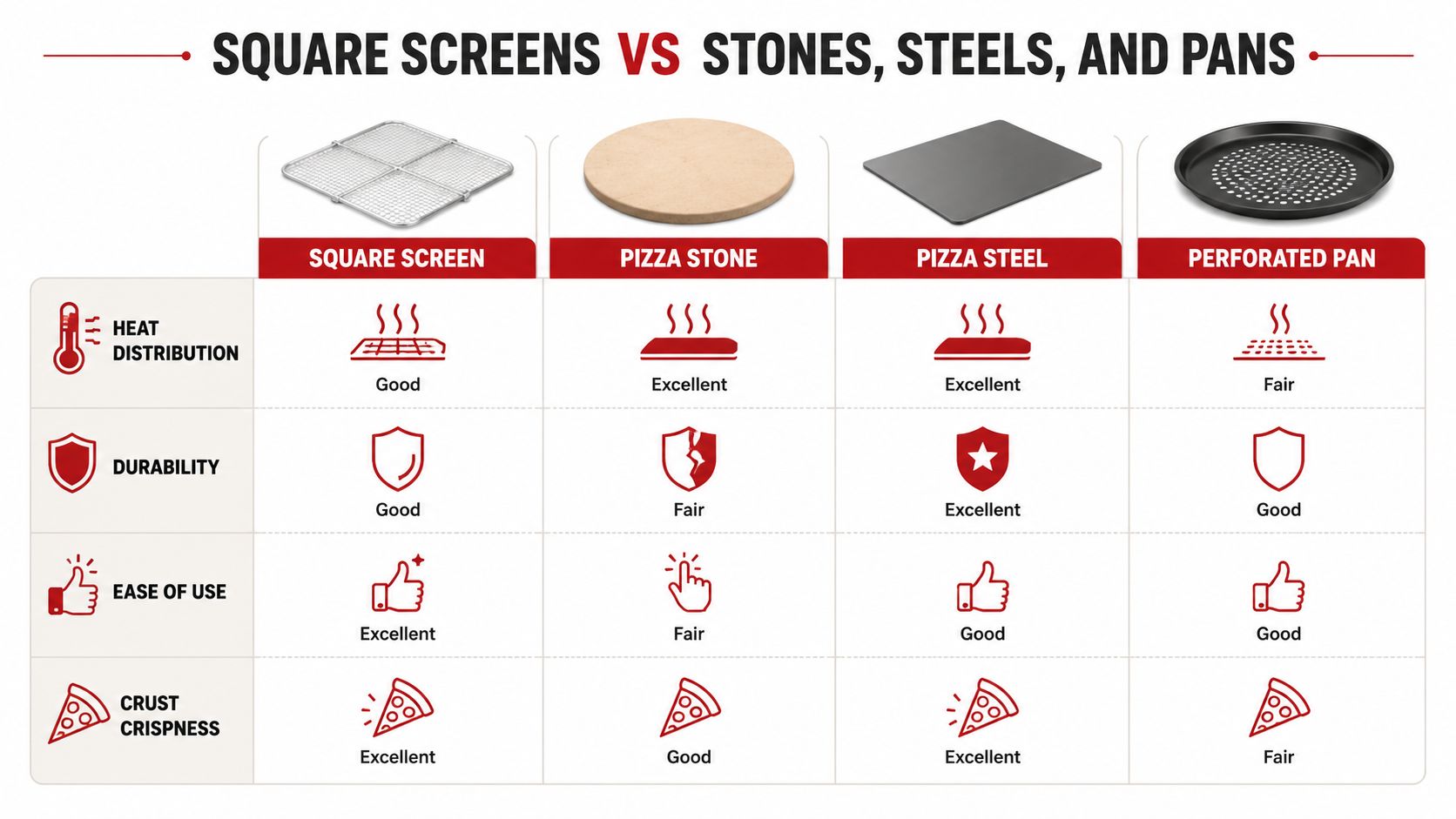
| Tool | Heat Retention | Bottom Browning | Handling | Best For |
|---|---|---|---|---|
| Square Pizza Screen | Low to moderate | Good with airflow, better when finished on a hotter surface | Excellent | Thin rectangular pies, easy launching, grill use |
| Pizza Stone | High | Strong | Fair | Crisp bottoms, steady oven baking |
| Pizza Steel | Very high | Excellent | Good | Fast browning, heavier heat transfer |
| Perforated Pan | Moderate | Fair to good | Good | Pan-style pizzas, supported dough |
Where each tool earns its keep
A stone brings thermal mass, so it resists temperature drop when dough lands on it. A steel pushes that even harder, which is why steels are prized for strong bottom browning. Screens don't compete on thermal mass. They compete on handling and airflow.
That matters because most home cooks aren't just trying to bake a pizza, they're trying to get it into the oven without tears, onto the grill without sagging, and back out without a disastrous fold. A screen is often the safest bridge between raw dough and heat.
If you want a deeper stone-versus-pan decision framework, this comparison from Hans Grill's pizza stone and pizza pan guide is useful as a companion read.
The honest trade-off
A square screen can be part of a great workflow, but it rarely needs to be the only tool. Many home cooks use the screen to launch the pizza, then let the pie finish on a stone or steel when they want more bottom color. That hybrid approach is where screens shine.
Bottom line: screens solve handling problems first, browning problems second.
If you're choosing one tool for one job, stones and steels are stronger finishers. If you're choosing the easiest path from dough to oven, the screen is hard to beat.
Using a Square Screen in the Oven and on the Grill
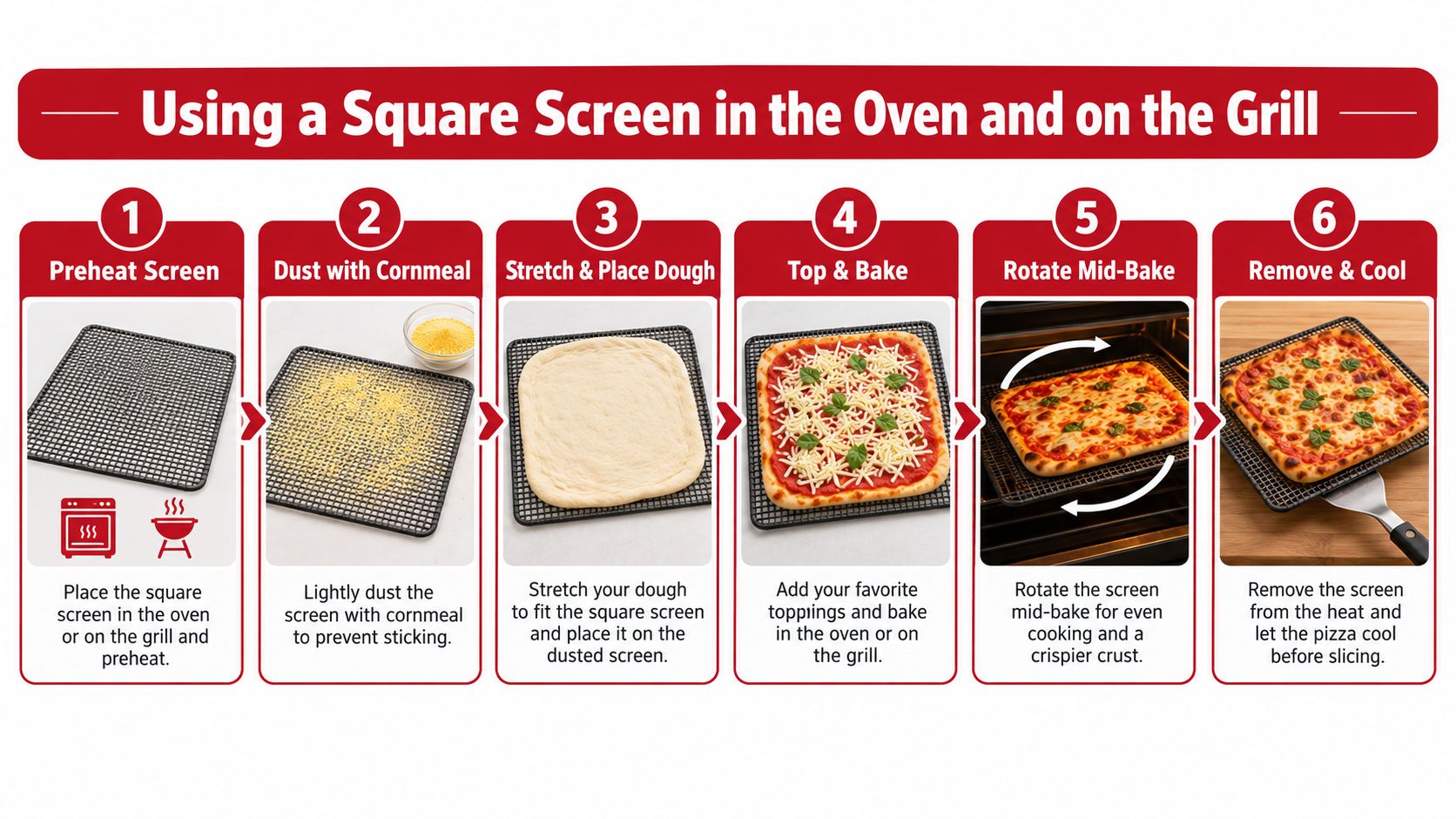
The easiest way to use a square screen is to think of it as a launch pad, not the final destination. Stretch the dough on the screen, top it, then use the screen to get the pizza into a hot oven or onto a grill without a complicated peel launch. For fragile dough, that's a big confidence boost.
In the home oven
Preheat the screen on a rack or on top of a stone if you have one. Dust it lightly with semolina or flour so the dough doesn't glue itself to the mesh. Then stretch the dough directly onto the screen instead of trying to transfer a fully topped pizza onto it.
If the crust looks pale on the bottom but the top is already set, slide the pizza off the screen onto a stone or steel for the final stretch of bake. That last move is where a lot of square pies get their best color. The screen got you there safely, the hotter surface finishes the job.
A typical home-oven workflow for a 12-inch square pie is straightforward, preheat fully, bake on the screen until the dough sets, then finish directly on stone or steel if you want more browning. That final move is often the difference between merely cooked and properly crisp.
On the grill
Grills reward a screen because launch and turn control matter even more outdoors. Preheat the screen over direct heat, then place the pizza on it and close the lid to manage flare-ups and keep the top cooking. Rotate the pie 90 degrees mid-bake if one side is coloring faster than the other.
For grill cooks, the screen also reduces the panic that comes with soft dough on a hot grate. If you've ever watched a corner slouch into the bars, you already know why that matters.
For a practical backyard workflow, this grill method pairs well with the approach described in pizza on a gas grill guidance, especially when you want control rather than a one-shot launch.
Cleaning, Care, and How Long They Last
A screen should behave like a real tool, not a disposable accessory. If you treat it well, it can stay flat, clean, and useful for a long time. If you abuse it, it'll warp, scratch, or lose its coating early.
The right cleanup habit
After baking, lift the screen, scrape off loose debris, and let it cool before washing. Coated aluminum needs a gentler touch than stainless, so skip harsh abrasives and don't soak it in anything aggressive. Stainless can take more punishment, but that doesn't mean it benefits from it.
The other myth to drop is seasoning. Screens do not need to be seasoned like cast iron or a steel baking surface. They're not asking for an oil polymer layer, they're asking for cleanliness and flat storage.
If you've ever cleaned a stone and wondered what's normal, this guide on how to wash pizza stones is a useful contrast. A screen is simpler, but it still rewards restraint.
How to store it
Store the screen so it keeps its shape. Hanging works well. Stacking is fine if you use spacers and avoid heavy weight pressing down on the rims. The biggest mistake is letting a pile of pans or trays slowly bend the frame over time.
Watch for early warning signs. Warping means the screen doesn't sit flat. Coating failure shows up as flaking or spots that no longer release dough cleanly. Those are signs to replace it before the tool becomes annoying.
A well-treated coated aluminum screen can last years of regular use. Stainless versions usually go even further if you keep them flat and avoid abuse. The screen is one of those tools that lasts longer when you handle it like it matters.
When a Square Screen Is Not the Right Tool
A square screen solves a narrow set of problems well, but it does not fit every pizza style. Thick Sicilian pies, focaccia-style bakes, and deep dish all need more support than a mesh surface can give. Those pies behave better in a pan or another solid baking vessel that can hold dough, toppings, and edge structure.
Styles that want something else
Neapolitan pies live in a different category. They depend on very high heat and a fast bake, so the screen is not the main tool for that job. Detroit-style pizza also relies on a different setup, with its square shape, crisped edges, cheese baked right to the rim, and sauce on top, as noted earlier. That style is built around the pan and the way the sides hold the dough.
A square screen makes the most sense for thin, snackable, party-cut, or tavern-style pizzas where easy handling and even airflow matter more than tall sides or a thick edge. In practice, it is a specialist tool. It helps with launch and browning on the underside, but it does not replace the structure a pan gives you.
The honest hierarchy
If your setup is still basic, buy the tool that fixes the biggest problem first. A dependable stone or steel gives you a strong baking surface and better bottom heat. A screen adds easier handling and a different bake path, but it usually works best as part of a system, not as the whole system.
That is the trade-off home bakers run into. A screen can help a good dough bake more evenly, but it will not rescue the wrong style of pizza. If the dough wants support, edge retention, or a contained bake, the screen is the wrong choice.
Buying the Right Square Screen for Your Setup
Start with four questions. Will you use it in an oven, on a grill, or both? What pizza size do you make? Do you want coated aluminum or stainless? And are you pairing it with a stone or steel for the finish?
- Choose for your heat source first. Oven and grill use stress different parts of the screen.
- Match the screen to the pizza shape. True square and rectangular pies deserve a matching surface.
- Pick the metal for your tolerance level. Lighter handling or longer wear, that's the trade-off.
- Decide whether you need a finisher. A stone or steel often gives the best final crust.
If you want a neat, high-function setup, look at a screen as one part of a broader kit, not a standalone miracle. A good stone or steel gives you the finish, a screen gives you the easier launch, and together they make home pizza night much less fussy.
If you're ready to build a setup that handles, browns, and bakes with less guesswork, take a look at Hans Grill. Their pizza tools are built for the same kind of home oven and backyard grill workflows covered here, so you can pair a square screen with a stone or steel and stop fighting your dough every Friday night.


