

What Are Baking Stones Made of? Materials Explained
Why do so many baking-stone guides tell you the material names, but skip the one thing that decides whether the stone works in your oven? The answer isn't just ceramic, cordierite, or steel, it's how each material handles thermal shock resistance, because that trait determines whether the stone keeps up with heat swings or cracks under them.
Table of Contents
- How a Baking Stone Actually Works
- The Most Common Baking Stone Materials
- Thermal Mass, Conduction, and Shock Resistance
- Stone vs Steel vs Natural Rock
- Food Safety and Marketing Claims to Watch For
- How to Choose the Right Stone for Your Setup
- Care, Cleaning, and Avoiding Thermal Shock
- Putting It All Together for Your First Bake
How a Baking Stone Actually Works
A baking stone is a heat bank, not a plate. That's the shift most first-time buyers miss, and it changes how you judge every material afterward.
When you slide a stone into a hot oven, it absorbs energy from the oven walls and air, then stores that energy until dough lands on top. The instant the dough touches the stone, the stone pushes heat back into the bottom of the dough, which helps set the crust and drive off moisture where you want the crispness to happen. That's the same reason a stone can help even out a home oven that browns one side faster than another, as King Arthur's oven-hot-spot test found when a stone reduced uneven browning in home ovens and worked better when fully preheated King Arthur Baking.
A pizza shop deck behaves differently from a home oven. A home oven cycles heat and moves it around with airflow, while a stone creates a more stable landing zone under the dough. The stone doesn't replace the oven, it buffers it.
A good stone doesn't just sit there and “hold pizza.” It changes the way the oven delivers heat to the dough.
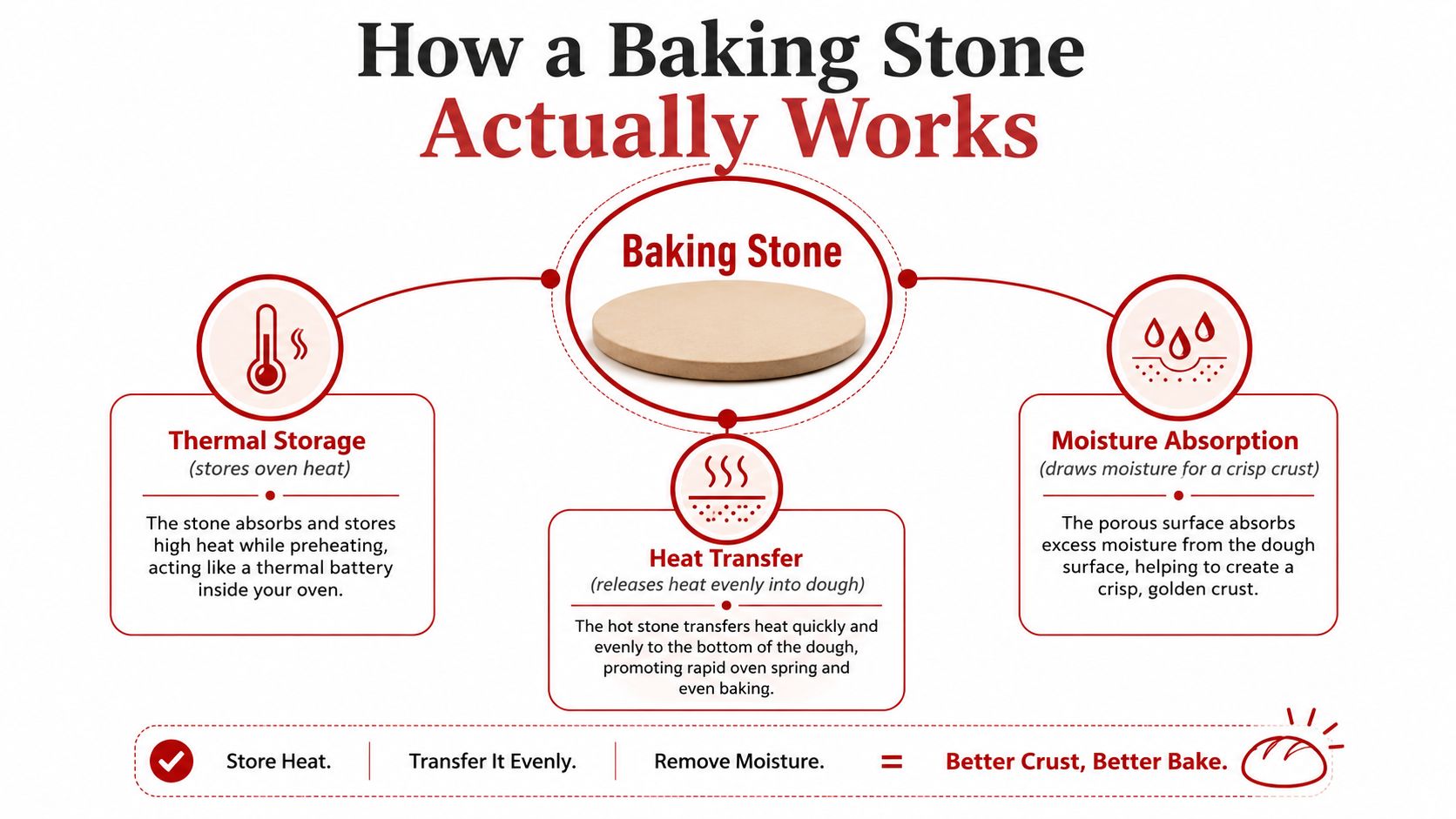
The practical lesson is simple. When you ask what are baking stones made of, you're really asking how much heat the surface can hold, how fast it gives that heat back, and whether it can survive the oven's swings without failing.
For a plain-language overview of why people use one in the first place, the guide at Hans Grill's pizza stone explainer is a useful companion read.
The Most Common Baking Stone Materials
What a baking stone is made from changes how it behaves in the oven. The material affects how much heat the stone stores, how evenly it gives that heat back, and how likely it is to crack if the oven temperature shifts quickly.
Cordierite
Cordierite is an engineered mineral material used widely in modern baking stones. Its main advantage is very low thermal expansion, so it can handle oven heat and cooling cycles with less risk of cracking Alibaba LifeTips. Serious Eats notes the same basic trade-off, cordierite is valued because it stays stable under fast heating and cooling and is less likely to crack or shatter Serious Eats.
For a home baker, that usually means a friendlier stone. It is still a mineral surface, so it needs preheating and careful handling, but it gives you more room for error than a brittle material would.
Ceramic and Fireclay
Ceramic and fireclay stones are the terracotta-style stones many home cooks picture first. They are common because they feel familiar, they are usually approachable, and they can bake evenly when you treat them with steady heat instead of sudden changes.
Their strength is everyday usability. They are not the toughest choice, but they make sense for general home baking if you want a stone that is easy to live with and you are willing to avoid thermal shock by preheating and cooling it patiently.
Soapstone and Other Natural Rocks
Soapstone and similar natural-stone products appeal to people who want a dense, heavy cooking surface. Their big trait is high thermal mass, so they can hold a lot of heat once they are warmed through.
That strength also creates the trade-off. Natural rocks vary a lot, and the label by itself does not tell you how the slab was finished, how consistent the material is, or whether it was intended for repeated food contact. A heavy stone can be useful, but only if the material is suited to the oven swings it will face.
Composites and Engineered Boards
Composite stones mix minerals with binders so manufacturers can keep the material more consistent from piece to piece. Bakerpedia describes older baking stones as having been mass-produced from transite, a hydraulically pressed cement-asbestos board, from the 1940s until 1985, then shifting toward ceramic, calcium-silicate, and other mineral-based composites after asbestos was banned Bakerpedia.
That history matters because it shows why newer boards are designed the way they are. Modern engineered surfaces are meant to give predictable heat behavior without the hazards tied to legacy materials, which makes them a practical option for buyers who want consistency more than tradition.
| Common Baking Stone Materials at a Glance | What it is | Defining property | Best fit |
|---|---|---|---|
| Cordierite | Engineered mineral baking surface | Thermal shock resistance | Hot ovens, grills, and beginners who want a forgiving stone |
| Ceramic and fireclay | Fired clay baking surface | Even baking, familiar feel | General home use and lighter budgets |
| Soapstone and other natural rocks | Dense natural mineral slab | High thermal mass | Specialty setups where weight and heat retention matter |
| Composites and engineered boards | Mineral mix with binders | Consistency at scale | Buyers who want predictable manufacturing |
Thermal Mass, Conduction, and Shock Resistance
The easiest way to understand a baking stone is to separate three properties that often get blended together. Thermal mass is the amount of heat the stone can hold. Thermal conductivity is how quickly that heat moves through the material. Thermal shock resistance is how well the stone handles sudden temperature changes without cracking.
Why one property matters most
For baking stones, thermal shock resistance usually deserves the most attention. A stone can hold a lot of heat and still fail if it cracks the first time you move it from a cool counter into a hot oven. A stone that survives the temperature swings but bakes unevenly is still disappointing, just in a different way.
The sponge-and-pan comparison helps here. A sponge soaks up heat and gives it back more gradually, while a metal pan heats quickly and passes heat along quickly. A 1-inch cordierite stone sits closer to the sponge side of that comparison, while a steel plate behaves more like the metal side. If you want a broader look at how that difference plays out in the oven, Hans Grill's baking steel guide is a useful companion piece.
That difference is why material choice changes pizza results so much. A stone with good shock resistance can handle repeated heating and cooling without failing, which matters more than sounding dense or premium. Thickness matters too, because a thicker slab usually takes longer to heat all the way through, and that changes how the bottom crust bakes.
If a stone cracks, the problem is usually not “stone quality” in the abstract. The real issue is whether the material can handle the oven's swings.
What that means in real baking
Cordierite earns its reputation because it is more heat-stable and less likely to crack or shatter during rapid heating and cooling. That matters most in a home oven, where the heat cycles on and off and the stone goes through repeated expansion and contraction. Ordinary ceramic can still bake well, but it tends to give up sooner when the oven is pushed hard or the cook is rushed.
Thermal mass and conductivity still matter, but they work best after shock resistance is solved. A stone that stores heat well, moves it through the surface at a steady rate, and survives repeated temperature swings gives you a more predictable bake. Once you see that sequence clearly, the choice becomes less about marketing language and more about matching the material to your oven, your pace, and how much handling the stone will need to endure.
Stone vs Steel vs Natural Rock
Shoppers usually end up choosing among three practical routes, a traditional stone, a steel plate, or a natural-rock slab. The right answer depends on how hot your oven runs, how fast you bake, and how much weight you want to live with every week.
Traditional stones
Cordierite and ceramic stones are the all-rounders. They're made to sit in a regular oven, preheat with it, and help the bottom crust brown more evenly. Cordierite earns the edge because it handles the repeated temperature swings of a typical home oven better than ordinary ceramic.
Baking steel
Steel behaves differently from stone because it moves heat faster. That's why it's popular for very hot, fast bakes. In the earlier comparison, the steel behaves more like the metal pan in the analogy, quick to heat, quick to transfer, and less forgiving if you need gentle buffering instead of aggressive bottom heat. For readers comparing tools, Hans Grill's baking steel guide fits naturally beside a stone decision.
Natural rock
Soapstone, marble, granite, and similar materials get marketed as “natural stone,” but that label can hide a lot. Some products are true rock slabs, others are fired clay or cordierite sold under mineral-sounding names. Independent coverage notes that many consumer pages blur those distinctions and don't clearly explain food safety or certification context OreateAI.
| Option | Strength | Trade-off | Best fit |
|---|---|---|---|
| Cordierite stone | Forgiving, stable, versatile | Not as fast as steel | Most home ovens |
| Ceramic stone | Familiar and widely available | Less tolerant of abuse | Light home baking |
| Baking steel | Fast heat transfer | Can be less forgiving | Very hot, quick pizza bakes |
| Natural rock | Dense and heat-holding | Variable composition | Specialty setups, careful buyers |
If you've ever wondered why one pizza bottom blisters fast while another stays pale, this is usually where the answer lives. The surface is not just a landing pad, it's a heat-transfer choice.
Food Safety and Marketing Claims to Watch For
The safest stone is usually the one whose material is clearly identified. That sounds basic, but plenty of listings lean on vague words like “natural,” “artisan,” or “restaurant-quality” without saying what the stone is.
The most useful shopping habit is also the simplest. Check whether the maker states the composition, check for a food-contact statement, and be cautious when the product page never says what the slab is made from. A stone can be inert in use and still be poorly described in marketing.
There's also a difference between food-safe, food-grade, and “seems fine for baking.” Those phrases don't always mean the same thing across countries or product categories. Reputable stones are usually built for repeated high-heat use, but they're not all documented the same way.
A few red flags are easy to spot. Glazed stoneware can raise questions if the glaze chemistry isn't disclosed, some soft natural stones can absorb moisture, and unbranded composites may hide unknown binders. None of that means every unlabeled product is dangerous, but it does mean the burden shifts to the buyer.
If a listing won't tell you the material, treat that silence as information.
A good quick check is to ask three questions. What is it made of? Is it intended for food contact? Does the maker explain care and temperature use clearly? If the answer to any of those is fuzzy, keep looking.
How to Choose the Right Stone for Your Setup
Choosing a baking stone is mostly about fit. The same slab can feel forgiving in one oven and frustrating in another, so the better question is not which material sounds impressive, but which one matches your heat source, your baking habits, and how much room you want for error.
Match the material to the oven
A home oven usually gives cordierite the easiest path for first-time use because it handles temperature changes well and gives you a steady baking surface. If your oven has a pizza setting or tends to run very hot, a thinner cordierite stone or a steel plate can both make sense. The choice depends on whether you want a little more forgiveness or a faster, more aggressive burst of heat from below. On a backyard grill or BBQ, thicker cordierite or steel often fits better because radiant heat is intense and the setup rewards materials that can take repeated stress.
The key idea is thermal shock resistance. A stone that tolerates sudden changes in temperature is less likely to crack when your oven cycle is less than gentle. That matters more than a glossy product description, because the best-looking material is not always the one that survives your actual kitchen routine.
Match the thickness to your patience
Thickness changes how a stone behaves before and after the dough hits it. A thicker stone usually needs a longer preheat, but it also stores more heat and keeps the bottom of the bake steadier once the oven door opens. A thinner stone heats faster, which can be convenient, but it also leaves less cushion if your oven temperature swings.
Ceramic can still work, and many home bakers use it without trouble. It just gives you less margin for rough handling and sudden heat changes, so it asks for a more careful routine. Cordierite earns its reputation because it is more forgiving when the heat cycle is imperfect.
A simple buying path
- Standard oven: Start with cordierite.
- Hot pizza oven or grill: Consider cordierite or steel, depending on how fast you want the bottom to brown.
- New to stone baking: Choose the most forgiving material, not the most dramatic-looking one.
- Shopping for a specific product: Hans Grill's rectangular cordierite stone and Pizza Stone PRO XL Set are examples of cordierite tools built around that material choice rather than around a marketing story.

If you want one practical default, choose cordierite for a first stone. It gives most home cooks a good balance of heat behavior, durability, and tolerance for ordinary mistakes, which is exactly what a first baking stone should do. For basic care guidance, Hans Grill's cleaning guide follows the same simple logic.
Care, Cleaning, and Avoiding Thermal Shock
Most cracked-stone stories come from one thing, not abuse in the dramatic sense, but small habits that stress the material. If you respect the heat cycle, the stone usually lasts much longer.
Before and during use
Start with a clean, fully dry stone. Put it into a cold oven, then preheat the oven with the stone inside. That slower ramp gives the material time to expand without a sudden jolt.
Don't season a baking stone like cast iron. Stones are not pans, and oiling them can create smoke, odors, and sticky residue without making the surface perform better. If you've heard “season it once and it'll get better,” that advice belongs to different cookware.
The safest routine is boring on purpose, dry stone, slow preheat, no surprise temperature shocks.
After use
Let the stone cool completely before moving it. Scrape off stuck food, wipe it with a damp cloth if needed, and air-dry it before storage. If a stain remains, that's usually cosmetic rather than a problem.
The biggest mistake is forcing the cooling or cleaning step. No dishwasher, no soak, and no plunge into cold water after a hot bake. If you want a concise care reference, Hans Grill's cleaning guide matches the same basic logic.
Three rules that save stones
- Never put a hot stone on a cold counter or sink surface.
- Never add cold water or ice to a hot stone.
- Never move a stone straight from freezer to oven.
Follow those, and you avoid most thermal-shock cracking before it starts. The stone doesn't need pampering, it needs consistency.
Putting It All Together for Your First Bake
A mid-range home oven, no pizza mode, and a Friday night pizza goal are enough to make the choice clear. In that setup, cordierite usually makes the most sense because it tolerates oven swings well and gives you a dependable surface without demanding perfect technique.
You don't need to chase the most exotic material. You need a stone that fits your oven's heat pattern, your patience for preheating, and your comfort level with handling hot cookware. If the oven is ordinary, a forgiving stone beats a finicky one.
A good first bake looks simple. Put the stone in a cold oven, preheat it fully, skip seasoning, launch the dough onto a dry surface, and let the material do its job. That sequence matters more than branding.
The deeper lesson is that material choice is really a heat-physics preference. Once you understand why thermal shock resistance matters, the rest of the decision stops feeling mysterious.
If you want a stone that's built around cordierite performance and straightforward home use, take a look at Hans Grill. Their pizza tools are aimed at the same home-oven problems covered here, and they're a practical place to compare a cordierite stone, a steel option, and other pizza-night gear before your next bake.


