

Cordierite Pizza Stone Cleaning: Safe Steps and Fixes
Scrub it until it looks new again. That's the most popular advice for cordierite pizza stone cleaning, and I'd ignore most of it. A working stone isn't supposed to stay pale. Dark patches from oil, cheese, and flour bake into the pores, and chasing them with soap, soaking water, and stiff metal brushes does more damage than the marks ever will.
The risks are quieter. Cold water on a hot stone, detergent trapped in porous ceramic, and moisture that never fully dries can crack the stone or flavor your next pizza. Clean off what's raised and loose. Leave what's flat and baked in. That shift in goal, from cosmetic to functional, will keep your stone cooking well for years.
Table of Contents
- Cleaning Method for Every Type of Residue
- Why Thermal Shock Decides Every Cleaning Choice
- How to Clean Your Stone Step by Step
- Cleaning Mistakes That Damage Cordierite
- Storing Your Stone Between Bakes
- Telling a Harmless Mark From a Real Crack
- Start Your Stone Routine This Week
Cleaning Method for Every Type of Residue
Start with the residue in front of you, not with a generic scrub.
| Residue | Safe method | Tool | When to use |
|---|---|---|---|
| Loose crumbs and cheese flecks | Dry brush the surface | Stiff dry brush | After every bake, once cool |
| Sauce or oil spots | Wipe with a lightly damp cloth, then dry fully | Lint-free cloth | After cooling, when the spot is visible |
| Baked-on cheese or burnt dough | Scrape gently, repeat over several bakes | Plastic scraper | When residue will not brush off |
| Dark brown or gray discoloration | Leave it alone; it is normal from heat | None | Never scrub |
| Lingering odor | Dry-heat burn-off in an empty oven, preheated from cold | Oven | Only when a smell persists |
Why these methods stay conservative
Cordierite wasn't invented for pizza. Corning's overview of cordierite notes the mineral was discovered more than two centuries ago, cordierite ceramics have been used for more than 100 years, and Corning developed a synthetic formulation in the 1970s for catalytic-converter substrates linked to the U.S. Clean Air Act of 1970. It's a technical ceramic chosen for low expansion and thermal-shock resistance, with typical expansion values around 1–4 × 10⁻⁶ °C⁻¹ depending on composition, porosity, and secondary phases.
That history explains the table. You remove food after cooling with a scraper or dry brush, use water sparingly, and keep detergent out because porous ceramic can retain residues and odors. A dishwasher is out for the same reason. Choosing the right brush matters here, and this guide to a pizza stone cleaning brush covers the tool side in detail.
The residue people mishandle most
It's the dark brown or gray discoloration. Bakers see a shadow where cheese landed three pizzas ago and treat it like contamination. They soak, scour, and grind at a flat mark that isn't food anymore, it's color baked into the surface. That effort adds water and abrasion without improving the next bake. If your fingertip glides over it and nothing lifts, you're done.
Baked-on cheese is the second trap. Hold a plastic scraper flat, work with short strokes, and accept partial progress. A stubborn patch that loses a little height after each bake is better than a gouged surface from one forced session. Sauce and oil spots need only a cloth that's barely damp, followed by enough air time that the spot no longer looks darker from moisture.
Use the burn-off row sparingly. Put the stone in an empty, cold oven, heat them together, and let dry heat carbonize what's causing a persistent smell. Don't run it because the stone looks used. Run it because it smells off when warm.
If it's flat, dark, and smooth, it isn't dirty. It's seasoned.
You'll know the method worked when three things check out. The surface feels smooth under your palm, no food sticks to the scraper on a final pass, and the stone is completely dry before its next heat. That's a clean stone, even if it no longer looks new.
Why Thermal Shock Decides Every Cleaning Choice
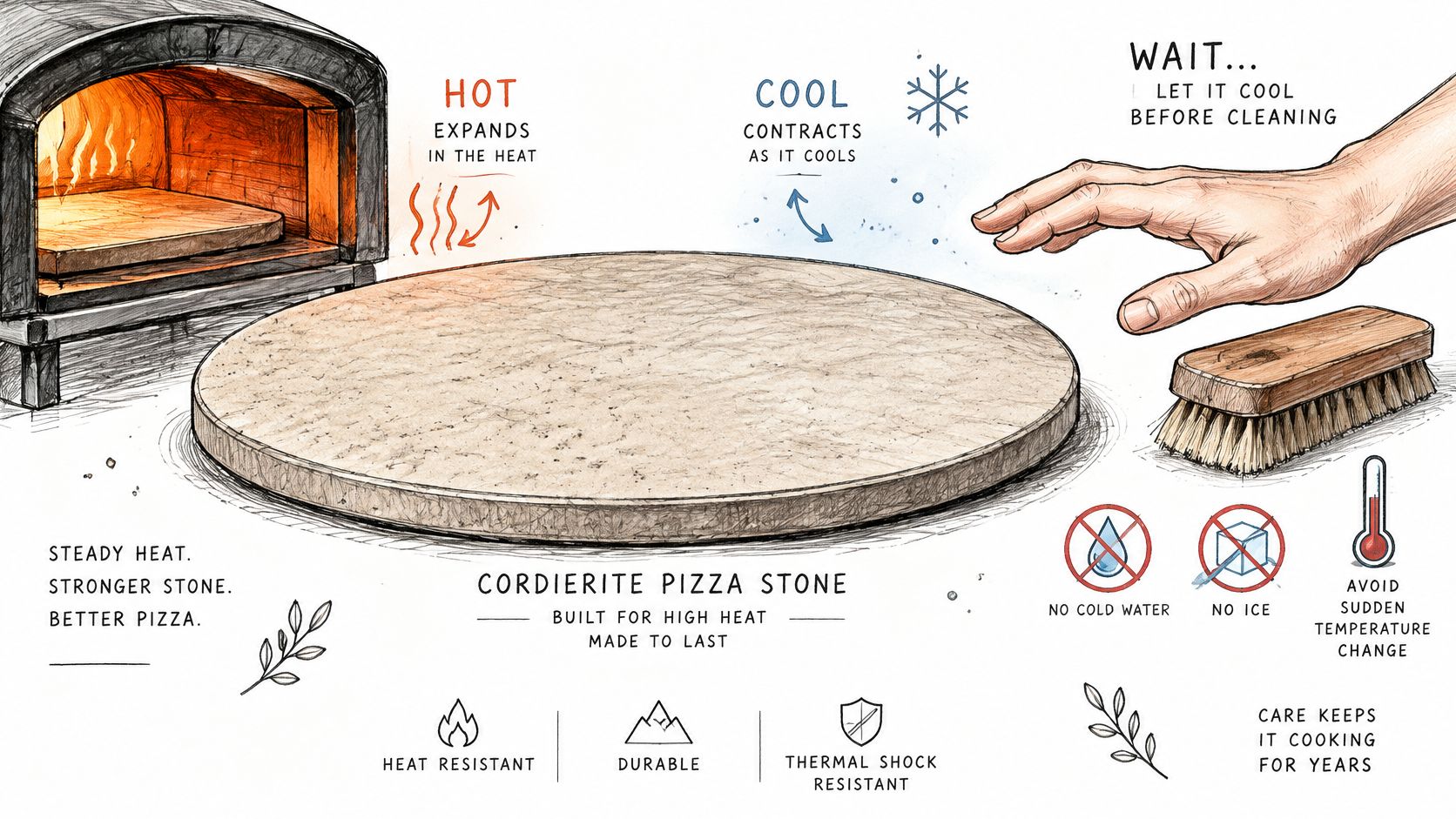
Every cleaning rule for cordierite traces back to one property. The material changes dimension very little as temperature rises or falls. Research on cordierite-based ceramics in PMC reports measured expansion coefficients from 6.2161 × 10⁻⁶ to 2.6181 × 10⁻⁶ °C⁻¹ across 20–700 °C, with expansion generally decreasing as cordierite content increases, and commonly cited material data puts the coefficient at approximately 2.5 × 10⁻⁶ per °C.
Low expansion is why the stone survives repeated high-heat cycles that would stress ordinary ceramic. It is not immunity.
How a crack actually starts
A crack starts with uneven temperature, not high temperature alone. Cold water hits one area of a hot stone and that area contracts while the rest stays expanded. A hot stone set on a cold stone counter does the same thing from below. The body can't flex, so stress concentrates until something gives.
Thickness, porosity, and manufacturing composition change how much stress a given stone tolerates. Two stones of the same size can react differently to the same shortcut, which is why one baker rinses a warm stone for years and another hears a ping on the first try. You can't see that margin from the outside, so don't test it. This background on cordierite pizza stone material helps explain why makers build with it despite that care requirement.
The one cooling rule
Wait until the stone is fully at room temperature before any water touches it. After a high-heat bake that often means several hours, not the time it takes to eat. If the underside still feels warm against your palm, it's not ready for a damp cloth. Leave it in the switched-off oven or on a heat-safe rack and walk away.
Heating carries the same logic in reverse. The cordierite stone should always be placed in a cold oven and heated with the oven, and never put in a hot oven when cold. A cold stone lowered into a fully preheated oven takes a sudden jump across its surface, exactly the gradient you're trying to avoid.
Practical rule: Gradual in both directions. Heat together, cool completely, then clean.
So the cleaning order writes itself. Dry scraping first, because it adds no temperature change and no moisture. Damp cloth second, only on a cool stone and only where needed. No immersion at any stage, because soaking loads the pores with water that will turn to steam and stress the body on the next heat.
How to Clean Your Stone Step by Step
This routine assumes one thing before step one. The stone has finished its bake and you haven't touched it yet.
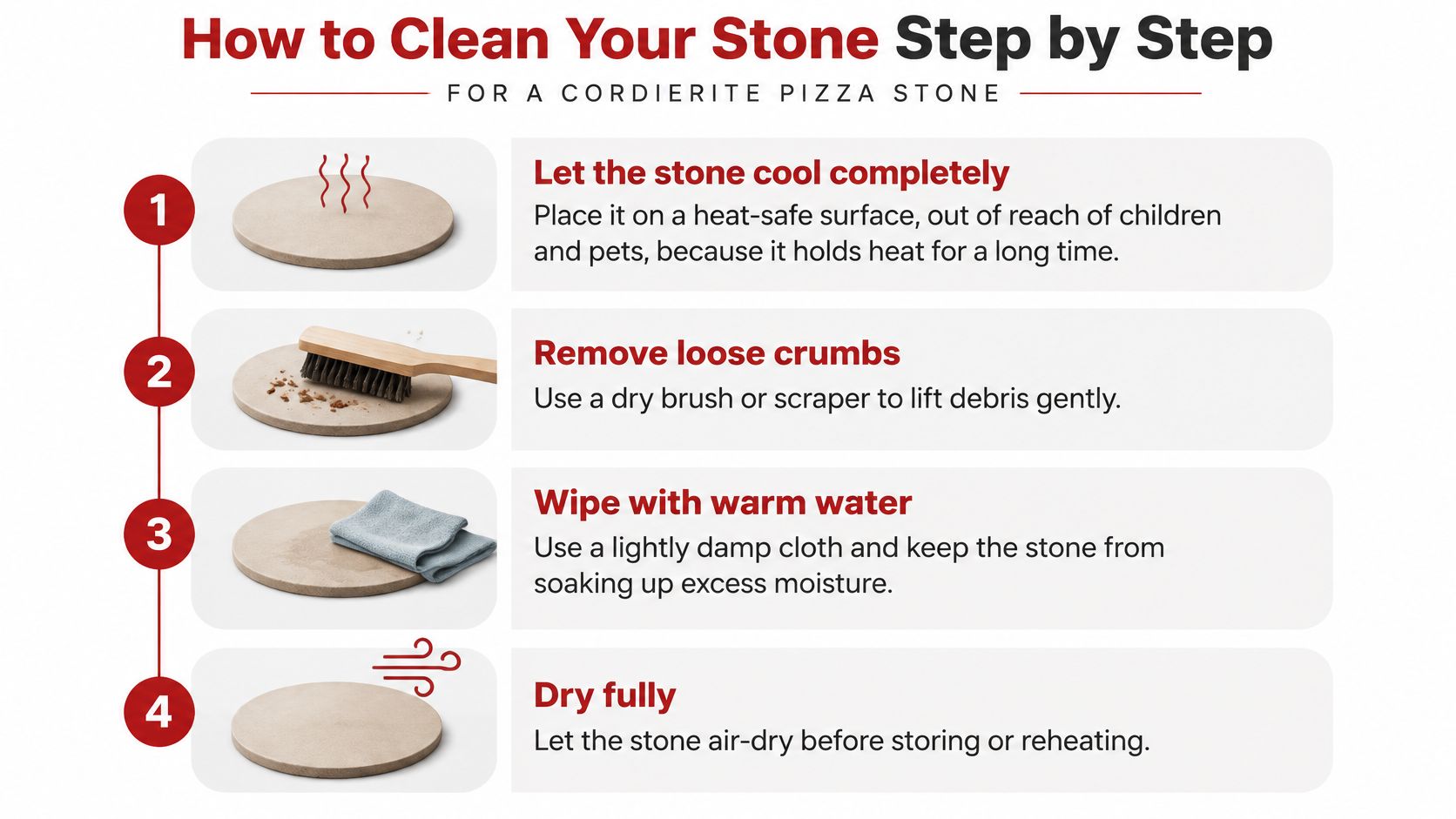
- Let the stone cool completely. Leave it on a heat-safe surface or in the switched-off oven until it reaches room temperature. Pizza stones, steels, and ovenware get extremely hot in use and retain heat for a long time, so use appropriate protection when handling them and keep hot equipment away from children and pets. Cooling fully avoids the thermal stress that starts cracks.
- Brush off loose crumbs. Use a dry brush and sweep toward a bin or tray held at the edge. Work the front lip and corners where flour collects. Dry brushing keeps water out of the pores, so it's always your first pass.
- Scrape stuck food. Hold a plastic scraper low and flat so the edge slides under residue instead of digging in. Match your effort to the residue table. Raised cheese gets scraping, flat color gets left alone.
- Wipe only if needed. Dampen a lint-free cloth, wring it until it's barely moist, and wipe the specific spot. Never use soap. The cordierite stone should never be cleaned with soap or put in the dishwasher, because the porous stone absorbs detergent and passes off-flavors to the next pizza.
Watch the sequence in motion before you try it on a stone that's still holding heat.
- Dry the surface, then air-dry. Pat with a clean towel, then stand the stone where air moves around it until no moisture remains. Surface dryness comes first and lies to you. Pores dry slower, and trapped moisture is what causes odor during storage.
- Check for damp patches. Look for areas that appear darker than the surrounding stone and feel cooler to the touch. If you find one, give it more time. Don't use oven heat to rush a stone you just wiped, since that's another fast temperature change.
What a finished stone looks like
Don't judge by color uniformity. A clean stone can carry dark blotches and still be ready. Judge by touch and smell instead.
- Even feel: Your palm crosses the surface without catching on grit or raised edges.
- No sticky patches: A dry fingertip doesn't drag anywhere.
- No loose debris: A final brush pass sweeps almost nothing into the tray.
- No smell when it warms: The next preheat smells like a hot oven, not old cheese or soap.
If one check fails, fix only that problem. Grit means brush again. Stickiness means scrape, not soak. A soapy or musty smell on warmup means the stone needed more drying time, or detergent got in at some point and will need several plain bakes to fade. I'd rather repeat a gentle step than escalate to a harsh one, because cordierite pizza stone cleaning rewards patience and punishes force almost every time.
Handle the stone with oven mitts whenever there's any doubt about temperature, and lift it with two hands supporting the underside. Most chips happen during cleaning, not baking, when a heavy stone gets carried one-handed to the sink. Keep it on the counter where you brushed it, and let the tools come to the stone.
Cleaning Mistakes That Damage Cordierite
The mistake I hear about most isn't exotic. Someone finishes pizza night, wants the kitchen done, and rinses a hot stone under the tap to speed things up. Sometimes it survives. Sometimes it cracks with a sound like ice on a lake. Patience beats speed here because you can't undo a thermal fracture, and the stone would have cleaned just as well two hours later with a dry brush.
| Habit | What it does to the stone | Safer swap |
|---|---|---|
| Washing with dish soap | Porous ceramic absorbs detergent and flavors later pizzas | Scrape, then wipe with a damp cloth |
| Running it through a dishwasher | Heat cycling and harsh detergent stress the body | Hand-clean after cooling |
| Soaking in water | Water is absorbed, prolonging drying and weakening the body | Brief damp-cloth wipe |
| Scrubbing with steel wool or wire brush | Scratches the surface and leaves metal fragments | Plastic scraper or dry brush |
| Using scouring powder | Abrasive particles lodge in the pores | Dry scrape, then lightly damp cloth |
Why soap is worse than it looks
Soap doesn't rinse off cordierite the way it rinses off a plate. The pores that pull moisture from dough also pull in detergent solution, and heat drives it back out into food later. Your next crust picks up a faint chemical note that no amount of topping hides. Worse, you can't wash the soap out with more water. That just pushes it deeper and extends drying.
The dishwasher compounds the problem. You get detergent saturation, prolonged water exposure, knocks from racks and other items, and temperature swings in one cycle. It's four risks stacked for zero benefit over three minutes of hand work.
Abrasives create tomorrow's sticking
Steel wool and wire brushes feel efficient because they remove material fast. Part of that material is your stone. Scratches and gouges give the next round of cheese and sauce more edges to grip, so each aggressive cleaning makes the next one harder. Metal fragments can also lodge in the pores where you can't brush them out.
Scouring powders work the same way at a smaller scale. The particles pack into the porous surface and stay there. You've traded a visible stain for invisible grit in your cooking surface.
Every shortcut on this list trades a few saved minutes for damage you can't reverse.
Underneath all five habits sits one assumption worth dropping. The darkening people try hardest to scrub away is harmless. Scrubbing is the habit that causes the most unnecessary damage precisely because the target never needed removing. Remove what's raised. Keep water brief. Let the color be.
Storing Your Stone Between Bakes
Storage failures are slow. A stone put away slightly damp doesn't crack that night. It develops a musty odor over two weeks, or picks up moisture in a cold garage where freeze-thaw cycles work water in the pores back and forth until the body weakens. Store it only when it's fully dry and at room temperature.
Where it should live
Keep the stone flat on a shelf or rack with nothing heavy resting on it. A cast iron pan sitting on one corner concentrates load on an edge that was never meant to carry it, and edges are where chips start. If you must stack, the stone goes on top, not underneath.
Choose a dry, ventilated spot. A damp basement shelf feeds moisture back into the pores, and a sealed plastic bag is worse because it traps whatever humidity was present when you closed it. Air should move around the stone, even slowly.
Say you cook in a small apartment. A cabinet shelf away from the sink, with the stone flat and a folded towel beneath it, works well. It's dry, it isn't jostled daily, and you can lift it straight out with two hands. Contrast that with a backyard griller who keeps the stone in a covered, dry spot away from rain, brought inside during wet weeks rather than left in a closed grill where condensation forms overnight. Different kitchens, same principle. Dry air, flat support, no load on the edges.
If your stone lives in the oven
Plenty of bakers store the stone on the oven rack full time, and that can work. Two exceptions matter. Remove it before any self-clean cycle, since that extreme heat and cycle stress add risk without benefit. Take it out for cabinet storage during humid weather too, especially if your oven sits unused for weeks in summer.
Remember that pizza stones, steels, and ovenware get extremely hot in use and retain heat for a long time, so a stone stored in the oven is a burn waiting for whoever preheats without looking. Tell anyone else who uses your kitchen that it's in there.
Storage check: Lift the stone. No dampness, no odor, and an even surface under your hand means it's stored right.
Run that check whenever you take the stone out, not just after cleaning. It takes five seconds and catches a humidity problem before it becomes an odor you bake into dinner.
Telling a Harmless Mark From a Real Crack
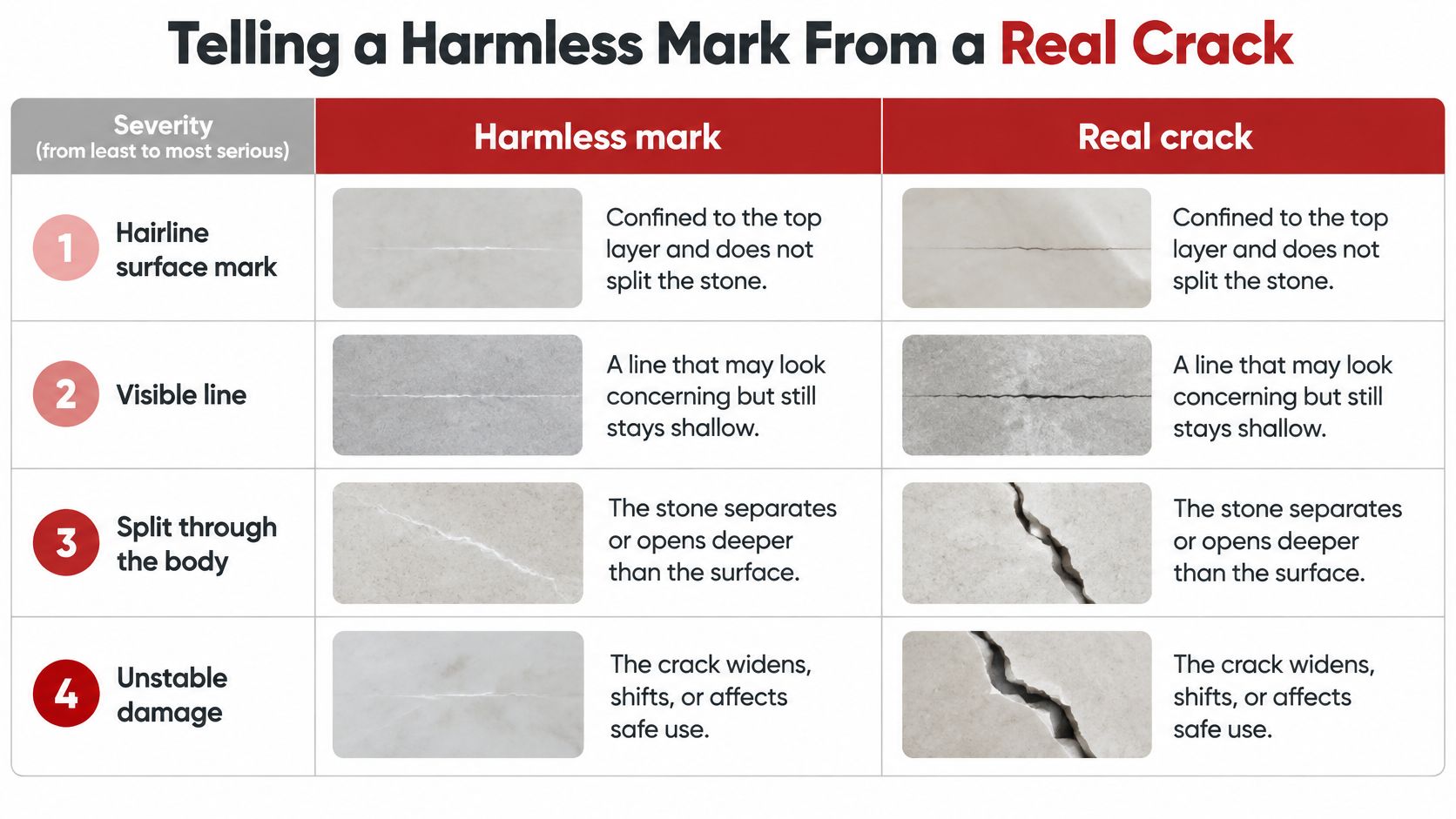
Not every line on a stone ends its life, and not every dark patch needs action. Sort what you see by severity first.
| Mark or crack | What it usually means | Action |
|---|---|---|
| Dark spots, uneven browning or smoky smell | Residue from heating | Leave alone and follow the residue table |
| Hairline crack in top layer only | Surface crack, stone intact | Keep using and monitor each bake |
| Crack that grows after a normal bake | Thermal shock or uneven heating | Stop, review cooling and preheating |
| Chunk flaking off cooking surface | Fragments can enter food | Stop using and replace |
| Crack running through full thickness | Structural split | Stop using and replace |
Run this checklist on your stone
- Inspect in good light after cooling. Window light at an angle reveals surface lines that overhead bulbs hide. Turn the stone over and check the underside too.
- Run a fingernail across the crack. If it glides over, you're likely looking at a surface mark. If it catches and drops in, the crack has depth.
- Judge depth with a thin probe. A toothpick or the corner of a plastic scraper tells you whether the line stays in the top layer or keeps going.
- Heat normally and watch. One regular bake, heated from cold, then inspect again after cooling. Measure the crack against a pencil mark at its tip if you want certainty.
- Decide. Shallow and stable means keep using and monitor. Growing, deep, or flaking means stop.
Dark spots, uneven browning, and a smoky smell usually belong to residue, not damage. Send those back to the cleaning routine. A hairline crack confined to the top layer that doesn't split the stone can usually stay in service, watched on every bake. The bright lines are a crack through the full thickness, a stone that's splitting, or a chunk flaking off the cooking surface, because fragments can end up in food. If you're working through a crack you've just found, this guide on why a pizza stone cracked walks through causes in more depth. Note that pizza stones that arrive cracked are always replaced free of charge, so inspect a new stone before its first bake.
A crack that grows after a normal bake is diagnostic. It signals thermal shock or uneven heating, so review your cooling and preheating habits before using the stone again. Continued growth after you've fixed those habits means the damage is structural, and no cleaning method will save it.
Start Your Stone Routine This Week
Dark blotches are normal. A stone does not need uniform color to be clean, so focus on residue you can feel, lingering odor, and changes in any existing crack. Set up a simple routine before your next pizza night, then repeat it after each bake.
Set up before pizza night
Keep the cleaning tools together near the oven so they are ready when the stone has cooled.
- Dry brush: Sweep away loose residue.
- Plastic scraper: Lift raised bits the brush leaves behind.
- Lint-free cloth: Use for an occasional barely damp wipe.
- Clean towel: Pat the stone dry, then let it air-dry fully.
Choose a dry, ventilated shelf or rack for storage. Keep the stone flat, away from the sink, and clear of heavy objects pressing on its edge. Having a spot ready avoids handling the stone while making room in a cabinet.
After your next bake, follow the same sequence: cool, brush, scrape, dry, store. Skip soap, soaking, and scrubbing at dark marks. The Rectangular Pizza Stone can be used in a kitchen oven and on a BBQ, costs $59.99, and Hans Grill's pizza peel and pizza stone set products come with a 1-year official warranty on all orders.
Check the stone at your next bake. Look for no grit under your palm, no sticky patches, no odor when it warms, and no crack that has grown since the last bake. Dark, uneven color alone is not a reason to scrub harder. If the surface feels clean and the crack has not changed, keep the routine steady.
If residue remains, review your cooling and drying timing before changing tools. Let the stone cool fully before cleaning, and make sure it is dry before storage. Timing matters more than forcing stubborn marks off the surface.
Before your next pizza night, put the cleaning kit and storage spot in place. That small preparation makes cordierite pizza stone cleaning a routine rather than a scramble.
Hans Grill sells cordierite pizza stones, peels, steels, and related accessories. If your stone is cracked or flaking and you need a replacement, visit Hans Grill to see options for an oven or BBQ.


