

Oven Pizza Steel Guide for Crisp, Fast Pizza
A common pizza-steel tip says the plate needs to get hotter than your oven setting. It doesn't. The steel's advantage is that it transfers heat quickly from its hot surface into the dough, not that it somehow exceeds the oven's temperature.
That distinction helps explain why a steel can brown a pizza base quickly, why thickness affects how well it handles another pizza, and why oven position can change your results. A crisp base depends on the whole setup: the steel's material and thickness, how thoroughly it's preheated, the pizza's size and toppings, and how heat moves around your oven.
Table of Contents
- Why an Oven Pizza Steel Changes the Bake
- How Pizza Steel Transfers Heat
- Pizza Steel Compared With Pizza Stone
- Choose the Right Pizza Steel Thickness
- Preheat and Bake With Confidence
- Choose the Right Oven or Grill Setup
- Clean and Maintain Pizza Steel Safely
- Make Your Final Pizza Steel Decision
Why an Oven Pizza Steel Changes the Bake
The top of your pizza can look finished while the underside stays pale. That mismatch is frustrating, but it doesn't mean your oven needs a hotter setting or that your baking surface must exceed the temperature shown on its display. It may mean the surface under the dough isn't transferring enough heat into the base while the toppings cook.
An oven pizza steel changes that contact. Once fully preheated, a dense metal plate can deliver heat into dough quickly, promoting faster base browning. The plate doesn't create extra heat. It changes how heat already stored in the oven and steel reaches the pizza.
Three ideas help make sense of the results:
- Surface temperature describes how hot the steel is at its surface.
- Heat-transfer rate describes how quickly heat moves from the steel into the dough.
- Stored heat describes how much energy the plate holds and can give up when a cool pizza lands on it.
Those ideas are related, but they aren't interchangeable. A steel can transfer heat rapidly yet cool noticeably when a pizza is loaded. A thicker plate stores more energy, which can help it resist that cooling, though it also needs more time and careful handling.
The aim isn't to buy the thickest plate or turn the oven as high as it goes. It's to find a steel that fits your oven and your baking habits, then give it enough time to heat through. A beginner making a single thin-crust pizza has different needs from someone baking several pizzas in succession.
Pay attention to where the pizza browns, how the top and base finish together, and whether the plate is ready for the next bake. Those observations are more useful than assuming a steel always works the same way in every oven.
How Pizza Steel Transfers Heat
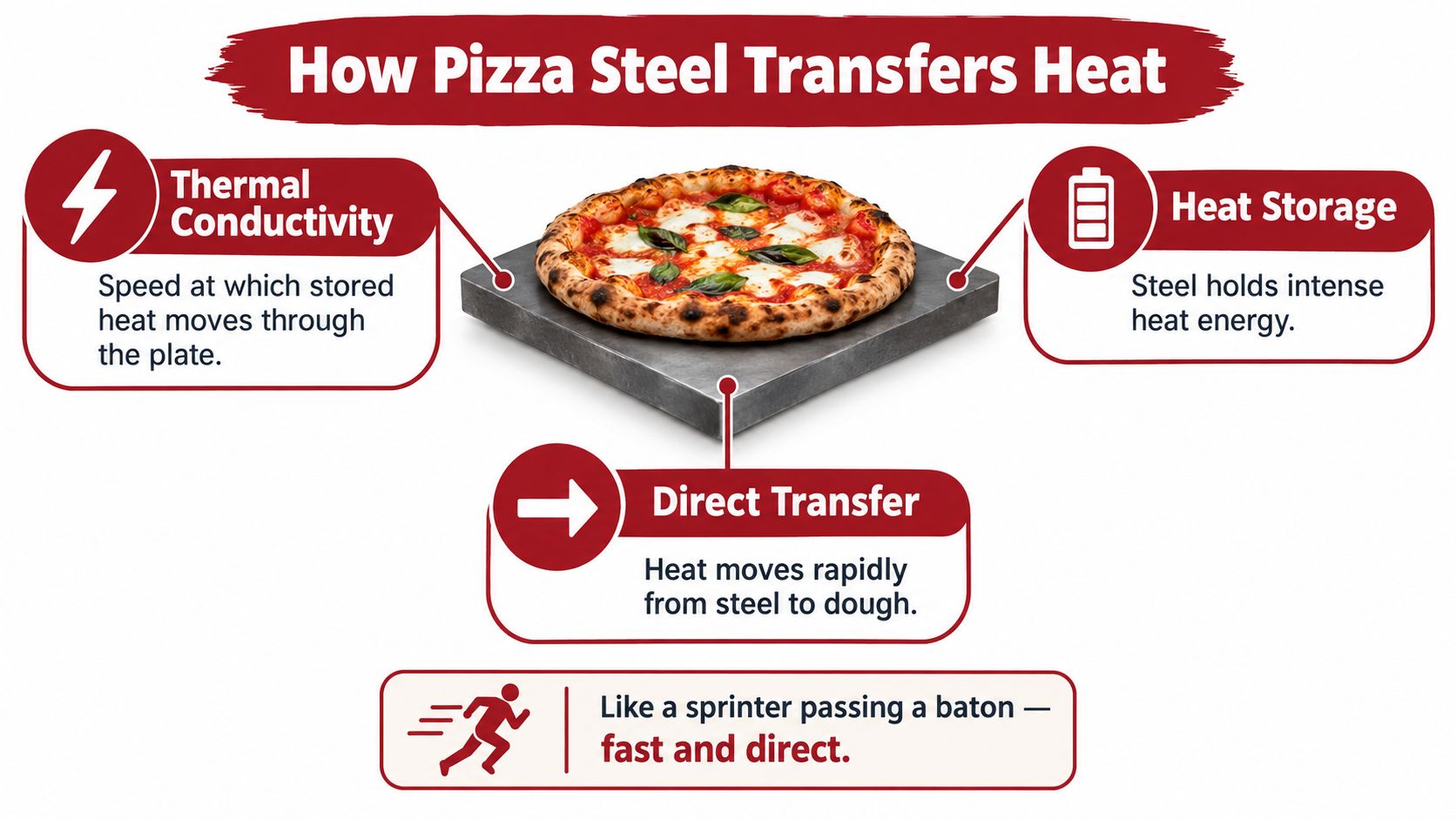
Think of a preheated oven as a battery and the steel as a conductor connected to it. The oven heats the plate; the plate holds some of that energy; then, when dough touches the surface, heat moves into the base. The battery analogy helps separate two jobs: how quickly the steel passes heat along, and how much energy it can keep available.
Thermal conductivity is a measure of how readily heat moves through a material. A plate with higher conductivity can spread and deliver heat more quickly, although its performance also depends on its alloy and temperature. Engineering data give a useful example: at 20°C, austenitic stainless steels have conductivity values of about 12–15 W/m·K, ferritic stainless steels are around 25 W/m·K, and carbon steel is approximately 53.3 W/m·K (engineering data on steel properties).
Thermal mass is the plate's capacity to store heat. Thickness contributes to that capacity: a thicker plate has more material to hold energy and can better resist rapid cooling when cool dough lands. In practice, conductivity helps determine the speed of transfer, while thickness helps determine how much stored heat is available to transfer. Neither quality, on its own, guarantees an evenly baked pizza.
Why contact and preheating matter
The pizza also needs close, broad contact with the plate. A thick steel won't fix a base that's unevenly stretched, loaded with excessive toppings, or poorly positioned over a hot spot. And if the plate hasn't heated through, its surface may be warm while the rest of the steel hasn't built up the stored energy needed for a steady bake.
Alloy properties change with temperature. A study of stainless steels assessed conductivity, specific heat, thermal expansion, thermal diffusivity, electrical resistivity, and emissivity, showing why one room-temperature specification can't describe every high-temperature behavior (study of stainless-steel thermophysical properties). For a home cook, the practical point is simple: a steel's material and its thickness both matter, and oven conditions influence how they perform together.
A fully preheated steel can brown a base quickly without becoming hotter than the oven setting. Its effect comes from direct, conductive heat transfer and stored energy, not from a higher temperature reading than the oven can provide.
Remember: Conductivity helps heat move. Thickness helps the plate hold heat. Good baking needs both in the right balance.
Pizza Steel Compared With Pizza Stone
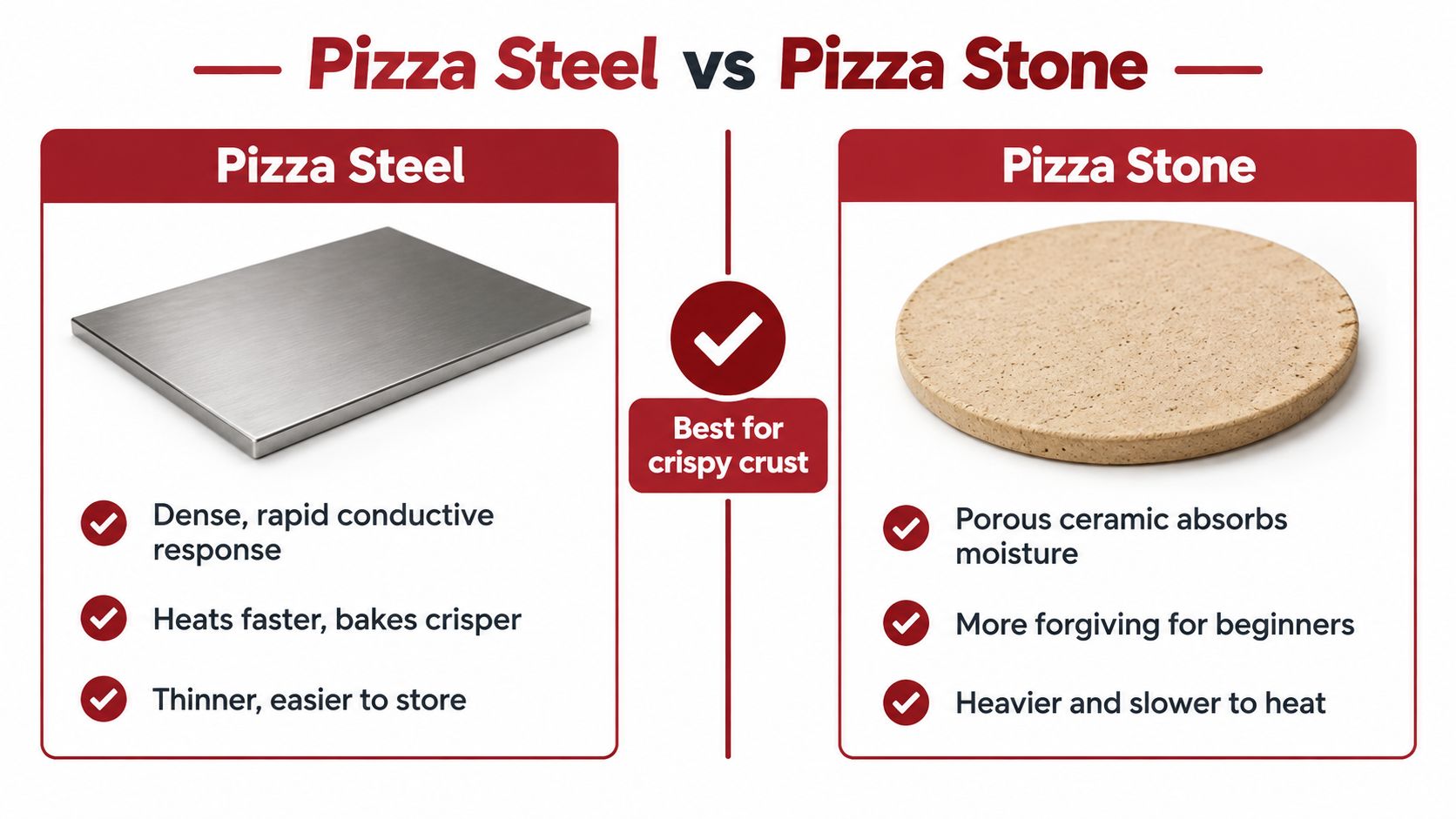
A pizza steel and a pizza stone both serve as preheated baking surfaces, but they don't transfer heat in quite the same way. Steel is dense metal, so it can move heat into dough rapidly. Stone is a porous ceramic surface whose baking behavior differs from that of metal. Neither is automatically the right choice for every kitchen or every pizza.
A steel may appeal if you want rapid browning beneath a thin crust and you're willing to manage a heavy, hot plate. That responsiveness can be a benefit, but it also makes timing important: if the base is already darkening while the toppings need more time, you may need to change the rack position or add top heat rather than keep baking as before. A stone can suit cooks who prefer a more familiar surface or don't want to handle a metal plate. Whichever you choose, the pizza can still brown unevenly if the surface isn't fully heated or the oven has strong hot spots.
| Consideration | Pizza Steel | Pizza Stone |
|---|---|---|
| Heat response | Conductive metal can deliver heat to dough quickly | Porous ceramic has a different, generally less-direct heat response |
| Surface character | Can brown a base rapidly; timing may need adjustment | A familiar baking surface for cooks who prefer stone |
| Heat retention | A thicker plate stores more energy but needs thorough preheating | Retains heat once heated; results depend on the stone and oven |
| Maintenance | Drying and rust prevention matter for uncoated steel | Avoiding damage from thermal changes and handling it carefully matter |
| Common results | Can suit cooks aiming for a crisp, quickly browned base | Can suit cooks who want a more forgiving-feeling surface |
Make the choice around your cooking habits
Consider how quickly you want heat to reach the base, how many pizzas you usually bake in a session, and whether lifting or storing a heavy plate will be a nuisance. Steel is worth considering if rapid base browning is a priority and you're comfortable making small adjustments to baking time and position. A stone may fit better if ease of handling matters more to you than metal's conductive response.
For a closer side-by-side discussion of how each surface may suit different cooks, see this pizza steel versus stone comparison. Treat the choice as a matter of fit, not a contest with one universal winner.
Choose the Right Pizza Steel Thickness
Thickness is a practical trade-off, not a ranking where the thickest plate wins. A thinner steel holds less stored heat, but it may be easier to lift, fit on a rack, and preheat for an occasional pizza. A thicker plate holds more energy and can resist cooling as dough is loaded, making that extra mass more relevant when you bake several pizzas in a row.
The basic material principle is well supported, but the right thickness for a particular cook isn't universal. Research on carbon grades found that conductivity can fall from approximately 72.8 W/(m·K) at 30°C to 34.6 W/(m·K) at 500°C for one structural grade. The same research notes that higher carbon content generally reduces conductivity, while thicker plates hold more heat and resist rapid cooling (carbon-steel conductivity research). Those findings explain why steel specifications matter; they don't prescribe a single ideal thickness for every oven.
A simple decision framework can help:
- For occasional single pizzas, favor a plate you can move and store comfortably. A thinner option may suit this pattern if you can preheat it fully and don't need it to recover quickly for another bake.
- For repeated pizzas, consider whether more stored heat would help maintain a more consistent base bake as you load another pizza. More thickness also means more weight and preheating commitment.
- For a small oven, measure the rack space and check the plate's footprint against the oven walls and heating elements before choosing. A plate that's awkward to position isn't a practical upgrade.
- For a grill, consider stable placement, clearance, and how you'll lift or handle the hot plate. A plate that fits in an oven may not suit your grill setup.
Advice that contrasts a 6 mm steel with a 10 mm plate is sometimes offered as a starting point, but those comparisons are anecdotal rather than a universal rule. Oven design, pizza size, batch schedule, and handling preferences all change what feels practical.
Ask yourself how often you bake, whether you'll make one pizza or a succession of them, and how much preheating and lifting you're prepared to manage. Include pizza fit, rack clearance, weight, and storage space in the decision. If you want a non-metal alternative, a cordierite stone is another kind of baking surface to consider. Choose a plate that suits your real routine, not an imagined baking session.
Preheat and Bake With Confidence
A home oven can signal that it is ready long before the steel inside it is. The display tracks air temperature, and air heats quickly; a solid plate has to absorb energy through its whole thickness, which takes considerably longer. Managing that gap between "oven ready" and "steel ready" is where consistent results start.
A repeatable baking routine
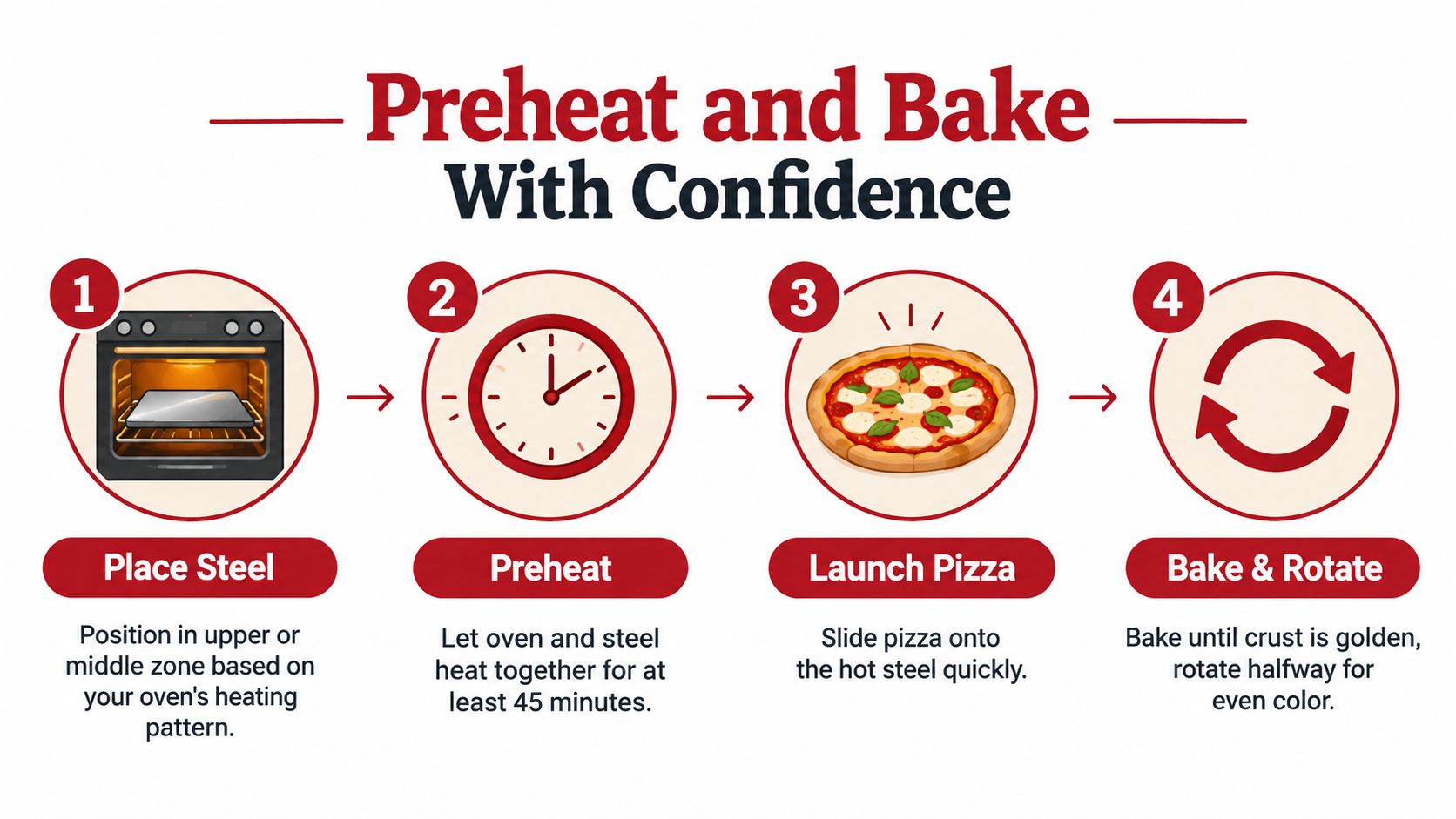
Start with placement. Set the steel in the upper or middle part of the oven, chosen for how your oven balances top and bottom heat. An oven that browns toppings slowly may benefit from a different rack position than one that finishes the top quickly. Confirm you can launch and retrieve a pizza without reaching past a hot rack.
Heat the oven and steel together. A typical home oven may need roughly 45–60 minutes of preheating for a steel plate, partly because the metal's conductivity shifts as it warms: published measurements for low-carbon steel put it near 51.3 W/(m·K) at 25°C, falling to about 39.2 W/(m·K) at 500°C, while another study reports approximately 43 W/(m·K) (carbon-steel thermal measurements and preheating guidance). If you own an infrared thermometer, read the plate surface directly; the oven display only reports air temperature.
Launch promptly and watch the first bake. Prepare the pizza so it can slide onto the steel without delay. Use a conservative bake time at first, then judge the base and toppings by sight rather than trusting the clock. A small test pizza reveals how hard your particular steel drives browning before you commit a full batch.
Adjust for balance. A base that darkens before the top finishes calls for a shorter bake, a lower steel position, or stronger top heat. A pale base under finished toppings points the other way: more preheat time and a surface-temperature check before extending the bake. Rotate the pizza when hot spots color one side faster than the other.
Because conductivity falls as the plate heats, a steel never runs at one fixed rating. The heat it delivers into dough depends on the temperature it reached during preheating, which is why identical recipes in two different ovens rarely produce identical bases.
Give the next pizza its own test
Removing a pizza drains stored heat from the plate, and the steel needs time to recover. A thicker plate holds more energy, yet that does not guarantee an identical second bake: dough temperature, topping load, launch speed, and the oven's own heat cycle all shift the result. Watch the next base and adjust rather than assuming the first pizza's timing will repeat.
For more detail on reading plate temperature and choosing a rack position, see this guide to pizza steel temperature. Keep notes on what your oven does. A few recorded observations will tell you more than any general timing chart: whether your steel wants a longer preheat, a different shelf, or a shorter bake.
Choose the Right Oven or Grill Setup
A steel can work in different cooking environments, but it won't behave identically in each one. Before using it, check how heat reaches the plate, whether the plate fits safely, how consistently the oven or grill holds heat, and whether you can load and retrieve pizza without handling the steel itself.
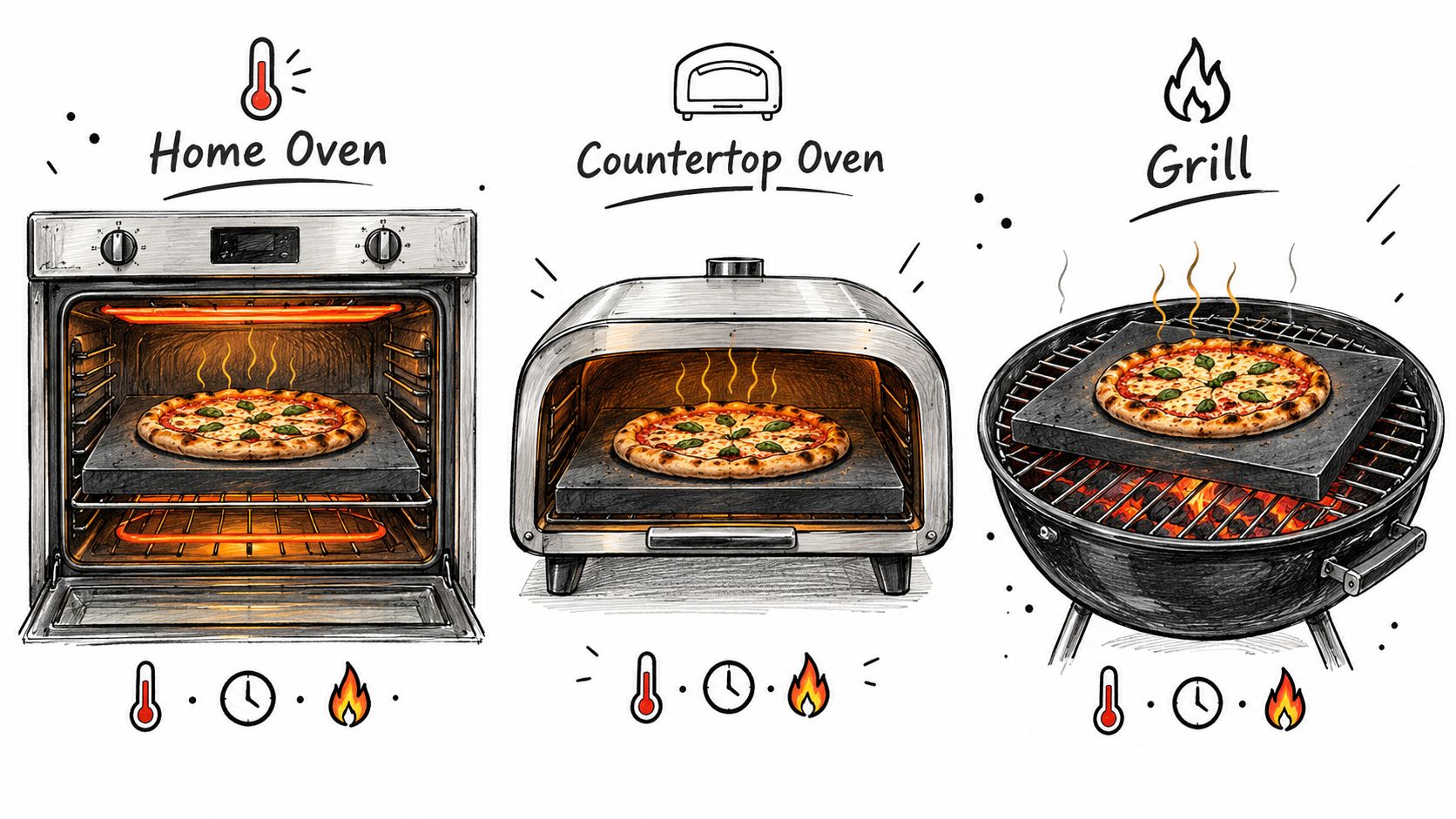
In a conventional home oven, the heating pattern and rack position affect how quickly the base and toppings finish. A steel may suit someone who wants a crisp base, provided the plate fits securely and can be left in place during preheating. If the top finishes first, the cook may need to change the position or baking approach. If the bottom finishes first, the solution may involve moderating the steel's position or giving the oven more time to heat through.
Countertop pizza ovens can differ in their internal layout and how they direct heat toward the cooking surface. Check the manufacturer's instructions and the steel's fit before using one. A plate that crowds an element, obstructs airflow, or is difficult to handle safely isn't a suitable choice just because it's made of steel.
A grill introduces another setup to assess. You'll need stable support for the plate and a way to launch and retrieve pizza without touching its hot surface. The location and intensity of heat can differ from an indoor oven, so observe how the top and base cook and adjust gradually.
Match the setup to your baking pattern
A beginner might start with a single test pizza in a home oven, where it's easier to observe the base and top before trying a batch. A repeat baker may pay more attention to how the plate recovers between pizzas. A backyard griller should also think through safe positioning and lifting before heating the steel.
Users discussing first-time steel baking mention roughly 45–60 minutes of preheating, along with concerns about rapid heat transfer, scorched bases, burns, recovery between pizzas, rust, and warping (discussion of first-time baking steel use). These are useful reminders of what to watch, not guarantees about what will happen in every oven. Follow the equipment instructions, preheat cautiously, and judge results in your own setup.
A demonstration can make it easier to visualize a pizza-steel setup in practice:
Clean and Maintain Pizza Steel Safely
Care starts with temperature, not a cleaning product. Let the steel cool before you try to clean or move it. A hot plate can burn you, and sudden contact with cold water can expose it to an abrupt temperature change. Wait until it's safe to handle, then remove loose food residue with a brush or cloth.
A simple care loop
Wipe or brush off crumbs and baked-on food rather than leaving them on the surface for the next session. If residue needs more attention, use a gentle cleaning approach that suits the steel and follow the care instructions provided with it. Avoid applying an unverified coating or seasoning treatment just because someone recommends it online. For product-specific guidance, consult this pizza-steel seasoning and care guide.
Dry the steel thoroughly after cleaning. Steel left damp can develop rust, so make drying part of the routine rather than an occasional repair step. Store the plate somewhere stable, dry, and easy to reach without having to lift it over other items or awkwardly balance it.
Safe handling: Plan where the steel will sit while it cools, and use a secure grip when moving it. Don't lift a hot plate unless you have the right protection and a clear, safe route.
If you keep the steel in an ordinary oven between uses, make sure it doesn't interfere with racks or heating elements. When moving it between an oven and a grill, plan the transfer before heating it. Don't improvise a lift while carrying food or reaching across a hot grill.
Check the surface and edges occasionally. Discoloration can appear with use, so look for more concerning signs such as visible distortion, unstable placement, or damage that makes the steel difficult to handle. If the plate sits unevenly or has changed shape, stop using it until you can assess whether it's still safe and suitable for your oven or grill. A clean, dry, stable plate is easier to care for than one that's left to collect residue or stored where it can fall.
Make Your Final Pizza Steel Decision
Start with your goal. If you want a thin pizza base that browns quickly, a steel may suit your baking style. If you'd rather handle a more familiar baking surface and avoid lifting a heavy plate, a stone may be a better fit.
Then consider how you bake. For one pizza at a time, a plate that's manageable and easy to preheat may make more sense than added mass you rarely need. If you often bake several pizzas in succession, you may value the extra stored heat of a thicker plate, while accepting its weight and longer preheat demands.
Your oven or grill also matters. Check the fit, rack clearance, heat pattern, and safe method for loading and retrieving a pizza. A steel that fits your cooking space and feels safe to handle is more useful than one chosen only for its thickness.
Steel isn't simply hotter than the oven. It transfers stored heat quickly into the dough, while thickness affects how much energy remains when the pizza lands.
Before you buy or use a steel, check these points:
- Pizza fit: Can the pizza sit comfortably on the plate without overhanging?
- Clearance: Does the steel fit securely without crowding oven racks or heating elements?
- Handling: Can you position and lift it safely?
- Storage: Do you have a dry, stable place to keep it?
- Bake routine: Are you ready to preheat fully, begin with a conservative bake, and adjust based on the first result?
Your first bake is a chance to learn your oven's behavior. Preheat the steel thoroughly, begin cautiously, check the top and base, then adjust position or timing based on what you see. Keep that routine consistent and the steel becomes easier to use with each pizza.
Hans Grill offers baking surfaces including pizza steels, cordierite stones, and tools for home ovens and BBQs. Compare the plate dimensions, clearance, handling, and storage space you need, then visit Hans Grill to explore options for your next pizza night.


